

Description
Collector’s Note – Why This Issue Matters
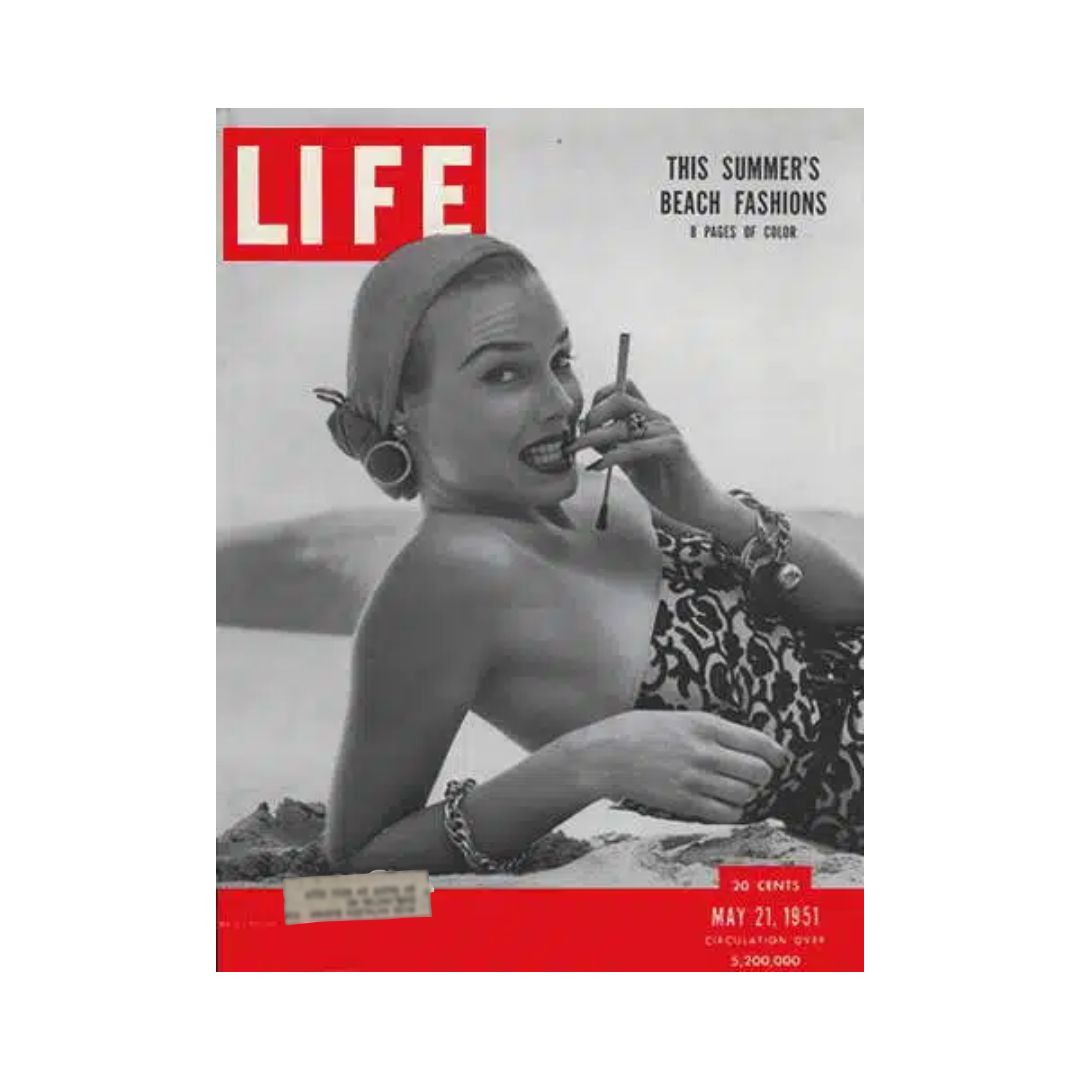
The May 21, 1951 issue of LIFE Magazine, Volume 30, Number 21, presents summer fashion through a striking beach photograph by Milton H. Greene. The cover features fashion model Lillian Marcuson during a photographic assignment conducted in the Virgin Islands. Greene photographed Marcuson and fellow model Suzy Parker in tropical settings for a feature devoted to warm-weather clothing and leisure. That location allowed the magazine to combine swimwear, travel imagery, natural scenery, and the visual promise of an approaching summer. The related fashion portfolio, “A Fancy Summer,” begins on page 79 and extends the cover theme into a carefully photographed survey of seasonal style. Together, the cover and interior feature document how LIFE used destination photography to transform clothing coverage into a larger story about aspiration, recreation, and modern living. Within an archive of historical LIFE Magazine issues, this edition stands as a vivid example of mid-century fashion photojournalism.
The issue is especially valuable because it captures beachwear at a time when American fashion publishing was balancing glamour with a growing culture of travel and outdoor leisure. “A Fancy Summer” presented clothing through color photography rather than treating garments only as products listed by designer, material, or price. Greene’s images placed the models within an environment associated with sunlight, movement, water, and escape from ordinary routines. The clothing can therefore be studied alongside the poses, locations, accessories, beauty ideals, and photographic direction used to define fashionable summer living in 1951. Yet the issue should not be interpreted only as a nostalgic collection of attractive styles, because its presentation also reflects the social and commercial assumptions of its original period. The cover demonstrates how LIFE could make a seasonal fashion subject visually important enough to occupy the same prominent space usually given to politicians, military figures, performers, and major news events. As a result, the edition offers evidence of both changing clothing trends and the increasing cultural authority of magazine photography.
The editorial contents create a much broader historical record than the beach-fashion cover alone might suggest. Its news section addresses Mexican migration and border labor, foreign policy, military aviation, an Egyptian royal marriage, the Willie McGee case, General Douglas MacArthur, and a major engineering project in Puget Sound. The immigration feature appears under a historical title containing a derogatory term for Mexicans, language that should be recognized as offensive rather than repeated without context. Other reports examine sales culture, astronomy, agriculture, popular music, television technology, archaeology, naval training, religion, sports, and children’s activities. This breadth demonstrates LIFE’s characteristic method of placing serious political and social reporting beside fashion, entertainment, science, art, and visually engaging human-interest stories. The issue consequently records both the polished consumer imagery and the difficult public debates present in American media during the spring of 1951. It belongs naturally within the broader archive of magazines published in 1951, where it can be compared with contemporary news, family, business, entertainment, and culinary publications.
About the Publication
LIFE was relaunched by Henry R. Luce as a weekly picture magazine in November 1936. Its editorial identity was built around the belief that photography could report, explain, and interpret contemporary life with an immediacy that conventional text-heavy magazines could not match. Large pages provided space for carefully sequenced photographs, extended captions, maps, illustrations, and dramatic page layouts. The magazine covered wars, elections, science, religion, business, entertainment, sports, fashion, art, family life, and major social questions. Its photographers worked both in the United States and internationally, producing images that often became the most widely recognized visual records of an event. LIFE also used staged and directed photography for fashion, celebrity portraiture, product features, and modern-living stories. This combination of documentary reporting and sophisticated visual presentation helped it reach an exceptionally broad audience. Cover selection was particularly important because a single photograph had to summarize a personality, event, cultural trend, or seasonal idea immediately. By 1951, LIFE had become one of the most influential mass-circulation magazines in the United States. Its editorial pages appeared alongside extensive advertising for automobiles, appliances, food, clothing, travel, cosmetics, and other products associated with postwar consumer culture. Surviving issues now function as primary sources for studying photojournalism, visual design, politics, fashion, advertising, public attitudes, and everyday American experience.
Key Highlights Inside
- “A Fancy Summer,” photographed for LIFE by Milton H. Greene, is the issue’s principal fashion feature and the editorial subject most closely connected with the cover. The portfolio uses beach and tropical settings to present swimwear and other seasonal clothing as part of a broader image of leisure and travel. Its photographs preserve period ideas about styling, beauty, posture, recreation, and the fashionable use of outdoor locations.
- Page 33 carries a Loomis Dean photo report under the historical headline “Wetbacks Swarm In,” concerning Mexican migration and border labor. The headline contains a dehumanizing ethnic slur that appeared in mainstream American reporting of the period and should be understood as offensive language. The feature is historically useful for examining immigration photography and editorial framing, but its terminology and assumptions require critical interpretation.
- The week’s-events section includes the editorial “How to Lose a World” and a report titled “The Issues Are Now Defined.” These pieces reflect LIFE’s interest in interpreting international policy and political conflict rather than limiting itself to photographic description. Their specific arguments should be taken from the original pages rather than inferred solely from the forceful titles.
- “Camera Records Big B–36 Crash” uses photography to document a major military-aviation event, while “General MacArthur in Fireworks” addresses the prominent general during a period of intense public controversy. A separate naval feature titled “The Navy’s ‘Dunker’” examines a military training subject later in the issue. Together, these reports demonstrate how defense and military leadership remained major editorial concerns during the Korean War era.
- Additional news features cover an Egyptian king’s marriage to a commoner and “The End Comes for Willie McGee.” The issue also presents “Puget Sound Gets Big New Cable,” documenting an important regional engineering or communications project. These stories show LIFE moving between international royalty, a consequential American legal case, and large-scale infrastructure within the same weekly section.
- Winthrop Sargeant contributes “Through the Interstellar Looking Glass,” while the archaeology department presents “The Discovery of Earliest Humans.” Both features introduce general readers to subjects concerned with humanity’s position in time and space. Their pairing demonstrates LIFE’s ability to translate specialized scientific and historical research into visually structured magazine journalism.
- Popular culture and recreation receive attention through “Patti’s Platters,” “Tempest on the Handball Court,” and the television feature “Big Screen.” The titles connect popular music, competitive sport, and changing television technology within the expanding entertainment culture of the early 1950s. Exact performers, players, equipment, and technical conclusions should be confirmed from the original articles.
- “Children’s Gardens” appears in the modern-living department, while “Tool–Shed Art” presents an artistic subject connected with ordinary materials or working spaces. Regular departments include Letters to the Editors, Speaking of Pictures, LIFE Goes to a Shad Harvest, and Miscellany. These features extend the issue beyond headline news by examining family activity, photography, regional work, visual creativity, and small incidents of public interest.
Condition & Rarity
The supplied listing does not provide a standardized numerical or letter grade for this May 21, 1951 issue. It also states that the displayed image is a stock photograph rather than a photograph of the exact magazine represented by the listing. The stock image can confirm the date and general cover design but cannot document the physical condition of the individual copy. No specific information has been supplied concerning cover creases, edge wear, corner wear, spine stress, surface rubbing, or discoloration. The presence or absence of a subscriber mailing label is likewise not confirmed. There is also no documented statement regarding tears, detached pages, missing advertisements, clipped photographs, handwriting, staining, tape repairs, or restoration. Those characteristics should remain unverified until photographs of the actual copy or a detailed physical description are available. Completeness is especially important because the issue contains a lengthy fashion portfolio, numerous photo reports, and more than 150 pages of editorial and advertising material. The preservation of the cover photograph also matters because Marcuson’s image and Greene’s composition establish the edition’s primary visual identity. LIFE was printed in very large quantities during this period, but surviving examples can vary substantially after decades of mailing, reading, folding, clipping, and storage. Historical and collector interest in an individual example should therefore be based on its completeness, actual condition, cover presentation, and documented contents rather than on an unsupported claim of exceptional rarity.
Looking for More Issues Like This?
Additional examples of twentieth-century photojournalism can be examined through the LIFE Magazine archive. Comparing issues from consecutive weeks can show how the publication moved between military reporting, political controversy, celebrity portraiture, scientific subjects, fashion, and everyday life. Readers interested in Milton H. Greene can examine other covers and portfolios to follow his evolving approach to fashion and personality photography. Fashion historians may compare the May 21 beachwear feature with LIFE’s seasonal reports on hats, coats, dresses, resort clothing, and beauty trends. Such comparisons can reveal changes in silhouettes, fabrics, styling, location work, color reproduction, and the commercial presentation of leisure. Researchers studying immigration can place the Loomis Dean report beside later magazine coverage of the United States–Mexico border while accounting for differences in language and editorial perspective. Military historians may examine the B–36 crash, MacArthur coverage, and naval-training feature within the wider context of Korean War reporting. The 1951 magazine archive provides additional perspectives from publications directed toward business readers, families, entertainment audiences, and specialized interests. Comparing those titles helps reveal how fashion, foreign policy, science, consumer culture, and social conflict were presented to different groups during the same year. The May 21 LIFE issue contributes an especially layered record by placing an elegant tropical fashion portfolio beside migration, military affairs, archaeology, television, religion, agriculture, art, and regional American life.