
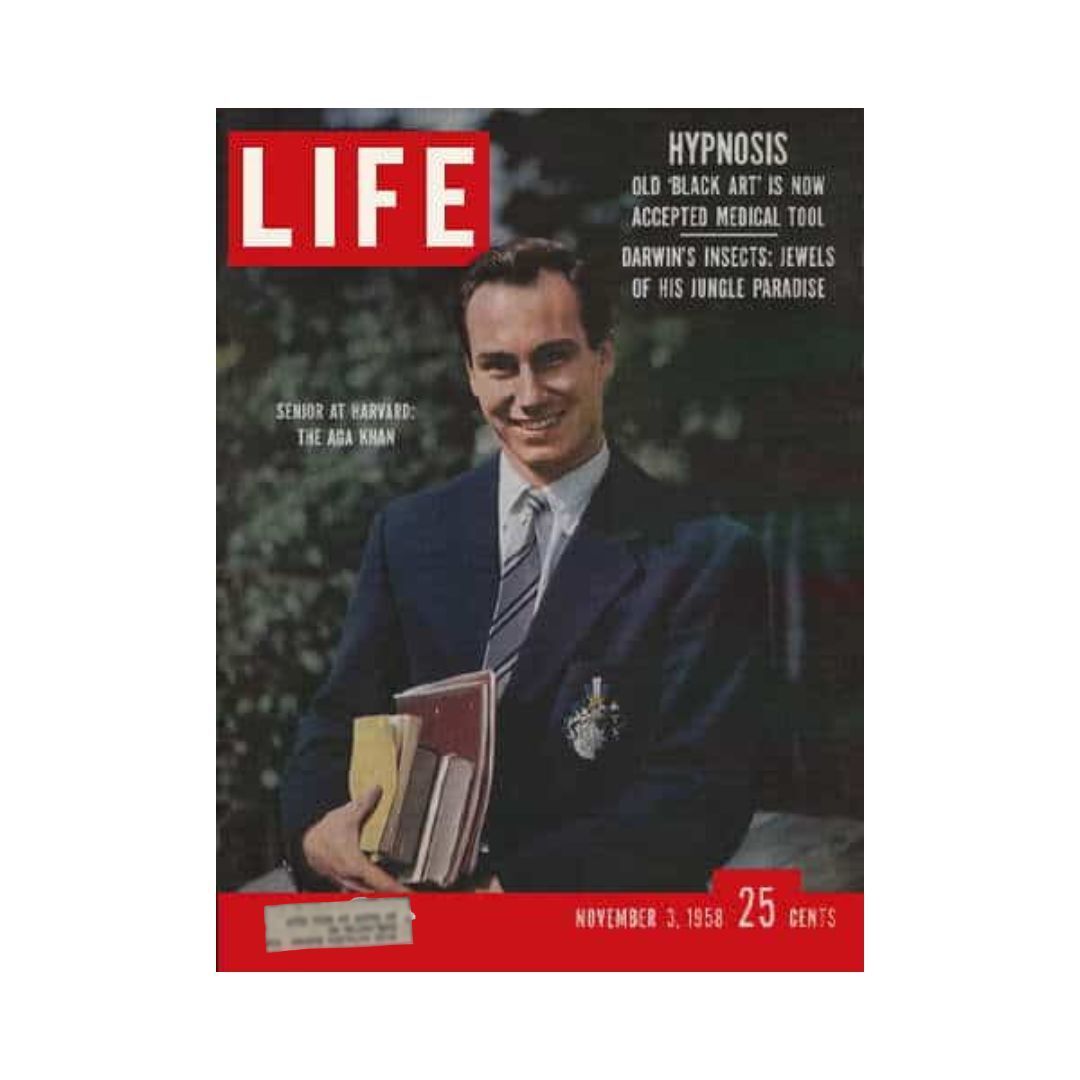

Description
Collector's Note – Why This Issue Matters
November 3, 1958 is a publication date of specific and multi-layered historical significance, and this Life Magazine issue documents it with a table of contents of unusual documentary depth. The Aga Khan "Close-Up" feature on page 75 — "Khan of Harvard Finds College 'a Warm, Happy Place'" — is a primary document of Karim al-Hussayni, the Aga Khan IV, during his undergraduate years at Harvard University, where he was studying Islamic history. He had become the 49th Imam of the Shia Ismaili Muslim community in July 1957 at age twenty, inheriting the imamate from his grandfather Aga Khan III while still a Harvard undergraduate. A Life Close-Up on the young Aga Khan at Harvard in November 1958 is therefore a primary document of one of the world's most significant Muslim religious leaders at the specific biographical moment of his early imamate — already holding one of the most important positions in the Muslim world while completing his American undergraduate education, a combination of circumstances that was genuinely without precedent and that made him a figure of unusual public fascination. The Life photographer's access to his Harvard experience provides a primary visual document of that specific biographical moment that no subsequent publication could replicate. For collectors building an archive of Life Magazine issues from the late-fifties, this November 3, 1958 edition is a primary document of an extraordinary religious and international figure at the most personally formative moment of his public life.
The "South's Closed Schools" feature on page 21 — photographed by Francis Miller and Paul Schutzer — is a primary document of one of the most significant civil rights stories of the late-fifties American South. The "Lost Class of 1959" framing refers to the specific school closures that Virginia and other Southern states were implementing as a form of "massive resistance" to the Supreme Court's Brown v. Board of Education desegregation mandate. Prince Edward County, Virginia had closed its entire public school system rather than integrate — a policy that would leave thousands of Black children without public education for years — and the Life feature documenting the "dreary, wasted days" of these students is a primary source record of that specific human cost, photographed by two of Life's most accomplished photojournalists. The Boris Pasternak editorial on page 34 is a primary document of a specific and historically significant literary-political moment: Pasternak had been awarded the Nobel Prize in Literature on October 23, 1958 — just eleven days before this issue's publication — and had been forced by Soviet authorities to decline it, in one of the most dramatic confrontations between state power and artistic freedom of the Cold War era. A Life editorial on "The Nature of Pasternak's Protest" published eleven days after his Nobel Prize announcement is contemporaneous primary source journalism of the highest historical order. Collectors researching American magazines from 1958 will find this Life issue a primary source document of extraordinary range across civil rights, Cold War literary politics, and international religious history.
The Georges Simenon profile by Henry Anatole Grunwald on page 95 — "World's Most Prolific Novelist: 'Maigret' Author Has Turned Out 400 Books" — is a primary document of one of the most significant European crime writers of the twentieth century at a specific late-career moment of American mainstream press recognition. Simenon's Maigret series had been enormously popular in Europe for decades but was still being introduced to the American mainstream, and a Life profile was among the most commercially significant forms of cultural endorsement available in 1958. The hypnosis feature — "Out of Ancient Magic Comes a New Medical Tool" — and the Darwin's World of Nature tropical insects essay reflect Life's characteristic editorial ambition to engage science, natural history, and medicine with the same photographic authority it brought to political and social journalism. The De Gaulle editorial on the "rebirth of hope" documents the French political moment just months after De Gaulle's return to power in June 1958 and the founding of the Fifth Republic in October 1958.
About the Publication
Life Magazine was founded by Henry Luce in November 1936 and by November 1958 had been publishing for twenty-two years, having long since established itself as the most widely circulated photojournalism publication in the United States, its combination of large-format photographic authority, comprehensive news coverage, and the specific editorial intelligence that brought science, arts, politics, and human interest into a single weekly format giving it a reach and cultural influence that no competitor matched. The November 3, 1958 issue represents Life at its late-fifties creative and commercial peak, its roster of photographers — including Francis Miller and Paul Schutzer, both documented contributors to this issue — producing the kind of photographic journalism that defined how America saw itself and the world in the decade between the war and the cultural upheavals of the sixties.
Key Highlights Inside
- Aga Khan IV "Khan of Harvard" Close-Up on page 75 — a primary visual and journalistic document of Karim al-Hussayni during his Harvard undergraduate years, produced while he was already serving as the 49th Imam of the Shia Ismaili Muslim community following his July 1957 succession at age twenty, constituting an irreplaceable primary source record of one of the world's most significant Muslim religious leaders at the specific biographical moment of his earliest imamate.
- "South's Closed Schools: The Lost Class of 1959" on page 21, photographed by Francis Miller and Paul Schutzer — a primary document of the Virginia and Southern states' massive resistance school closure policies implementing the human cost of segregationist defiance of Brown v. Board of Education, produced by two of Life's most accomplished photojournalists and constituting a primary visual record of the civil rights movement's specific late-fifties school desegregation crisis.
- Pasternak editorial "The Nature of Pasternak's Protest" on page 34 — a contemporaneous primary source document published eleven days after Boris Pasternak's October 23, 1958 Nobel Prize announcement and his Soviet-compelled refusal, engaging one of the most significant confrontations between state censorship and artistic freedom in the entire Cold War era at its precise moment of maximum public attention.
- Georges Simenon profile by Henry Anatole Grunwald on page 95 — a primary document of the Maigret author's American mainstream press recognition at a specific late-career moment, constituting one of Life's more significant single-author literary profiles and a primary bibliographic record of the Belgian crime writer's introduction to the American mass magazine audience.
- De Gaulle "Rebirth of Hope" editorial on page 34 — a primary document of Life's engagement with French political renewal published just weeks after De Gaulle's Fifth Republic constitution was ratified in October 1958, capturing the specific early-Fifth Republic optimism at its inaugural moment.
- Darwin's World of Nature Part III tropical insects essay, hypnosis medical feature, Queen Frederika of Greece nuclear knowledge visit, India Himalayan dam construction, and the hula hoop music feature — the full scientific, medical, international, and popular culture documentation range of a November 3, 1958 Life reflecting the publication's characteristic ambition to document the complete width of American and world experience in a single weekly photojournalism package.
Condition & Rarity
Life Magazine issues from November 1958 are approaching their sixty-eighth year of existence, and the condition landscape for surviving copies of this specific issue reflects both the general attrition of that age and the specific historical collecting significance of an issue combining the Aga Khan Harvard feature, the Lost Class of 1959 civil rights documentation, and the Pasternak Nobel editorial. The listing uses stock photography and directs collectors to the described condition for assessment — the standard practice for a large inventory of issues from this period. Life's large-format staple-bound design made it susceptible to cover separation, page stress, and the accumulated wear of nearly seven decades, and surviving copies that retain structural integrity with complete editorial content represent meaningful survivals. Collectors evaluating surviving examples of this issue should prioritize the Aga Khan Close-Up page integrity, the completeness of the Francis Miller and Paul Schutzer civil rights photography, and overall structural soundness as primary condition criteria for an issue of this historical density.
Looking for More Issues Like This?
A surviving copy of the November 3, 1958 Life Magazine with the Aga Khan Harvard feature, the Lost Class of 1959 civil rights photography, the Pasternak Nobel editorial, and the Simenon profile is among the most multiply historically significant single issues in the publication's late-fifties archive — the convergence of Islamic religious history, American civil rights documentation, Cold War literary politics, and European crime fiction's American breakthrough gives this issue a research profile extending across multiple scholarly disciplines simultaneously. If this issue is no longer available, the full Life Magazine collection at OriginalMagazines.com is the most comprehensive place to browse surviving issues from across the publication's history and locate other late-fifties civil rights features, Cold War cultural coverage, or significant issues from Life's most editorially accomplished decade. The 1958 magazine collection brings together surviving issues from across that year's major publications for collectors working to document the full breadth of American print journalism during one of the most consequential years of the late Eisenhower era.