




Description
Collector's Note – Why This Issue Matters
The October 17, 1969 issue of Life Magazine featuring Naomi Sims on the cover is one of the most historically significant issues the publication produced during its entire run — and that is not a claim made lightly for a magazine with as rich and consequential a publishing history as Life. Naomi Sims was, by the autumn of 1969, in the process of becoming the first African American model to achieve genuine mainstream supermodel status in the United States, and her appearance on the cover of Life — one of the most widely read and culturally authoritative magazines in the country — was a landmark moment in both the history of American fashion and the broader story of Black representation in mainstream media. This was not a niche publication or a specialty title. Life in 1969 was still one of the highest-circulation magazines in America, read in homes across every region and demographic. Putting Naomi Sims on the cover was a statement of visibility with a reach that few other media platforms of the era could have matched. Collectors building around vintage Life Magazine issues will immediately recognize this cover as one of the essential issues from the magazine's late period — the kind of document that sits at the intersection of fashion history, civil rights history, and media history simultaneously.
To understand the full weight of this cover, it helps to know who Naomi Sims was and what she had already accomplished by October 1969. Born in 1948 in Oxford, Mississippi, and raised in Pittsburgh, Sims arrived in New York in the mid-1960s and almost immediately began redefining what was possible for Black women in the American fashion industry. In an era when major fashion magazines and advertising agencies routinely excluded Black models from their pages and campaigns, Sims broke through with a combination of extraordinary physical presence, professional discipline, and an instinct for self-promotion that was ahead of its time. She had appeared on the cover of The New York Times Magazine in August 1969 — just weeks before this Life cover — in what is often cited as another pioneering moment in Black modeling history. Her Life cover followed almost immediately, and together these two appearances in the autumn of 1969 effectively announced to the American mainstream that the fashion industry's racial barriers were beginning to crack. For collectors focused on magazines from 1969, this issue represents one of the most culturally loaded single covers the year produced.
The broader context of October 1969 deepens the significance of this issue further. The late 1960s were a period of extraordinary social transformation in the United States, with the civil rights movement, the women's liberation movement, the antiwar movement, and a sweeping generational rebellion against established cultural norms all operating simultaneously and feeding into each other in complex ways. The fashion industry was not immune to these forces — it was, in fact, one of the arenas where the struggle over representation and inclusion was being fought in visible, commercially significant terms. Naomi Sims's rise happened within and because of this broader cultural upheaval, and her Life cover in October 1969 arrives as a document of exactly that moment: a country in the process of remaking its own image of itself, one cover at a time. The issue is not merely a fashion collectible. It is a primary document of American social history.
About the Publication
Life Magazine was founded by Henry Luce and launched in November 1936 as a groundbreaking weekly photojournalism publication that would fundamentally reshape how Americans understood visual media. Where previous illustrated magazines had used photography as a supplement to text, Life reversed that hierarchy — photographs were the primary editorial statement, and text existed to contextualize and extend what the images communicated. At its peak in the 1950s and early 1960s, Life reached circulations of eight million copies or more per week, making it one of the most widely read publications in American history and one of the primary visual records of mid-twentieth-century American life. Its photographers — among them Margaret Bourke-White, Alfred Eisenstaedt, Gordon Parks, and W. Eugene Smith — produced some of the most iconic images in the history of American photography, and the magazine's covers were cultural events in themselves. By 1969, Life was facing increasing competition from television as the dominant visual medium of American culture, and the magazine was beginning the slow circulation decline that would lead to its closure as a weekly publication in 1972. But in October 1969 it remained a genuinely mass-market publication with enormous cultural reach, and a cover appearance in Life still carried a weight and visibility that no other American magazine could quite match.
Key Highlights Inside
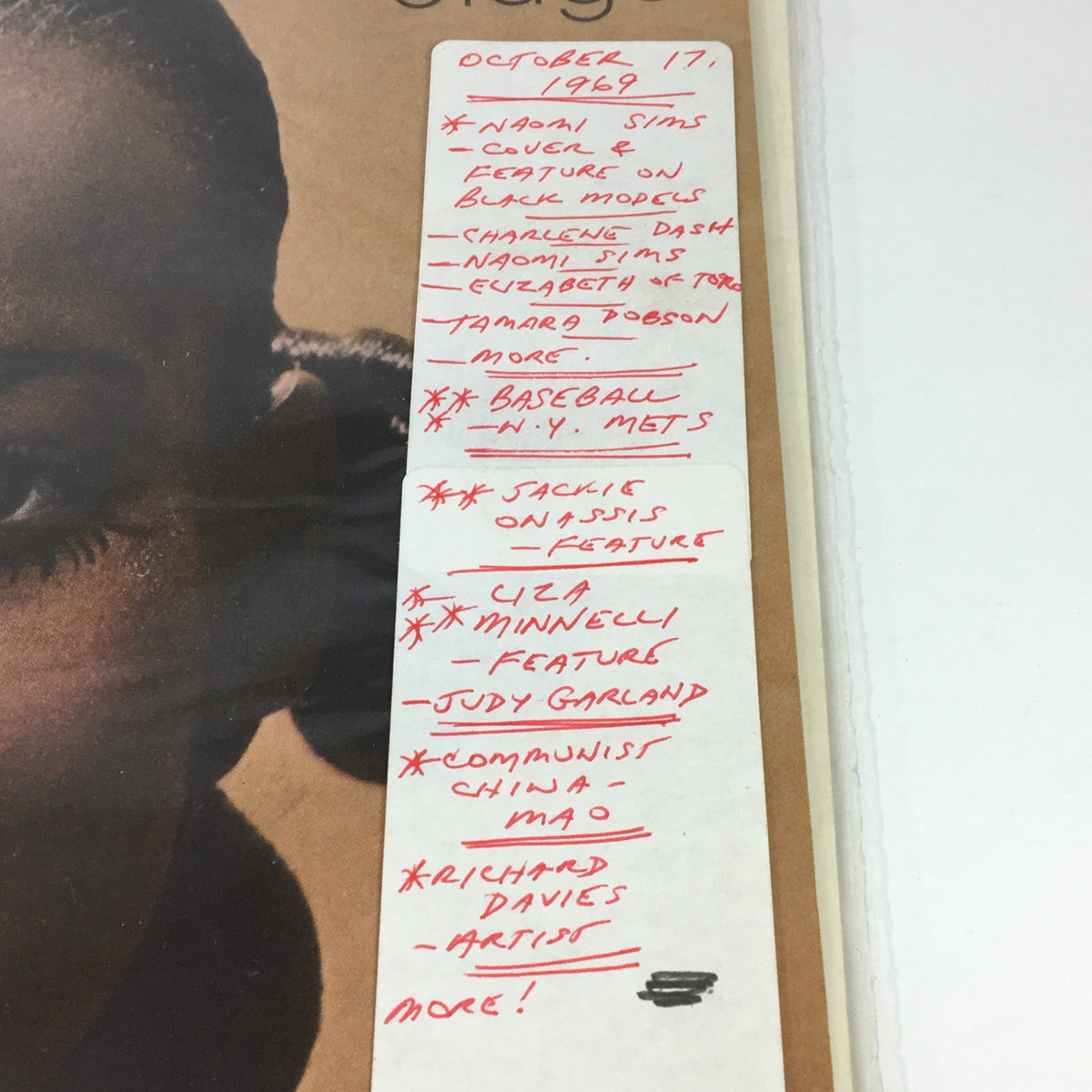
- Naomi Sims cover portrait: The cover itself is the defining artifact of this issue — a full-color portrait of Naomi Sims that announced her arrival as a mainstream American cover model at one of the most significant cultural junctures in the history of the fashion industry. The cover's existence as a physical object carries historical meaning that extends well beyond its function as a magazine front page.
- Feature coverage of Naomi Sims: A Life cover appearance in this era was almost always accompanied by interior editorial coverage of the cover subject, and it is reasonable to expect that this issue included substantive photography and reporting on Sims, her career, and the broader questions of race and representation in the American fashion industry that her rise had brought to the surface.
- Late 1960s photojournalism: Consistent with Life's editorial identity throughout its weekly run, this issue would have included the publication's signature long-form photographic essays on subjects drawn from American and international news, culture, and daily life — visual journalism of a quality and ambition that defined the magazine's reputation across three decades of publication.
- Fashion and cultural context of autumn 1969: The late 1960s were a period of extraordinary ferment in American fashion, with the youth culture, the counterculture, and the civil rights movement all exerting simultaneous pressure on an industry that was being forced to reckon with its own exclusions and assumptions. Any fashion-adjacent content in this issue would have existed within that charged atmosphere.
- Advertising as historical document: Life's advertising pages in 1969 are themselves primary historical material — consumer goods, automotive advertising, fashion, and domestic products marketed to a mass American readership at the end of the 1960s offer an extraordinarily revealing window into the material culture and commercial aspirations of the period. These pages are often as historically instructive as the editorial content that surrounds them.
- Note: Specific interior articles, photographic essays, and individual editorial features beyond the Naomi Sims cover and anticipated interior coverage have not been individually confirmed from available listing details. The above reflects what is verifiable from the cover subject, publication date, and the well-documented editorial practices of Life Magazine during its late weekly period.
Condition & Rarity
A Very Good condition rating for a fifty-five-year-old weekly magazine is a meaningful result, and the storage attributes described for surviving copies of this issue place it in the upper tier of what typically remains from Life's late 1960s run. Life was printed on relatively high-quality coated paper stock compared to standard newsstand periodicals — the photographic reproduction demands of the magazine's editorial format required it — which means that well-preserved copies tend to retain their color vibrancy and page integrity better than contemporaneous publications printed on lower-grade newsprint. However, the magazine's large format, comparable to Fortune in its vulnerability to spine stress and edge damage over decades of storage, means that copies in genuinely Very Good or better condition represent a meaningfully smaller fraction of surviving examples than the condition grade alone might suggest. The bagged and boarded storage format described for this issue is the preferred preservation method for vintage periodicals of this size and significance — the board backing prevents the spine and page block from warping or folding under their own weight, while the bag protects the cover surface from handling damage, dust, and humidity fluctuation. For a cover of this specific historical importance, where the visual integrity of Naomi Sims's portrait is central to the issue's collector value, the combination of Very Good condition, intact color, and protective storage represents the kind of result that serious collectors actively seek. Issues from this specific cover date have attracted sustained collector interest from multiple communities simultaneously — fashion history collectors, civil rights history collectors, Life magazine specialists, and Black cultural history archivists — which means that well-preserved examples circulate actively and are recognized across a broader collector market than most single issues of any weekly publication.
Looking for More Issues Like This?
The Naomi Sims October 1969 cover is one of the most historically recognized issues in Life Magazine's entire publishing history, and finding a copy in Very Good condition with proper protective storage is genuinely the result of a patient search — these do not surface casually or frequently in the collector market. If this particular issue has already been claimed, the broader Life Magazine collection at OriginalMagazines.com spans the publication's remarkable weekly run and regularly includes issues from the late 1960s that document the civil rights era, the counterculture, and the social transformation of America during one of its most consequential decades, all through the lens of the finest photojournalism the country produced. Collectors with a specific focus on the cultural and political atmosphere of 1969 — a year that included the moon landing, Woodstock, the Manson murders, the Stonewall uprising, and the beginnings of the Nixon era — will find the 1969 magazine archive an extraordinarily rich source of primary material from across the major American publications of that year, offering a complete and genuinely moving picture of a country in the midst of profound and irreversible change.