

Description
Collector's Note – Why This Issue Matters
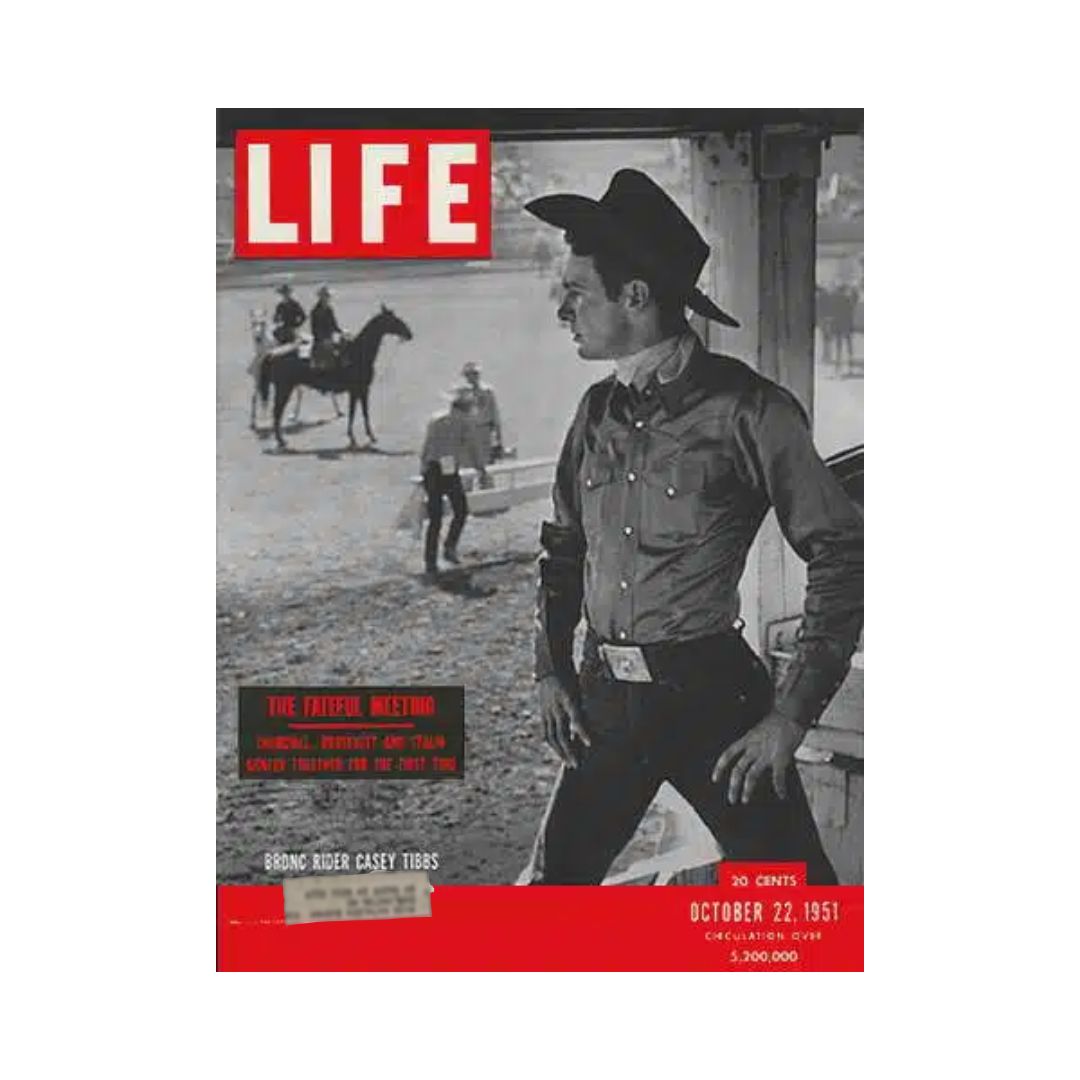
October 22, 1951 places this Life Magazine issue at a richly documented moment in mid-century American life — a week when the Korean War was actively claiming American lives, Winston Churchill was publishing his war memoirs, and a champion bronc rider from South Dakota was compelling enough to earn the cover of the most widely read photojournalism publication in the United States. Casey Tibbs was twenty-two years old in the fall of 1951 and already the most recognizable name in professional rodeo — a multiple world champion whose combination of technical mastery, physical grace, and genuine charisma had made him the closest thing to a mainstream celebrity that the rodeo world had ever produced. Life's decision to put Tibbs on its cover and devote a photographic essay to him — photographed by the celebrated Hy Peskin, one of the foremost sports photographers of the era — was a statement about the breadth of American athletic culture that Life understood as part of its editorial mission: documenting not just the sports that commanded network television and urban press attention, but the ones that defined life and identity across the vast interior of the country. For collectors building an archive of Life Magazine issues from across the publication's peak decades, this October 1951 edition represents the magazine's characteristically democratic approach to American achievement — treating a champion rodeo rider with the same photographic seriousness and editorial respect it brought to generals, politicians, and film stars.
The photographic essay "Champ Rider" by Hy Peskin is the documentary centerpiece of the issue and deserves particular attention as a primary source record. Peskin was one of the most accomplished sports photographers of his era, whose work for Life and Sports Illustrated over three decades produced some of the most significant sports imagery in twentieth-century American photojournalism. His assignment to photograph Casey Tibbs reflects the seriousness with which Life's editors treated the rodeo story — this was not a novelty feature given to a junior staff photographer but a genuine photojournalistic essay entrusted to one of the magazine's best visual journalists. The resulting pages would have brought Tibbs's athletic achievement to Life's enormous general readership with a visual authority and compositional quality that transformed the regional story of a rodeo champion into a document of American excellence with national resonance. Collectors researching American magazines from 1951 will find this issue a particularly well-constructed example of Life's editorial approach at its mid-century best — combining a genuinely American subject with world-class photographic talent to produce something that transcended sports coverage and became cultural documentation.
The surrounding editorial content of this issue deepens its documentary value considerably. The Korean War coverage — "Soldiers Shed Blood in Korea" — places the issue in the specific and painful context of a conflict that was consuming American lives with no clear resolution in sight, and the editorial juxtaposition of wartime sacrifice with the domestic vitality of a rodeo champion is itself a document of how Life navigated the emotional complexity of the early fifties. The Winston Churchill war memoirs installment — Volume V, Part 2 of his account of the Second World War — was one of the most anticipated serialized publications of the postwar era, and its appearance in the same issue as the Tibbs feature reflects Life's consistent ambition to address the full range of its readers' intellectual and cultural interests within a single weekly package. The Suez Canal photographic essay by David Douglas Duncan — another of Life's most distinguished photographers — adds a third major visual journalism piece to an issue that was operating at an unusually high level of photographic ambition even by Life's demanding standards. Red Skelton's television profile, the fashion pages, and the theater coverage of Saint Joan round out an editorial package of remarkable completeness and range.
About the Publication
Life Magazine was founded by Henry Luce in 1936 as a weekly photojournalism publication and operated continuously in that format until 1972, when it transitioned to special issues before relaunching as a monthly in 1978. At its peak in the postwar decades it was among the most widely circulated magazines in the United States, built on the editorial conviction that photography could document history, convey emotion, and communicate across barriers of education and background in ways that text alone could not. Its staff photographers over the decades included some of the most celebrated photojournalists of the twentieth century — among them Hy Peskin and David Douglas Duncan, both represented in this issue — and its pages served as the primary visual record of American and world affairs across more than three decades of continuous publication. By October 1951 Life was operating at the absolute height of its cultural authority and institutional confidence, with a readership that encompassed a substantial cross-section of American households and an editorial team that understood its mission as nothing less than the comprehensive visual documentation of American life in all its geographic, social, and cultural breadth. That breadth — the same issue covering Korea, Churchill, rodeo, television, fashion, and theater — is precisely what makes individual issues from this period such rich primary source documents.
Key Highlights Inside
- "Champ Rider" photographic essay on page 123, photographed by Hy Peskin — a primary document of Casey Tibbs's championship rodeo career at its early peak, produced by one of Life's most accomplished sports photographers and representing the magazine's commitment to treating the full breadth of American athletic achievement with the same visual seriousness it brought to more conventionally prominent sports.
- Korean War coverage across multiple "Week's Events" pages beginning on page 24 — direct documentary content from an active conflict that was claiming American lives in October 1951, capturing the specific emotional and political tenor of a war that had no clear end in sight and that was generating a sustained public anxiety visible throughout the news coverage of this period.
- Winston Churchill's war memoirs, Volume V, Part 2, on page 86 — an installment of one of the most consequential serialized publications of the postwar era, appearing in the same issue as the Tibbs feature and reflecting Life's consistent ambition to address its readership's full intellectual range within a single weekly edition.
- Suez Canal photographic essay on page 76, photographed by David Douglas Duncan — a second major visual journalism piece by one of Life's most distinguished photographers, documenting a geopolitical flashpoint that would become one of the defining international crises of the decade just a few years after this issue's publication.
- Television feature on Red Skelton's "rubber face" on page 71 — a document of early American television culture at a moment when the medium was still in its formative years and Life was actively covering it as the new cultural force it was becoming, alongside fashion coverage on page 114 and theater coverage of Saint Joan on page 141.
- "Speaking of Pictures" feature documenting cartoonists' treatment of American presidents on page 18, editorial commentary on the upcoming political campaign and atomic power on page 38, and the full range of Life's regular departments — collectively constituting a comprehensive primary source record of American political, cultural, and social life in the third week of October 1951.
Condition & Rarity
Life Magazine issues from October 1951 are approaching their seventy-fifth year of existence, and the condition landscape for surviving copies reflects the full weight of that age alongside the specific physical characteristics of the publication's format. Life's large-format staple-bound design made it more vulnerable to spine stress and cover separation than smaller-format weeklies, and the paper stock used for both cover and interior pages — while adequate for the photographic reproduction standards of the early fifties — has proven subject to the tanning and brittleness that accumulates in acidic paper over multiple decades of storage. The listing notes that a stock photo is used, meaning individual copies within the available inventory may vary in specific condition details while conforming to the general grade described. This is a common and transparent practice for dealers maintaining substantial back-issue inventory across multiple copies of the same issue, and it reflects the reality that Life issues from this period survive in a range of conditions that the grade description encompasses rather than specifies precisely. Collectors evaluating individual copies of this issue should prioritize cover integrity — the Casey Tibbs image is the primary visual document and its legibility is the most important single condition attribute — alongside spine security, the preservation of both photographic essays in their complete form, and the readability of the Churchill memoirs installment as the secondary content most likely to attract research interest. The absence of a mailing label, where present in individual copies, represents the preferred condition for display purposes.
Looking for More Issues Like This?
A Life Magazine from October 22, 1951 with the Casey Tibbs cover and the full complement of Peskin and Duncan photographic essays is a historically specific issue that rewards the collector's attention well beyond its cover subject — the combination of Korean War coverage, Churchill memoirs, and two major photojournalistic essays makes it one of the more editorially complete examples of Life at its mid-century peak. If this issue is no longer available, the full Life Magazine collection at OriginalMagazines.com is the most comprehensive place to browse surviving issues from across the publication's history and locate other issues from the early fifties or notable cover subjects from Life's peak decades. The 1951 magazine collection brings together surviving issues from across that year's major publications and offers the broader cultural and historical context for collectors interested in the full range of American print journalism during one of the most consequential years of the postwar era.