
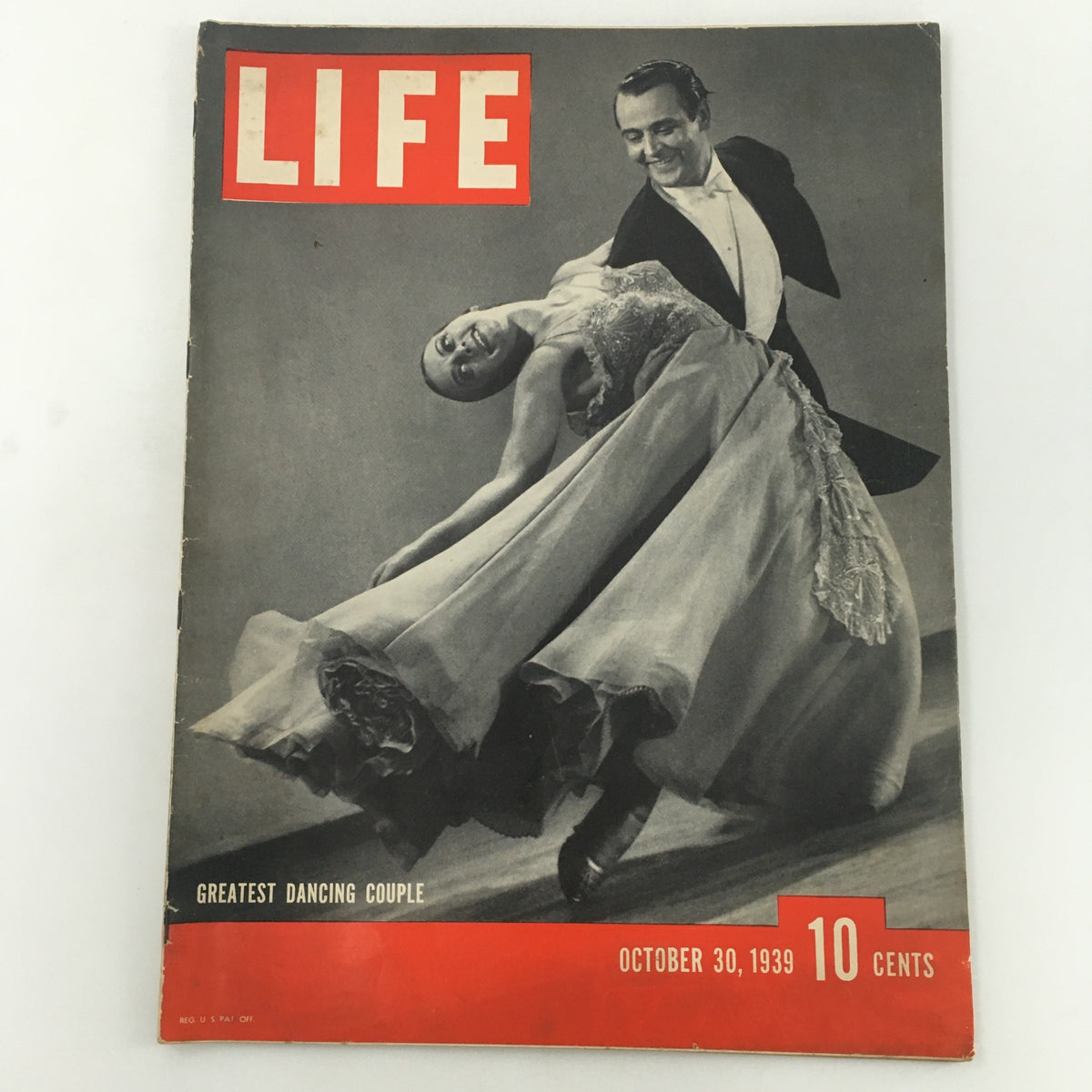

Description
Collector's Note – Why This Issue Matters
Life Magazine dated October 30, 1939, is identified in the supplied listing by a feature described as “The Greatest Dancing Couple.” The names of the dancers are not provided, so their identities should not be assumed from the title alone. What can be established is that the issue connected Life’s large-format photojournalism with the glamour and public popularity of partnered dance during the late 1930s. Its publication date places it only weeks after the outbreak of war in Europe in September 1939. The United States had not yet entered the conflict, and American magazines continued to document entertainment, fashion, leisure, and domestic culture alongside increasingly serious international news. The issue therefore emerged at a moment when the elegance of popular entertainment existed beside growing uncertainty about world events.
Partnered dancing occupied a highly visible place in late-1930s American culture through ballrooms, nightclubs, stage productions, social events, and motion-picture musicals. Dance couples could become recognizable public figures because their performances combined athletic precision, personality, fashion, and carefully rehearsed visual harmony. Hollywood helped circulate idealized images of elegant partnership, while live dance venues kept ballroom and popular styles connected to everyday social life. Life was especially well suited to covering this subject because sequential photographs could record movement, posture, expression, and interaction in ways that written description alone could not. The unnamed feature associated with this issue likely appealed to readers who followed both contemporary entertainment and photographic storytelling, although its exact format is not confirmed. As a result, the magazine belongs to the visual history of dance as presented to a broad American audience before television became the dominant household medium.
The phrase “Greatest Dancing Couple” reflects the dramatic, personality-centered language commonly used to introduce prominent entertainers to mass-market readers. Such a description establishes the importance assigned to the featured pair without revealing whether the interior material took the form of a photo essay, profile, performance study, or brief illustrated report. Without a confirmed table of contents or direct view of the relevant pages, the dancers and the precise scope of the coverage must remain unidentified. Even with that limitation, the exact date makes the issue useful for researchers tracing how dance and celebrity were represented in the final months of the 1930s. Within the broader history of Life Magazine’s photographic coverage of American culture, it illustrates the publication’s ability to treat entertainment as a subject worthy of serious visual documentation. It also forms part of the wider print record preserved by magazines published during 1939.
About the Publication
Life was a major American general-interest magazine best known for its large pages, ambitious photography, and visually organized approach to current events. During its weekly era, it covered politics, international affairs, war, science, entertainment, fashion, sports, and everyday social life for a broad national readership. Its editorial format frequently combined extensive photographic sequences with captions, short explanatory passages, and longer reported articles. This structure allowed readers to encounter public figures and major events through images that were often as important as the accompanying prose. In 1939, Life was still a relatively young weekly picture magazine, yet it had already established a powerful role in shaping how Americans visually understood their own society and the wider world. Surviving issues now serve as primary-source records of news, advertising, design, celebrity, leisure, and public attitudes during the years immediately preceding American involvement in the Second World War.
Key Highlights Inside
- The principal confirmed subject is a feature described as “The Greatest Dancing Couple.” The supplied title does not identify the dancers, so no specific performers should be attributed to the issue without verification from the cover or interior pages.
- The October 30, 1939 publication date places the magazine within the final months of a decade strongly associated with ballroom culture, stage entertainment, and Hollywood dance films. It also situates the issue shortly after the beginning of the Second World War in Europe, giving its entertainment coverage a significant historical backdrop.
- The dance theme reflects Life’s interest in documenting movement, personality, and performance through photography. Its oversized format could give readers a detailed view of costumes, posture, expressions, and physical coordination that smaller periodicals could not reproduce with the same visual impact.
- The feature provides evidence of the cultural importance assigned to prominent dance partnerships in the late 1930s. Successful couples were often presented as unified public personalities whose appeal depended on timing, chemistry, individual skill, and visual elegance.
- The issue belongs to Life’s early period as a weekly picture magazine, when photography was central to its editorial authority. Entertainment subjects appeared alongside national and international reporting, demonstrating the wide range of material considered relevant to its general-interest readership.
- A complete table of contents, the names of the dancers, and the exact form of the interior coverage have not been confirmed from the supplied listing. Additional articles, photographs, advertisements, and news subjects should therefore be documented through direct examination rather than inferred from the feature description.
Condition & Rarity
The magazine is described as being in good condition, with wear consistent with age and previous handling. Reported flaws may include small rips, edge wear, creases, and marks, although the location and severity of each imperfection are not specified. The absence of an address label leaves the cover design unobstructed and is consistent with a newsstand example rather than a subscriber-delivered issue. Collectors examining a surviving example should also inspect the spine, cover attachment, page edges, interior completeness, and any signs of brittle paper or moisture exposure. Because large-format Life magazines were frequently read, stored flat, folded, or stacked, edge damage and binding stress are important factors in assigning a precise collector grade. A plastic protective covering can limit further dust and handling abrasion, but preservation is best supported by stable storage away from sunlight, humidity, heat, and excessive pressure.
Looking for More Issues Like This?
The October 30, 1939 dance-themed issue can be difficult to identify precisely when the featured performers are not named in surviving descriptions. Readers researching similar photo essays, entertainers, and prewar American culture can explore the broader collection of vintage Life magazines. The 1939 magazine archive provides additional publications documenting the entertainment, politics, fashion, and international developments of the same year. Comparing issues from this period can show how editors balanced glamorous cultural subjects with the growing seriousness of world affairs. These related collections provide useful context for understanding the “Greatest Dancing Couple” feature within the magazine culture of the late 1930s.