



Description
Collector's Note – Why This Issue Matters
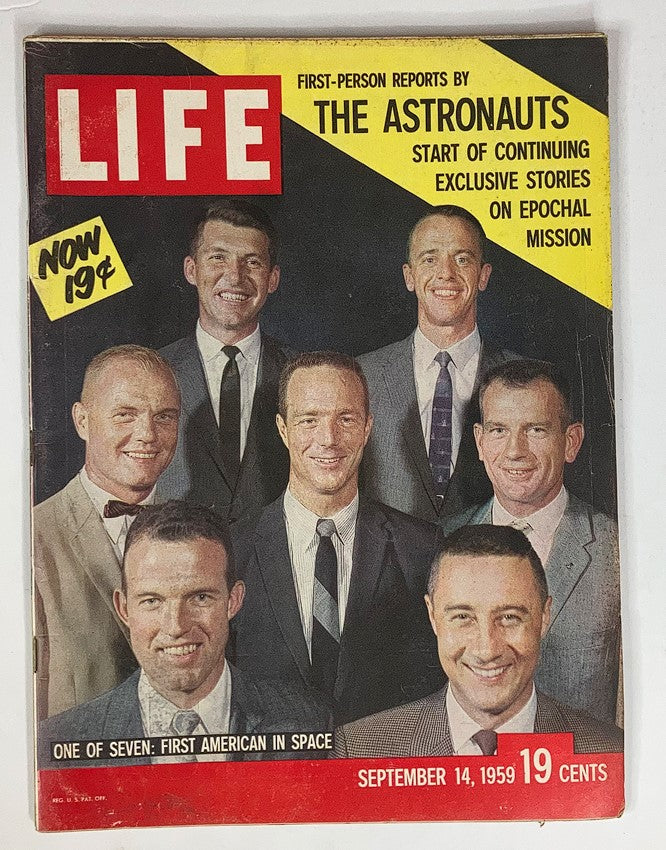
The September 14, 1959 issue of Life magazine — Volume 47, Number 11 — featuring "7 Astronauts Tell Their Stories" is one of the foundational documents of the American space age and one of the most historically significant issues in the magazine's entire publishing history. To understand its full weight requires understanding the extraordinary arrangement that made it possible. NASA had introduced the Mercury Seven to the world in April 1959, and Life had secured an exclusive contract with all seven astronauts and their families to tell their personal stories — an agreement that gave the magazine a monopoly on intimate access to the human side of the American space program that no other publication could breach. The September 14 issue represents one of the earliest and most complete expressions of that exclusive arrangement, presenting the astronauts' own voices and perspectives to an American public that was simultaneously thrilled by the space race and deeply anxious about the Soviet Union's lead in it. That the men who would be first to go into space were willing to share their stories — their fears, their motivations, their family lives, their assessments of the risks they were accepting — with Life's tens of millions of readers was itself a remarkable act of public communication, and the resulting journalism is among the most significant produced about any American program of the postwar era. For collectors building a serious archive of Life magazine issues from the Mercury program years, this September 1959 issue is an essential primary document.
The specific framing of this issue — "7 Astronauts Tell Their Stories" — is worth distinguishing carefully from the more famous September 21, 1959 issue that followed a week later, which featured the seven astronauts' wives on its cover. The September 14 issue is the astronauts themselves: their own words, their own accounts, their own perspectives on what they had signed up for and what they believed it meant. In 1959 this was genuinely extraordinary journalism. These were military test pilots — men trained to be emotionally controlled, professionally reticent, and institutionally loyal — who were being asked to speak personally and publicly about the most dangerous and consequential assignment of their careers, one that was simultaneously a national priority and a matter of life and death. The Life exclusive gave them a platform and a format for doing so with a degree of narrative control that other forms of coverage would not have allowed, and the resulting first-person accounts have been cited and excerpted in virtually every serious history of the Mercury program written since. The distinction between this Volume 47, Number 11 and the subsequent Volume 47, Number 12 astronauts' wives issue matters to serious collectors — they are companion documents of the same moment, each approaching the human story of the Mercury program from a different angle, and a collection that contains both is significantly richer than one that contains only one.
The broader historical context of September 1959 in the space race gives this issue a specific geopolitical dimension that amplifies its significance as a primary document. The Soviet Union had launched Sputnik in October 1957 and had followed it with a series of increasingly ambitious space achievements — Luna 1, the first spacecraft to escape Earth's gravity, had been launched in January 1959, and Luna 2 would strike the Moon on September 14, 1959, the very day this Life issue was published, in a coincidence of timing that is almost too perfectly symbolic. The American public was reading about their seven astronauts' personal stories on the same day that the Soviet Union demonstrated its continued ability to reach the Moon while American human spaceflight was still more than eighteen months away. That tension — between the heroism and humanity of the Mercury Seven and the Soviet lead that made their mission so urgent — runs through every dimension of what this issue meant to its original readers and gives it a historical resonance that is precisely calibrated to its specific publication date. Those assembling a comprehensive archive of 1959 magazines as primary documents of the space race's opening years will find this issue among the most historically specific and editorially distinguished pieces in that collection.
About the Publication
Life magazine, relaunched by Henry Luce in 1936 as a large-format photojournalism weekly, was by September 1959 in the confident maturity of its postwar peak and in the early stages of one of its most historically significant editorial commitments — the exclusive contract with NASA and the Mercury Seven families that gave the magazine unparalleled intimate access to the human story of the American space program across the critical years of the late fifties and early sixties. The magazine's large-format pages and absolute commitment to photographic storytelling made it uniquely suited to the visual and human dimensions of the space race, and the exclusive arrangement with the astronauts and their families produced some of the most significant and widely reproduced American journalism of the period. At its peak Life reached upwards of 8 million direct subscribers with total readership estimated considerably higher through pass-along copies, making it the primary vehicle through which most Americans encountered and emotionally engaged with the human story of space exploration in its earliest years. The magazine ceased weekly publication in 1972, but the issues from the Mercury program years — 1959 through 1963 — represent the fullest and most historically consequential expression of its exclusive space race editorial mission, with the September 14, 1959 astronauts' personal stories issue standing as one of the most significant individual pieces in that extraordinary body of journalism.
Key Highlights Inside
- The "7 Astronauts Tell Their Stories" cover feature — produced under Life's exclusive contract with the Mercury Seven, which gave the magazine unparalleled access to the personal accounts and perspectives of the men who would be first to go into space — constitutes a primary historical document of the Mercury program's human dimensions, presented in the astronauts' own words at the precise moment when their mission was being defined and their public identities were being constructed for an anxious and fascinated American public.
- The September 14, 1959 publication date coincides with the Soviet Luna 2 spacecraft's impact on the Moon — an event that represented a continuing demonstration of Soviet space capabilities while the American human spaceflight program was still more than eighteen months from its first success — giving this issue a specific geopolitical context that makes the astronauts' personal accounts even more charged and consequential than they would be as purely human interest journalism.
- The issue is precisely identified as Volume 47, Number 11, distinguishing it from the companion Volume 47, Number 12 astronauts' wives issue of September 21, 1959 — a distinction that matters to serious Life space age collectors, as the two issues approach the Mercury Seven's human story from complementary angles and are most fully understood and most historically valuable as a pair.
- The first-person nature of the content — "7 Astronauts Tell Their Stories" — gives this issue a specific documentary character that distinguishes it from profile journalism or observational reporting: these are the Mercury Seven's own accounts, presented in a form that has been cited extensively in the historical literature on the Mercury program and that represents one of the closest things to primary oral history documentation of the astronauts' perspectives at this formative early stage of their mission.
- The Life exclusive access that produced this content was negotiated at a moment of maximum public and governmental investment in the space race's outcome, giving the resulting journalism a urgency and a national significance that pure editorial merit alone could not have produced — making this issue a document not just of human interest but of the specific Cold War stakes that shaped how the Mercury program was communicated to the American public from its earliest days.
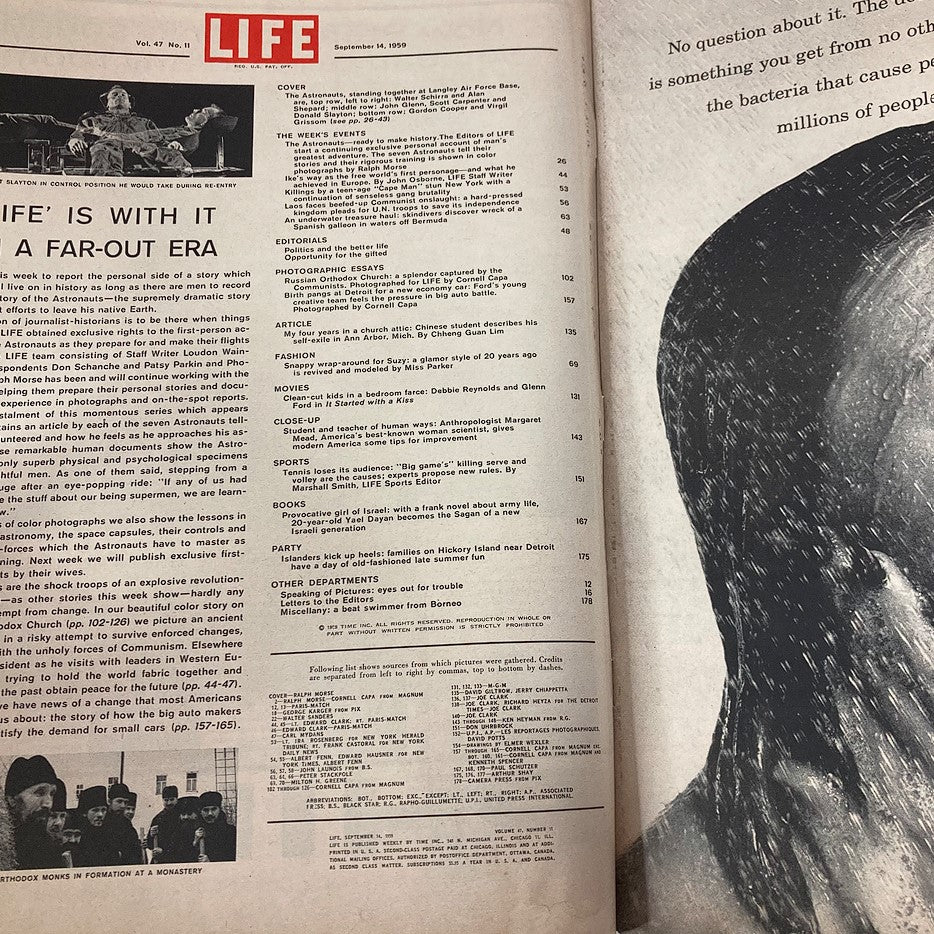
- Note: Specific article titles, individual astronaut account details, photography credits, and full interior editorial contents have not been independently verified for this issue beyond the confirmed cover story. The above reflects what is documented from the cover, volume and issue identification, and the well-established historical record surrounding Life's Mercury Seven exclusive coverage in September 1959.
Condition & Rarity
Surviving copies of the September 14, 1959 Life in collectible condition represent a meaningful minority of the original print run, and sixty-five years of attrition have been considerable for a publication printed on the combination of coated photographic stock and lighter editorial paper that characterized Life of this era — paper engineered for a reading life of weeks rather than decades. The listing describes this issue as being in good shape and provides photographs as the primary condition reference — an honest and appropriate approach for a vintage periodical whose specific condition attributes are best assessed visually — and collectors evaluating any surviving copy should pay particular attention to the cover stock condition, the spine integrity, and the legibility of the interior content, which includes the first-person astronaut accounts that are the primary editorial and historical asset of this specific issue. The large-format pages of Life from this period are more susceptible to edge stress and corner wear than smaller-format periodicals, and the coated photographic pages typically survive in better condition than the cover and outer editorial pages in copies that have passed through decades of varied storage. Protective plastic sleeve storage is the appropriate preservation standard for large-format coated-stock magazines of this type and era, and its presence confirms that the issue has been given some preservation attention across its storage history.
Looking for More Issues Like This?
The September 14, 1959 Life astronauts' personal stories issue is one of the most historically significant and editorially distinctive pieces in the magazine's entire Mercury program coverage — a primary document of the Mercury Seven in their own words, published on the day the Soviet Union demonstrated its continued Moon-reaching capabilities, at the precise moment when the American space program's human story was being constructed for public consumption through Life's exclusive access. The Life magazine collection at OriginalMagazines.com spans a wide and carefully assembled range of issues from across the publication's remarkable run, with particular depth in the space age years that represent the fullest expression of its exclusive Mercury program documentary mission — including companion issues that complete the picture this September 14 edition begins. For collectors drawn to the full historical texture of the year America's astronauts first told their stories to the nation, the 1959 magazine collection offers a rich cross-section of that pivotal year across multiple titles and perspectives.