
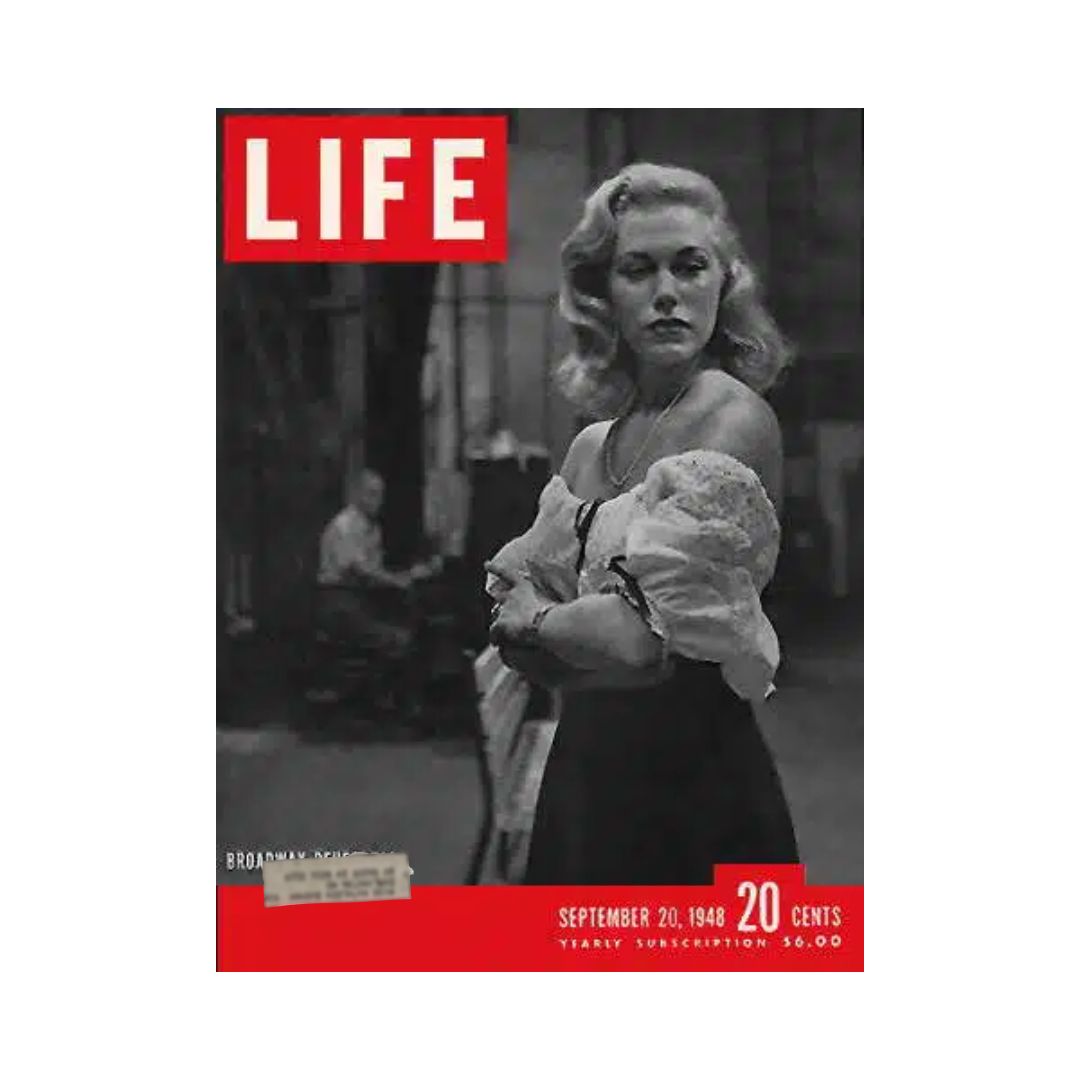

Description
Collector's Note – Why This Issue Matters
The September 20, 1948 issue of Life Magazine is one of the more substantively rich single issues in the publication's late 1940s run, and its confirmed table of contents makes that richness unusually verifiable for researchers and collectors approaching it as a primary source. Joan Diener on the cover places this issue within the Broadway theatrical world at the beginning of what would prove to be a significant career — she would go on to originate the role of Aldonza in the original Broadway production of Man of La Mancha in 1965 and become one of the more distinctive vocal presences on the American musical stage over the following decades. In September 1948 she was a young performer at the beginning of her public life, and a Life cover appearance at that stage of a career was a meaningful form of establishment recognition. The magazine's theatrical coverage in the late 1940s was particularly strong, reflecting the postwar Broadway boom that was producing some of the most significant work in American musical and dramatic theater, and a cover devoted to a Broadway figure in this period documents that cultural moment with the visual authority that only Life's large-format photography could provide. For collectors building a serious archive of the publication's postwar cultural coverage, the Life Magazine collection at OriginalMagazines.com spans the full breadth of its decades of American cultural and photojournalistic documentation, with the late 1940s issues representing a particularly rich period of postwar transition and cultural vitality.
The confirmed table of contents for this issue reveals an editorial range that is genuinely extraordinary even by Life's consistently ambitious standards. W. Eugene Smith's "Country Doctor" photo essay on page 115 alone elevates this issue into a historically significant tier of photojournalism history. Smith's "Country Doctor" — depicting a rural Colorado physician named Ernest Ceriani making his rounds — is widely regarded as one of the foundational works of American photojournalism, a piece that established the extended photo essay as a form of documentary storytelling with the depth and emotional resonance of long-form prose journalism. It is the kind of work that photography historians still teach and reference as a defining example of what the form can achieve, and its original publication in this specific issue gives the September 20, 1948 Life a canonical status within the history of photojournalism that collectors of that tradition recognize immediately. The additional confirmed content — the Schmoo craze documentation, the piece on Czechoslovakia mourning Beneš and independence in the shadow of the communist takeover, the coverage of Queen Wilhelmina's abdication in favor of her daughter Juliana, and the Aldous Huxley feature — collectively make this one of the more historically dense single issues in Life's postwar run. The full range of 1948 magazines from this year documents the immediate postwar period across multiple publications and subjects, but few single issues from this year contain the specific convergence of cultural, political, and photojournalistic significance that this September 20 issue provides.
The Schmoo content — "The U.S. Becomes Schmoo-Struck" on page 46 — deserves particular attention as a historical artifact. The Schmoo was a creature introduced by cartoonist Al Capp in his Li'l Abner comic strip in August 1948, and its reception was one of the most extraordinary pop culture phenomena of the immediate postwar years. The Schmoo — a creature that produced whatever its owner needed, asked nothing in return, and reproduced endlessly — became an instant national obsession, generating merchandise, commentary, and the kind of mass cultural conversation that only a handful of pop culture events in any given decade achieve. Life's coverage of the Schmoo craze, appearing just weeks after the character's introduction, documents the phenomenon at its absolute peak moment of public fever — primary source material for anyone researching postwar American popular culture and the specific hungers and anxieties that the Schmoo's fantasy of effortless abundance was speaking to in a country that had just emerged from years of wartime scarcity and Depression-era deprivation. That combination of canonical photojournalism history, Cold War political documentation, postwar pop culture, and Broadway theatrical coverage in a single issue makes the September 20, 1948 Life an unusually rewarding find for serious collectors.
About the Publication
Life Magazine was founded by Henry Luce in 1936 as the first American publication built entirely around photojournalism, and by the late 1940s it had established itself as the most culturally influential periodical in the United States, reaching tens of millions of readers weekly through a combination of large-format photography, long-form feature writing, and visual storytelling that the magazine had essentially invented as an editorial form. Its audience was genuinely mass market in a way that almost no other publication could claim, cutting across regional, class, and educational lines to deliver a picture of American and world affairs that was simultaneously aesthetically ambitious and broadly accessible. By the late 1940s, Life was at the height of its photojournalistic ambition, with a roster of staff photographers — including W. Eugene Smith, Alfred Eisenstaedt, Margaret Bourke-White, and others — who were producing some of the most important documentary photography of the twentieth century. The extended photo essay format that Smith's "Country Doctor" exemplified in this specific issue was a Life editorial innovation that transformed photojournalism from caption-driven illustration into a primary narrative form in its own right, and the publication's willingness to devote substantial page space to a single photographer's extended documentary project was central to that transformation.
Key Highlights Inside
- "Country Doctor" photographs by W. Eugene Smith (page 115) — Smith's extended photo essay depicting rural Colorado physician Ernest Ceriani is one of the canonical works in the history of American photojournalism, widely taught and referenced as a defining example of the extended photo essay's capacity for documentary depth and emotional resonance. Its original publication in this issue gives the September 20, 1948 Life a historically significant status within photojournalism history that is independent of but complementary to its other significant content, and collectors of photography history and Life photojournalism specifically recognize this as one of the more important issues in the publication's postwar run.
- "The U.S. Becomes Schmoo-Struck" (page 46) — Coverage of the Schmoo phenomenon just weeks after Al Capp's creation first appeared in Li'l Abner documents one of the most extraordinary immediate pop culture crazes of the postwar decade at its peak intensity. The Schmoo's cultural resonance — its fantasy of effortless abundance and unconditional generosity speaking directly to a country emerging from wartime scarcity — makes contemporaneous coverage of the public's response a primary source of genuine value for researchers of postwar American popular psychology and consumer culture.
- "Czechs Mourn for Beneš and Independence" (page 49) — Coverage of Czechoslovakia's mourning for Edvard Beneš — who died in September 1948, months after the communist coup that had ended the country's democratic government — documents one of the defining moments of the early Cold War's consolidation of Soviet control over Eastern Europe. Beneš had been the president who signed the Munich Agreement under duress in 1938 and the symbol of Czech democratic aspirations throughout the war and its aftermath; his death in the wake of the communist takeover carried enormous symbolic weight, and Life's coverage from this specific moment is primary documentation of American photojournalism's engagement with the Cold War's human cost.
- "Wilhelmina Gives Way to Daughter" (page 40) — Coverage of Queen Wilhelmina's abdication in favor of her daughter Juliana documents a significant moment in postwar European monarchical history. Wilhelmina had become one of the most symbolically important figures of the resistance to Nazi occupation during the war, leading the Dutch government-in-exile from London, and her abdication after fifty years on the throne in favor of Juliana was a major European event with genuine international resonance.
- "Brave New World" by Aldous Huxley (page 63) — A feature connected to Huxley's dystopian novel appearing in Life in September 1948 — just three years after the atomic bomb and in the first years of the Cold War — would have carried a specific cultural urgency that the 1932 novel's original publication could not have anticipated. Coverage of or by Huxley in this period reflects the mainstream American press's engagement with the anxieties about technological power, social control, and human freedom that the postwar nuclear moment had made newly immediate.
- Joan Diener Broadway cover feature — The cover portrait of Diener documents a young Broadway performer at the outset of a significant theatrical career, within Life's consistent tradition of recognizing theatrical talent before it had achieved its greatest achievements. The late 1940s Broadway world that Diener was entering was one of the most creative periods in American theatrical history, and Life's coverage of its rising talent provides primary documentation of that world at a specific and historically rich moment.
Condition & Rarity
The listing notes that the image shown is a stock photo and that the condition described applies to the issue received rather than a specific photographed copy — an honest disclosure practice that is standard among high-volume vintage magazine sellers who maintain multiple examples of the same issue. This means condition assessment for surviving copies of this issue must rely on what is typical for Life Magazine issues from September 1948 rather than on specific photographed attributes. For a publication now approaching eighty years old, the baseline condition expectations for typical surviving examples include: address labels on the front cover bonded permanently to the coated cover stock in the vast majority of subscription copies, with label-free newsstand examples representing a meaningful premium; some degree of corner blunting and cover surface wear from handling and storage; potential spine stress and staple rust at the binding points; and interior page toning along the outer margins that accumulates on paper stock of this era under typical storage conditions. The W. Eugene Smith "Country Doctor" photo essay makes page completeness and the integrity of the photography pages particularly important condition variables for this specific issue — the large-format photo spreads that define the essay's visual impact are the primary research and display asset, and any significant damage to those pages affects the issue's value for both scholarly and collector purposes more substantially than damage to text-heavy sections would. Collectors evaluating surviving copies of this issue should prioritize the condition of the Smith photography pages, the Joan Diener cover portrait, and the overall spine integrity when making grade assessments.
Looking for More Issues Like This?
The September 20, 1948 Life Magazine is one of those issues that multiple collector communities pursue simultaneously — photojournalism historians seeking the W. Eugene Smith "Country Doctor" essay, Cold War documentation collectors, postwar Broadway enthusiasts, and Life archive builders all have strong reasons to want this specific issue, which means strong surviving copies move consistently when they surface. If this issue is no longer available, the Life Magazine collection at OriginalMagazines.com is the most comprehensive resource for exploring what else has surfaced from the publication's extraordinary run of postwar photojournalism and cultural documentation — a collection that spans the full breadth of Life's decades of American and world coverage. For collectors building a broader documentary picture of American cultural and political life during the immediate postwar years, the 1948 magazines collection brings together a wide range of titles from that pivotal year, collectively documenting the transition from wartime to Cold War and the full texture of American life at a moment of genuine historical transformation.