
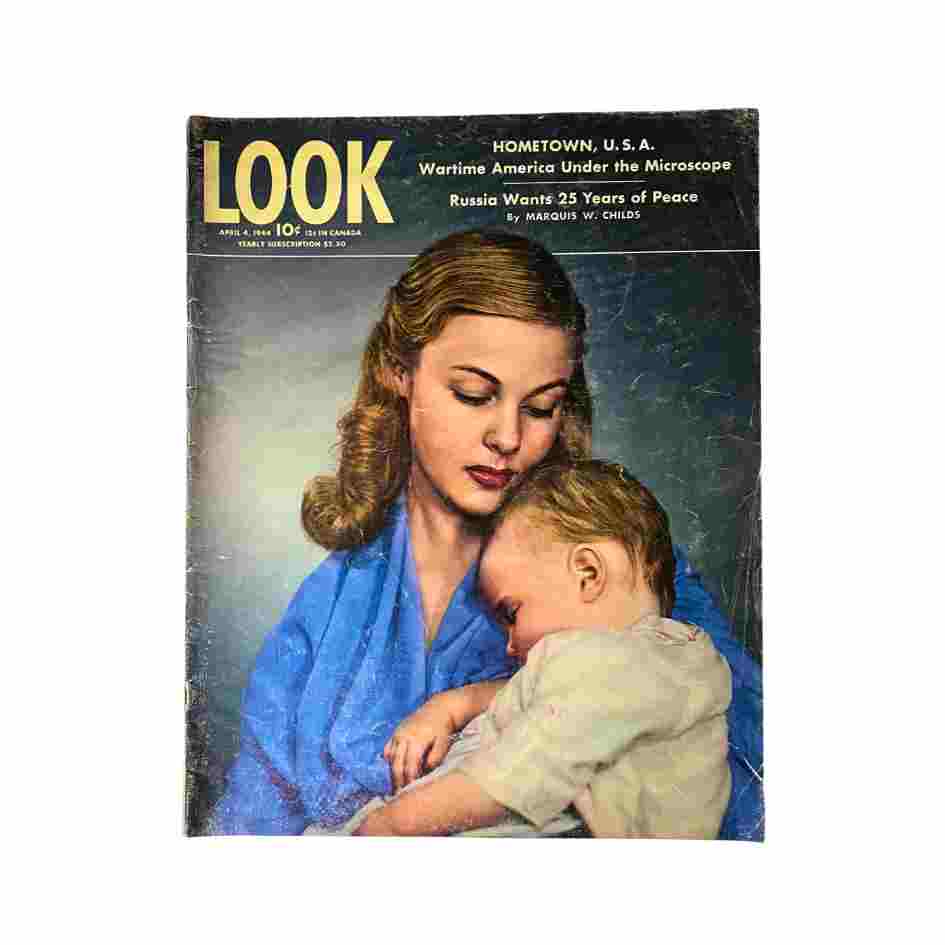


Description
Collector's Note – Why This Issue Matters
The April 4, 1944 issue of Look Magazine is a primary document of exceptional wartime significance and editorial ambition — and the fully documented table of contents reveals an issue of remarkable breadth that captures American wartime life in virtually every dimension simultaneously. The date April 4, 1944 places this issue approximately two months before the D-Day invasion of June 6, 1944, at the specific moment when the war's momentum had shifted decisively but the decisive Allied blow in Western Europe had not yet been struck. The featured cover story, "Hometown, U.S.A.: Wartime America Under the Microscope," is among the most historically interesting pieces in this issue's contents: this was the first installment of a Look Magazine series on Glens Falls, New York — a specific, named American community being used as a case study for the full sociology of wartime American domestic life. The choice of Glens Falls as a representative American town for this kind of comprehensive sociological documentation was not accidental; the mid-sized upstate New York industrial city was selected to stand in for the experience of communities across the country, and the Look series would produce some of the most detailed primary documentation of American home-front social life available in any periodical of the period. The combination of the Germany bombing feature by Donald Grant — documenting a Flying Fortress mission in the first-person journalism that Look was producing from embedded positions — with the Glens Falls hometown series in the same issue creates an extraordinary primary document that spans the full spectrum from the air war over Europe to the American grocery store and dinner table. Collectors building a focused archive of wartime American magazine journalism will find the Look magazine collection an essential resource for the publication's wartime coverage at its most historically comprehensive.
The scientific and cultural content documented in this issue adds layers of documentary value that extend well beyond the immediate war journalism. The Walt Disney feature on sulfa drugs — "Mickey Mouse Depicts the Wonders of the Life-Saving Sulfa Family" — is a primary document of the extraordinary wartime collaboration between American entertainment culture and public health communication that produced some of the most interesting graphic journalism of the era. Disney's participation in wartime information campaigns was a significant chapter of both the studio's history and American public health communication, and a Look Magazine feature using Mickey Mouse to explain sulfa drugs to a mass civilian audience in April 1944 is an artifact that sits at the intersection of animation history, medical history, and wartime public health journalism. The Marquis W. Childs article on Soviet postwar reconstruction needs — "Russia Wants 25 Years of Peace" — is a primary document of American mainstream journalism's engagement with the Soviet alliance at its moment of maximum wartime cooperation, in the specific pre-Yalta period when the postwar settlement was still being negotiated. The Greer Garson profile and the Tommy Dorsey fan club feature document the specific entertainment culture of the home front in April 1944. Collectors focused on the wartime period will find that 1944 magazine issues document what military historians have called the most consequential year of the war with primary source authority of extraordinary depth.
The "Can We Believe the War News?" article by Ira Wolfert is a primary document of wartime American journalism's self-examination — a mainstream magazine engaging directly with the question of press reliability and censorship that was central to the public's relationship with war reporting throughout the conflict. Wolfert was one of the most decorated war correspondents of the era, the author of Battle for the Solomons (1943) and a Pulitzer Prize winner, and his examination of this question in April 1944 carries the specific authority of a practitioner reflecting on his own profession from inside the wartime information ecosystem. The combination of this piece with the "How to Win Raises and Influence Bosses" office etiquette feature, the Easter hat fashion content, and the "If You Captured Hitler, What Would You Do With Him?" street interview captures the extraordinary compression of wartime American life — the simultaneous navigation of global catastrophe and ordinary domestic experience — that gives wartime magazines their unique documentary character.
About the Publication
Look Magazine was founded in 1937 by Gardner Cowles as a direct competitor to Life, offering large-format photojournalism combined with in-depth feature articles for a mass American readership. By April 1944, Look had established itself as one of the most widely circulated magazines in the United States, covering the war across its military, political, scientific, and domestic dimensions with the comprehensive editorial program that distinguished it as a genuine primary source of the full American wartime experience rather than simply a military or political publication. Its biweekly schedule and large-format photojournalism gave each issue a documentary quality that made individual issues genuinely valuable as archives of the specific moment they documented.
Key Highlights Inside
- "Hometown, U.S.A.: Wartime America Under the Microscope" — the first installment of a Look Magazine sociological series on Glens Falls, New York, providing one of the most comprehensive primary documentary records of American home-front community life available in any single periodical article from the wartime period.
- "A Flying Fortress Bombs Germany" by Donald Grant — embedded first-person journalism documenting an American bombing mission over Germany in April 1944, produced approximately two months before D-Day at the peak of the strategic bombing campaign.
- "Mickey Mouse Depicts the Wonders of the Life-Saving Sulfa Family" by Walt Disney — a primary document of Disney's wartime public health communication work, situated at the intersection of animation history, medical journalism, and the wartime information campaigns that used popular culture as a vehicle for public health messaging.
- "Russia Wants 25 Years of Peace" by Marquis W. Childs — American mainstream journalism's engagement with Soviet postwar reconstruction needs in April 1944, at the moment of maximum US-Soviet wartime cooperation and before the Yalta Conference had defined the postwar settlement.
- "Can We Believe the War News?" by Ira Wolfert — wartime journalism self-examination by a Pulitzer Prize-winning war correspondent, providing a primary document of how the American press was addressing questions of censorship, reliability, and its own role in the information ecosystem of the war.
- Greer Garson profile "First Lady of the Screen" — wartime entertainment journalism on MGM's top star in April 1944, documenting the specific intersection of Hollywood celebrity and wartime cultural morale that gave films and their stars a particular social function in this period.
Condition & Rarity
The listing discloses creases and marks and directs collectors to the provided photographs for condition assessment without specifying a precise overall grade. Collectors evaluating this issue should examine those photographs carefully to assess the specific location and extent of the creases and marks relative to the cover design and the interior content that give the issue its primary documentary value. What can be stated with confidence is that a Look Magazine from April 4, 1944 is now more than eighty years old, placing it in the category of wartime periodicals where physical aging — yellowing, edge wear, and the deterioration of paper produced under wartime rationing constraints — is expected. The creases and marks are the standard physical record of a large-format publication stored and occasionally handled across eight decades rather than evidence of unusual damage. The newsstand origin confirmed by the absence of a mailing label preserves the full surface integrity of the cover without adhesive damage. A protective plastic covering indicates deliberate preservation intent appropriate for a primary document of this historical significance and editorial depth.
Looking for More Issues Like This?
Look Magazine issues from April 1944 with fully documented tables of contents spanning wartime bombing journalism, the first installment of the Glens Falls hometown sociological series, Walt Disney's sulfa drug public health feature, Marquis Childs on Soviet reconstruction, and Ira Wolfert on press reliability are among the most editorially comprehensive wartime primary documents available in the American periodical collector market. The broader Look magazine collection is the most reliable starting point for finding other significant wartime issues from across the publication's history, including other 1944 issues that document the war's most decisive year across its military, political, scientific, and domestic dimensions. Collectors building a focused archive of 1944 as the year of D-Day, Yalta, and the war's approaching conclusion will find the complete 1944 magazine collection an invaluable resource for locating other primary documents from this extraordinary year.