




Description
Collector's Note – Why This Issue Matters
January 14, 1964 is a date of specific and extraordinary art historical significance, and this issue of Look magazine is one of the most important periodical objects in American civil rights history. The table of contents confirms — under "Art" — "The Problem We All Live With, Painted for LOOK by Norman Rockwell." This is the original publication context for one of the most celebrated and historically significant paintings in American art: Rockwell's depiction of six-year-old Ruby Bridges being escorted by federal marshals to William Frantz Elementary School in New Orleans in November 1960, the first Black child to integrate that school. Rockwell had painted the image for Look specifically, breaking from his long association with the Saturday Evening Post to produce a series of civil rights paintings for the magazine, and "The Problem We All Live With" was the most powerful of them — a work that has since become one of the most recognized images of the Civil Rights era and that hangs in the permanent collection of the Norman Rockwell Museum. The January 14, 1964 Look is the first published appearance of this painting, making it one of the most historically significant magazine issues in American art and civil rights history. For collectors exploring original magazines from 1964, this specific January issue is among the most historically charged primary documents available in the entire vintage magazine market.
The Civil Rights context of the painting's publication gives this issue a specific historical weight that rewards careful attention. January 1964 was a period of sustained and intensifying Civil Rights movement activity — the Civil Rights Act was being debated in Congress, Freedom Summer was being planned, and the movement's most consequential legislative battles were just months ahead. Norman Rockwell's decision to use his celebrated illustrative gifts in explicit service of civil rights representation — painting Ruby Bridges with the slur-defaced wall behind her and the shattered tomato at her feet — was itself a significant cultural statement from an artist whose earlier work had been associated with a more idealized vision of American life. Look's publication of the painting in January 1964 placed one of America's most beloved popular illustrators in direct conversation with the most urgent moral crisis of the era. The broader table of contents — Julius Horwitz on "Our Middle-Class Ghettos," John Peter on "How We Live," and the urban housing coverage — contextualizes the Rockwell painting within a sustained editorial engagement with American domestic inequality. For collectors tracing the cultural history of the publication through original Look magazine issues, this January 14, 1964 number is the single most historically significant issue in the magazine's publishing history.
The newsstand copy designation and absence of a label add specific collector value for this particular issue. A label-free copy of the first published appearance of "The Problem We All Live With" preserves the cover image from adhesive damage, and given the extraordinary historical significance of the interior content, the overall integrity of the surviving copy carries additional documentary importance beyond the typical condition considerations for a general-interest magazine.
About the Publication
Look magazine was founded by Gardner Cowles Jr. in 1937 as a biweekly general-interest photojournalism publication, competing directly with Life magazine for the mass American readership that was hungry for photographic coverage of world events, American life, and celebrity culture. By January 1964, Look was in a period of sustained editorial ambition, engaging with the Civil Rights movement, urban America, and social change with a directness and seriousness that distinguished its best issues from purely commercial photojournalism. Its decision to commission Norman Rockwell for a series of civil rights paintings — of which "The Problem We All Live With" was the centerpiece — represented one of the most significant editorial choices in the magazine's history.
Key Highlights Inside
- "The Problem We All Live With" — Norman Rockwell, painted for Look: As confirmed in the table of contents — the first published appearance of one of the most historically significant American paintings of the twentieth century, Norman Rockwell's depiction of Ruby Bridges integrating William Frantz Elementary School in New Orleans in 1960, a work that now hangs in the Norman Rockwell Museum and is among the most recognized images of the Civil Rights era.
- "Our Middle-Class Ghettos" by Julius Horwitz: As confirmed in the table of contents — a feature on American residential segregation and urban inequality by a writer known for his direct engagement with social housing realities, contextualizing the Rockwell painting within a broader editorial statement about American domestic inequality in January 1964.
- "How We Live" by John Peter and the full urban housing editorial: As confirmed in the table of contents — comprehensive coverage of how Americans lived in cities in early 1964, providing the domestic context within which the Rockwell civil rights painting appeared.
- Newsstand copy, no label: The listing confirms this is a newsstand edition with no address label — a meaningful positive for an issue of this historical significance, as label adhesive causes irreversible cover surface damage affecting most surviving subscription copies from this era.
- Plastic protective covering: The listing confirms an applied protective covering, indicating custodial awareness of the issue's collectible and historical value.
Condition & Rarity
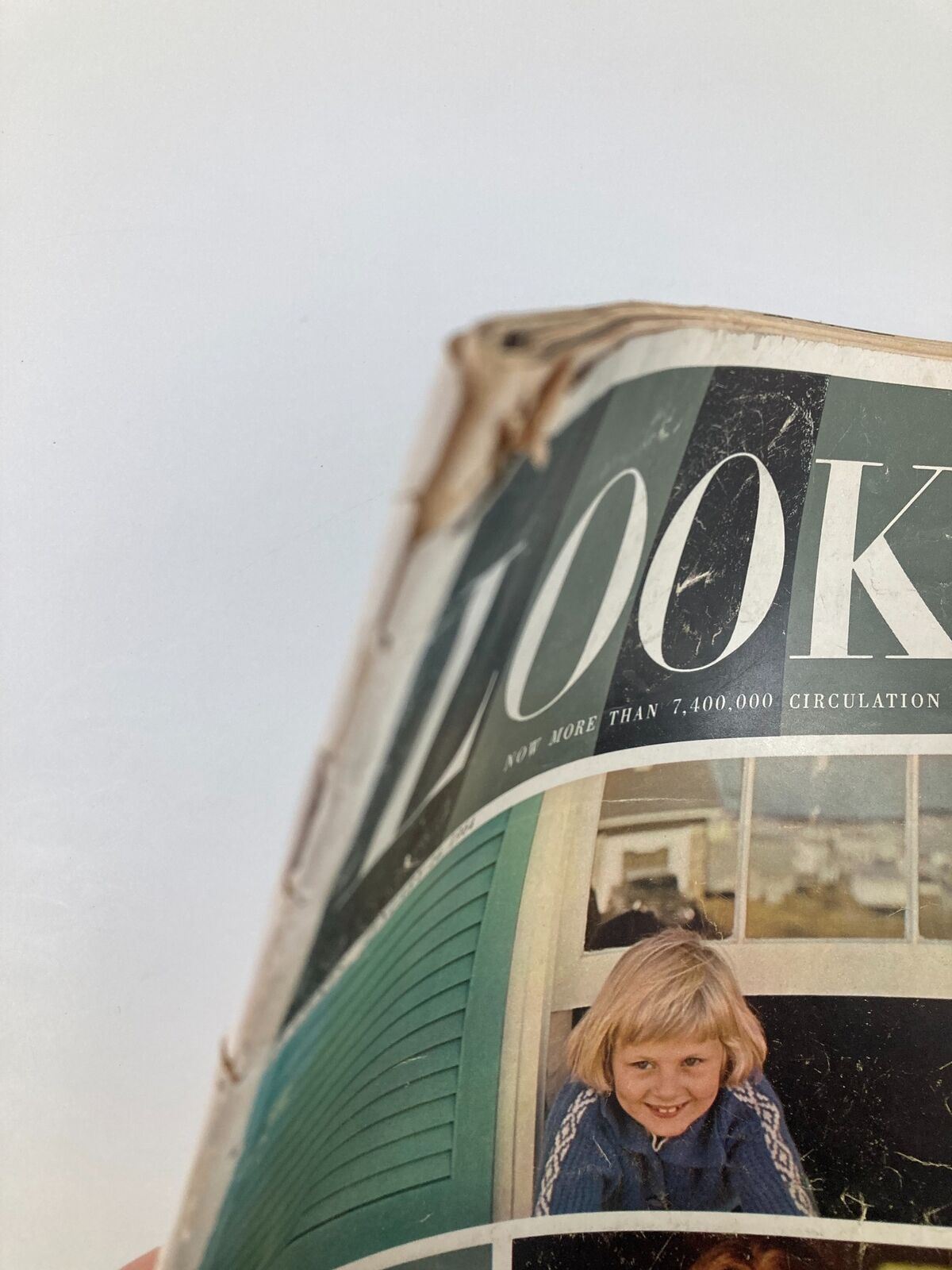
The listing describes this issue as in acceptable condition with marks and wear particularly around the binding, creases on the front corners, possible rips, no address label, and a plastic protective covering applied, with photographs provided for detailed condition assessment. In collector-grade terms, acceptable is the lowest functional grade in the standard scale, indicating visible wear and structural issues that affect presentation. The binding wear, corner creases, and possible rips noted are the primary structural concerns, and their extent should be assessed through the photographs. The absence of a label is a genuine positive that preserves the cover from adhesive damage. For an issue of the historical significance of this specific January 14, 1964 Look — the first published appearance of "The Problem We All Live With" — condition assessment must account for the extraordinary documentary value of the interior content alongside the physical condition factors. At the acceptable grade described, this is a reading and research copy appropriate for collectors who prioritize access to the Rockwell publication context and the full table of contents over display-grade presentation.
Looking for More Issues Like This?
The January 14, 1964 Look magazine — the first published appearance of Norman Rockwell's "The Problem We All Live With," one of the most historically significant American paintings of the Civil Rights era — is one of the most important single issues in the entire vintage magazine market, and surviving copies at any condition grade are primary documents of American art and civil rights history. If this issue is no longer available, the original Look magazine collection at OriginalMagazines.com is worth exploring for other significant issues from the publication's distinguished history. For those drawn to the Civil Rights era and the cultural landscape of 1964, the 1964 magazine collection rewards careful exploration — it is a year whose historical weight is present in every issue that has survived it.