


Description
Collector's Note – Why This Issue Matters
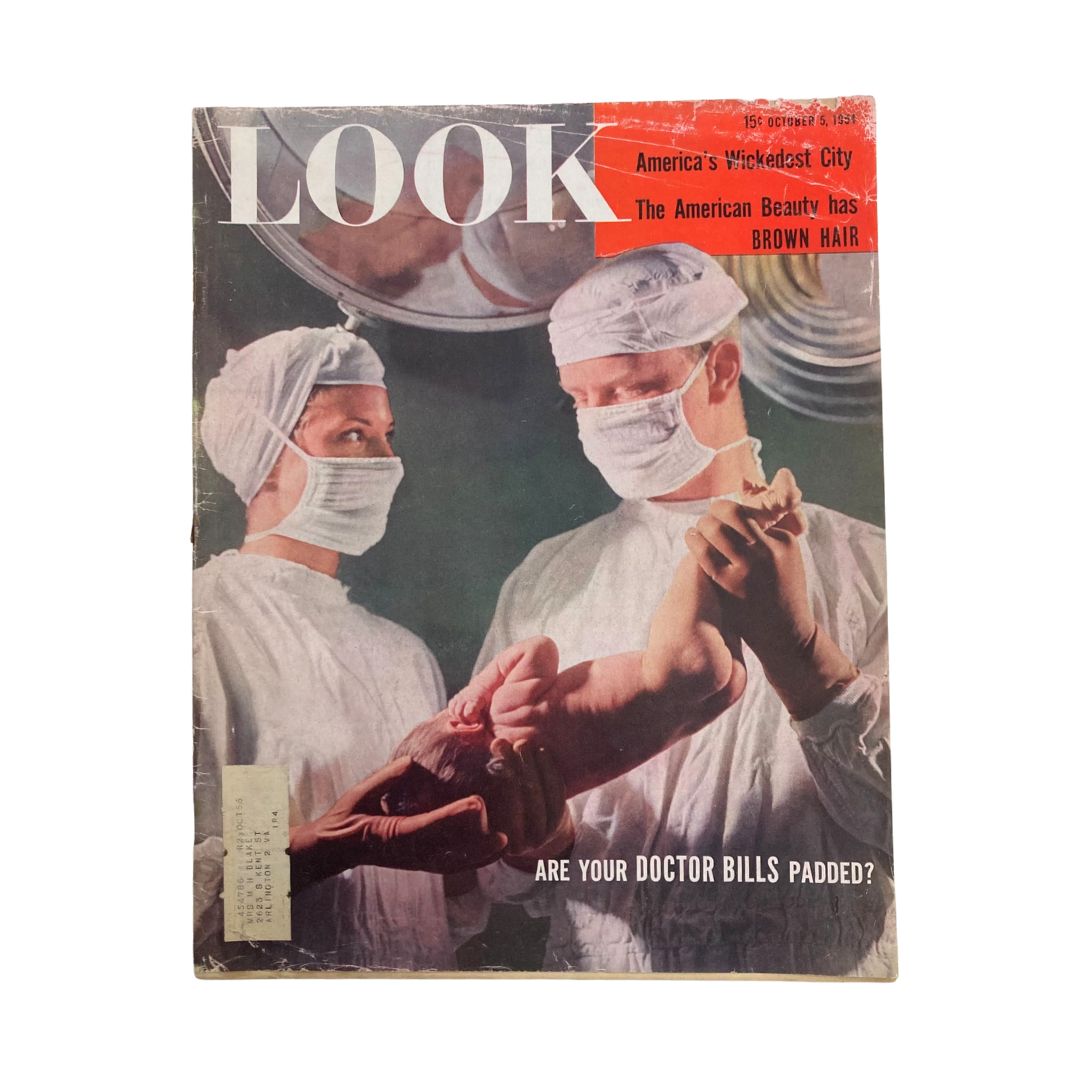
The October 5, 1954 issue of Look Magazine, with its cover story "Are Your Doctor Bills Padded?", is a primary document of American healthcare journalism at a historically significant moment — the mid-1950s debate over medical costs, insurance, and the relationship between patients and the medical establishment that preceded by decades the same conversations Americans are still having today. By 1954, the American medical system was undergoing rapid transformation: hospital costs were rising dramatically in the postwar period, the Blue Cross and Blue Shield insurance systems were expanding but far from universal, and the specific question of whether physicians were billing patients honestly and fairly was being raised in the popular press with increasing directness. A Look Magazine cover story by Roland Berg investigating medical billing practices is therefore a primary document of the healthcare cost debate in its 1954 form — a historical anchor point for understanding how long Americans have been grappling with the same structural tensions in their medical economy. The documentary value of this specific cover story for historians of American healthcare policy and for collectors interested in the history of medical journalism is considerable, and the Look platform gave it an audience of millions of American households who received the magazine as one of the two or three most widely circulated picture magazines in the country. Collectors building a focused archive of Look Magazine's journalism across its most historically significant decades will find the Look magazine collection the most comprehensive resource for the publication's coverage of American domestic and political life across this period.
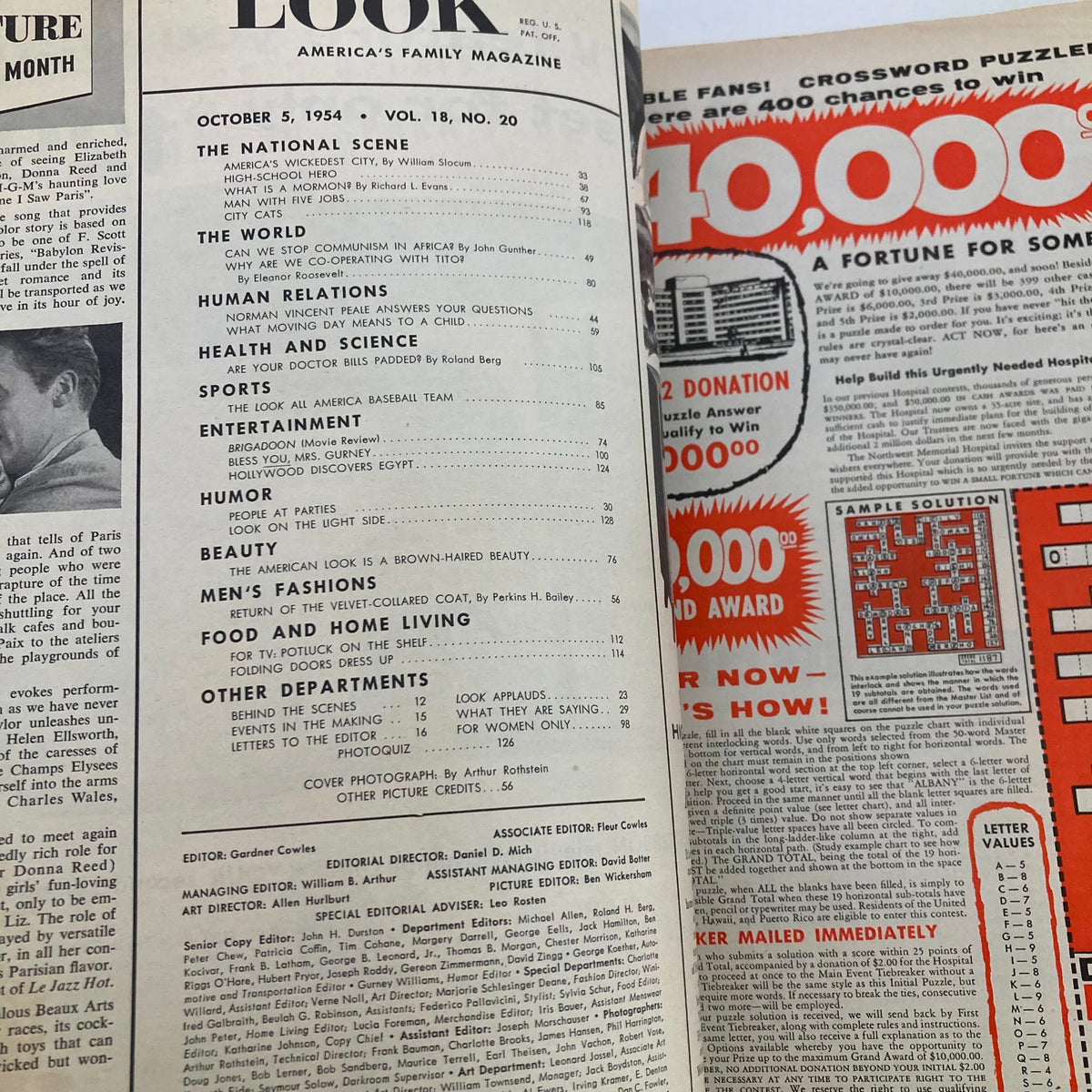
The breadth and quality of the non-healthcare content documented in this issue makes it a rich primary source well beyond the cover story's specific subject. John Gunther's "Can We Stop Communism in Africa?" and Eleanor Roosevelt's "Why Are We Co-operating with Tito?" place the issue squarely within the specific geopolitical anxieties of 1954 — the year of the French defeat at Dien Bien Phu and the beginning of direct American involvement in Vietnam, when the question of how to contain Communism in the developing world was the defining question of American foreign policy. Gunther was one of the most respected political journalists in America, the author of the "Inside" series of books on various countries and regions, and his analysis of African Communist threat carried specific authority for the Look readership. Roosevelt's article on Tito reflects the specific and complicated American relationship with Yugoslav non-alignment — Tito's break from Stalin had made Yugoslavia a useful anomaly in Cold War geopolitics, and American cooperation with a Communist leader was exactly the kind of counterintuitive policy question that required public explanation in the popular press. Norman Vincent Peale's presence in the Human Relations section reflects the mid-1950s cultural phenomenon of positive thinking — his 1952 book The Power of Positive Thinking was still a bestseller in 1954 — and his Look column documents the specific intersection of popular psychology, Protestant religiosity, and mid-century American self-improvement culture. Collectors focused on the mid-1950s will find that 1954 magazine issues document one of the most consequential years of the Cold War era with primary source authority.
The entertainment and culture content documented in this issue adds a specific popular culture dimension that enriches its value as a comprehensive primary source of October 1954. The Brigadoon film review documents the MGM musical adaptation released that year, starring Gene Kelly and Cyd Charisse — the specific Hollywood moment when the great MGM musical was beginning its decline from its early-1950s peak. "Hollywood Discovers Egypt" reflects the mid-1950s biblical epic cycle that was one of Hollywood's dominant commercial strategies in response to the threat of television. "The Look All America Baseball Team" is a primary document of the 1954 baseball season — the year of the Cleveland Indians' record-setting 111 wins and the New York Giants' stunning World Series sweep, widely considered one of the greatest upsets in baseball history. These specific cultural touchstones converging in a single October 1954 issue give the publication a documentary comprehensiveness that rewards examination across multiple fields of historical interest simultaneously.
About the Publication
Look Magazine was founded in 1937 by Gardner Cowles as a direct competitor to Life, offering large-format photojournalism combined with in-depth feature articles for a mass American readership. By the mid-1950s, Look had established itself as one of the two or three most widely circulated magazines in the United States, reaching tens of millions of American households with a combination of political journalism, cultural features, health and lifestyle content, and the visual photojournalism that gave it its distinctive identity. Its biweekly publication schedule — in contrast to Life's weekly — allowed for slightly deeper editorial development of individual stories, and its editorial program in 1954 reflected the full range of postwar American concerns: Cold War politics, healthcare economics, popular culture, sports, and the specific domestic anxieties and aspirations of Eisenhower-era middle-class American life.
Key Highlights Inside
- "Are Your Doctor Bills Padded?" by Roland Berg — the cover story investigating medical billing practices in 1954, a primary document of the healthcare cost debate that predates contemporary discussions by seven decades and captures the specific mid-1950s moment when rising hospital costs, expanding insurance, and the question of physician billing transparency were being actively contested in the popular press.
- "Can We Stop Communism in Africa?" by John Gunther — Cold War geopolitical analysis by one of the most authoritative political journalists of the era, appearing in October 1954 as American policymakers were absorbing the implications of Dien Bien Phu and the beginning of direct US involvement in Southeast Asia.
- "Why Are We Co-operating with Tito?" by Eleanor Roosevelt — popular journalism on the specific complexity of American-Yugoslav relations in 1954, reflecting the Cold War's counterintuitive strategic calculations and the role of the popular press in explaining non-obvious foreign policy choices to an engaged American readership.
- Norman Vincent Peale's Human Relations column — a primary document of the most commercially successful positive psychology phenomenon of the 1950s, with the author of The Power of Positive Thinking addressing Look's mass readership in the specific format of a practical advice column that documented the intersection of Protestant religiosity and mid-century American self-improvement culture.
- "The Look All America Baseball Team" — a primary document of the 1954 baseball season, the year of the Cleveland Indians' record 111 wins and the New York Giants' World Series sweep, capturing the sport at one of its most historically memorable single-season moments.
- Brigadoon movie review and "Hollywood Discovers Egypt" entertainment coverage — primary documentation of the mid-1950s Hollywood landscape at the specific moment when the MGM musical's golden age was giving way to the biblical epic cycle that was the industry's response to the television threat.
Condition & Rarity
The listing does not specify a precise condition grade beyond indicating that the item shown in the photographs is the exact issue being documented and that a protective plastic covering is included, and collectors evaluating this issue should examine the provided photographs carefully to assess its specific physical state. What can be stated with confidence is that a Look Magazine from October 5, 1954 is now seventy years old, placing it in the category of vintage periodicals where physical aging — yellowing, edge wear, and the natural brittleness of paper from this era — is expected and does not compromise the extraordinary historical and documentary significance of the documented contents. Look's large format means that surviving copies have been subject to the specific physical stresses of large-format magazine storage across seven decades, and condition assessment should attend to both the cover imagery and the interior page integrity, given the richness of the documented table of contents. A protective plastic covering indicates deliberate preservation intent appropriate for a publication whose content significance as a primary source of mid-1950s American life extends well beyond its surface condition.
Looking for More Issues Like This?
Look Magazine issues from October 1954 with documented tables of contents featuring healthcare journalism, Cold War geopolitical analysis by John Gunther and Eleanor Roosevelt, Norman Vincent Peale, and the specific cultural documentation of the 1954 baseball season and Hollywood landscape are among the most editorially rich single issues available for collectors working to document the full texture of mid-Eisenhower-era American life. The broader Look magazine collection is the most reliable starting point for finding other significant issues from across the publication's distinguished run, including other 1950s issues that document American political, cultural, and domestic life across the decade. Collectors building a focused archive of 1954 as a pivotal Cold War year will find the complete 1954 magazine collection an invaluable resource for locating other titles and issues that document this consequential year from the multiple perspectives that serious historical research requires.