
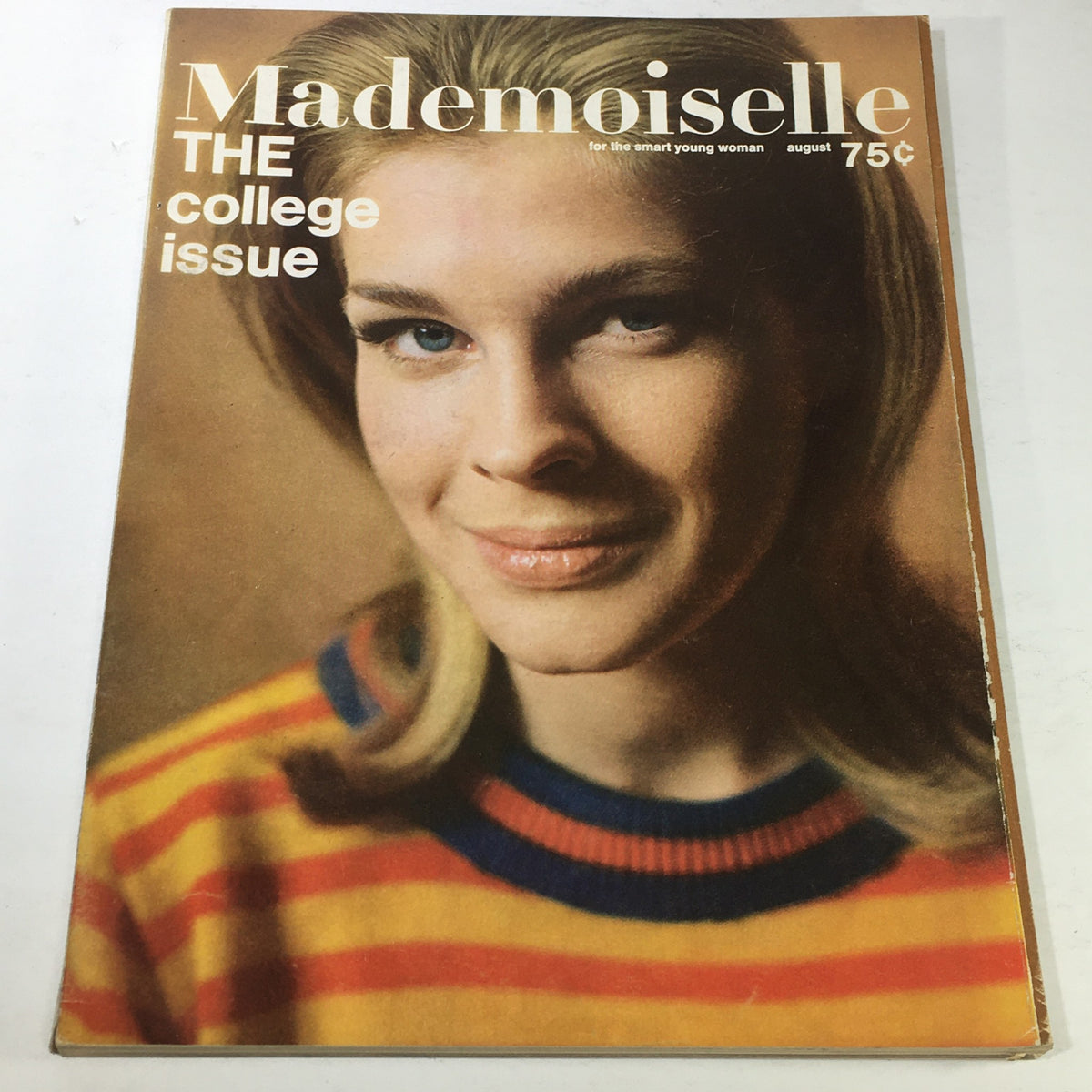

Description
Collector's Note – Why This Issue Matters
August 1964 is a date that resonates deeply for anyone who studies the American sixties seriously. The Civil Rights Act had been signed into law just weeks earlier, in July 1964 — the most significant piece of civil rights legislation since Reconstruction — and American campuses were preparing to receive a generation of students who would prove to be the most politically engaged and socially transformative cohort in the history of American higher education. The Free Speech Movement at Berkeley was still months away, but the mood on campuses across the country was already charged with a new kind of political seriousness that had no precedent in the postwar era. A College Issue of Mademoiselle published in this precise August — landing in the hands of young women preparing to return to or begin college in the fall of 1964 — exists at the exact threshold between the early sixties world those women had grown up in and the fundamentally different world they would help create over the following four years. That positioning gives this issue a historical weight that pure fashion content alone cannot account for. Collectors building a serious archive of the decade will find that 1964 magazine issues document a year whose significance as a turning point in American history has only grown with the passage of time.
Mademoiselle's College Issue was one of the most anticipated and editorially ambitious entries in the magazine's annual publishing calendar, and the August 1964 edition carried that ambition into a cultural moment of unusual consequence. The young women addressed by this issue were on the cusp of an experience — the American college campus of the mid-sixties — that would reshape their understanding of themselves, their country, and their possibilities in ways that no previous generation of college women had encountered in quite the same form. The fashion content, the beauty advice, the lifestyle features, and the cultural commentary that filled a College Issue of this period were all produced with full awareness of this readership's particular intelligence and ambition. The result is an editorial document that functions simultaneously as a fashion record and a social history — evidence of how a major women's publication was imagining the college-educated young American woman at one of the most consequential moments in modern American life. The full arc of the magazine's College Issue tradition across this decade is visible in the Mademoiselle magazine collection, which allows collectors to trace how the editorial approach evolved as the decade intensified around it.
The no-label, newsstand origin of this copy is a meaningful collector distinction for a College Issue specifically. Mademoiselle's August editions were among the most heavily newsstand-distributed of the year — they were bought by college-bound women who saw them on racks, not just by existing subscribers — and a surviving newsstand copy preserves the cover design exactly as it was intended to function: as a visual statement visible from across a magazine rack, designed to stop a young woman in her tracks and make her pick it up. The cover of a 1964 College Issue, label-free and intact, is the complete aesthetic object the art director created, undisturbed by the postal infrastructure that subscription copies inevitably carry on their covers.
About the Publication
Mademoiselle was a Condé Nast publication founded in 1935 and directed consistently at young, educated American women — primarily college students, recent graduates, and young urban professionals building independent lives. Its editorial identity distinguished it from competitors through a genuine and sustained commitment to literary quality alongside fashion and beauty content, with a publishing history that included notable early or significant work from writers including Sylvia Plath, Truman Capote, Joyce Carol Oates, and Cynthia Ozick — a literary pedigree that reinforced its reputation as the thinking woman's fashion magazine. The College Issue was its most prestigious annual editorial franchise, developed over decades into a format that commanded attention from both its readership and the broader fashion and publishing industry. By August 1964 it was twenty-nine years into its publishing history and had developed an editorial voice that was simultaneously aspirational and substantive — addressing its readers as intelligent, culturally engaged people who also cared deeply about fashion, beauty, and the aesthetic dimensions of their lives.
Key Highlights Inside
- The full College Issue editorial package for fall 1964 — Mademoiselle's most ambitious annual format, curated specifically for the college-educated young woman heading into the fall semester of one of the most consequential academic years in modern American history, the eve of the mid-sixties campus upheaval that would transform American society.
- Back-to-campus fashion content reflecting the specific aesthetic moment of August 1964 — the silhouettes, fabrics, colors, and styling approaches that defined how fashion-conscious college women were dressing as they returned to campuses in the fall of 1964, at the precise moment when the early-sixties collegiate aesthetic was beginning its transition toward the bolder, more experimental looks that would define the decade's second half.
- Beauty and lifestyle content consistent with Mademoiselle's College Issue format — the hair, makeup, dormitory living, and personal style guidance that the magazine deployed each August to address the practical and aspirational concerns of the young woman beginning or resuming college life.
- Period advertising pages representing the brands and products marketing to the college demographic in August 1964 — a cross-section of early-sixties consumer culture aimed at young American women at a moment when that demographic was being identified and courted by advertisers with increasing sophistication and investment.
- Note: Specific article titles, bylines, fiction contributors, and additional named interior features beyond those indicated in the listing have not been confirmed from available sources. The highlights above reflect what is documented in the listing and Mademoiselle's well-established editorial format for its annual College Issue during this period.
Condition & Rarity
Surviving copies of the August 1964 College Issue display the characteristic condition profile of a newsstand-origin periodical that has passed through six decades without institutional preservation. Edge wear, binding stress, marks, and rips are expected and honest attributes of an original, unrestored magazine from this vintage — they identify an authentic artifact rather than a reproduction or later facsimile, and experienced collectors read them as the natural patina of a magazine that was actively used and genuinely valued by its original reader. The absence of a subscriber address label is a significant positive in collector evaluation: label-free copies preserve the full cover image exactly as it was designed and printed, without the adhesive marks or obscured imagery that subscription labels permanently introduce. College Issues, which tended to run larger and more heavily produced than standard monthly editions, can be more prone to binding stress over time due to their greater page count, making structural integrity a particularly important variable when evaluating any surviving copy. The protective plastic sleeve on well-preserved copies is the correct conservation measure for a magazine of this age and paper stock, stabilizing further deterioration from handling and environmental exposure without requiring any alteration to the original item.
Looking for More Issues Like This?
A no-label newsstand copy of Mademoiselle's August 1964 College Issue in collectible condition is among the more historically significant finds available in the vintage women's magazine market — the combination of the College Issue format, the specific date, and the label-free cover makes it a document that rewards serious attention from collectors, fashion historians, and cultural researchers alike. If this particular issue is no longer available, the full Mademoiselle magazine collection at OriginalMagazines.com is the most comprehensive source for exploring other issues across the title's long publishing history, with strong representation in the sixties decades that collectors and researchers prioritize most highly. For anyone building a broader archive of the mid-sixties, the complete 1964 magazine collection brings together fashion, culture, news, and lifestyle titles from a year that stands as one of the genuine turning points in twentieth-century American history.