


Description
Collector's Note – Why This Issue Matters
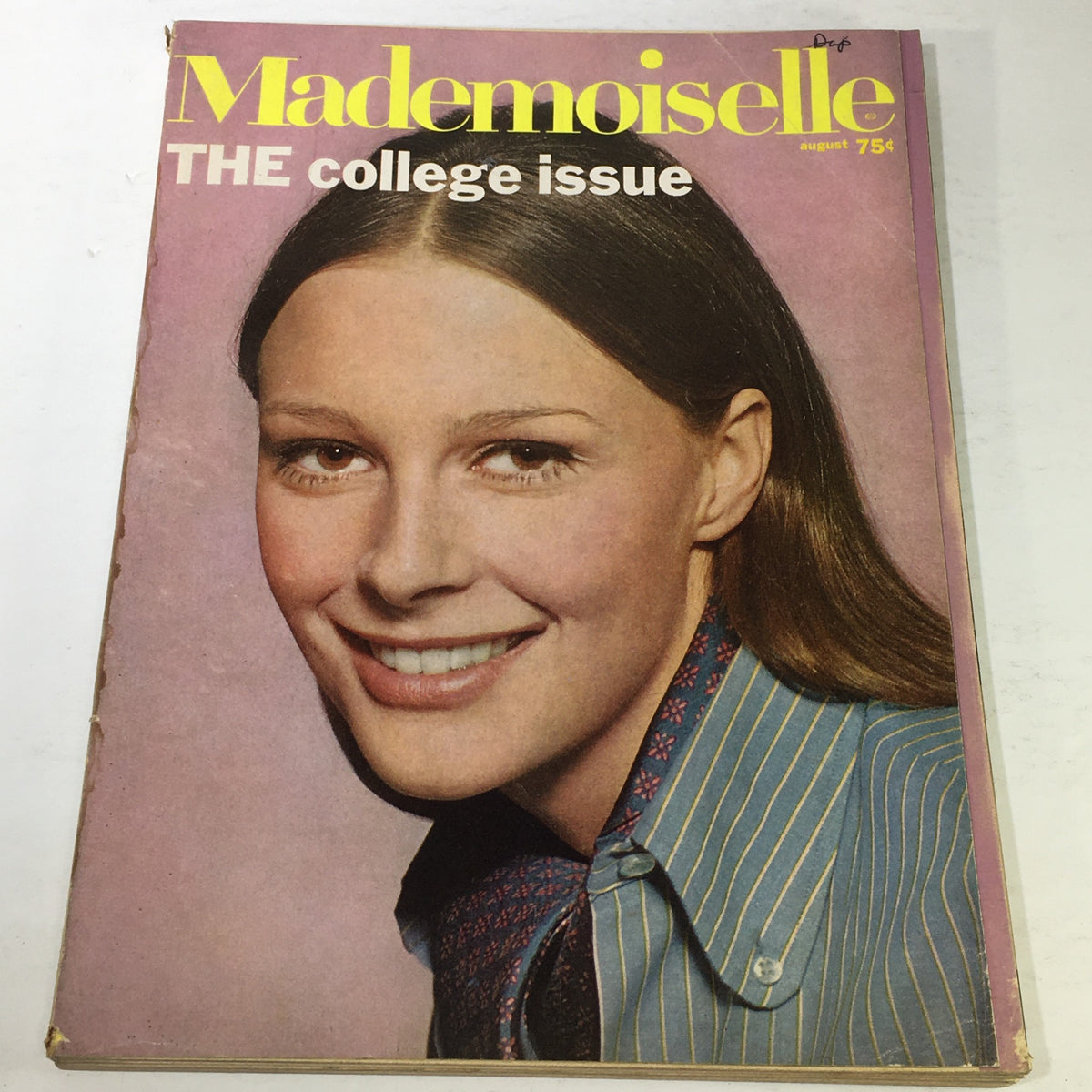
The August 1967 College Issue of Mademoiselle is one of the most historically significant recurring formats in the magazine's publishing calendar, and the August 1967 edition in particular arrives at a genuinely extraordinary moment in the history of American college life. The College Issue was an annual tradition at Mademoiselle that predated the emergence of youth culture as a distinct commercial and editorial category — the magazine had been addressing college women since its founding in 1935, and the annual College Issue was its most elaborate and most carefully considered engagement with that readership. By August 1967, however, the "college woman" that Mademoiselle was addressing inhabited a radically different world than in previous decades: the Summer of Love was unfolding in San Francisco in the exact weeks this issue would have been on newsstands, campus antiwar activism was at its most organized and visible, and the specific question of what American college life meant — aesthetically, politically, personally — was being actively contested in ways that made even a fashion magazine's college issue a document of significant cultural complexity. An August 1967 College Issue of Mademoiselle therefore captures the mainstream fashion press's engagement with campus culture at its most historically charged moment, and the specific editorial choices made within it — what to show, who to feature, what to address and what to avoid — are themselves primary evidence of the cultural negotiations the era demanded. The full arc of the magazine's engagement with college culture and its broader editorial identity across this pivotal decade is traceable through the Mademoiselle magazine collection.
The College Issue format carried a specific editorial ambition that distinguished it from standard monthly issues. Mademoiselle's College Issues were typically more substantive, more self-consciously addressed to an intelligent readership, and more willing to engage with social and cultural questions alongside the fashion content than the regular monthly issues. The magazine had a distinguished history of publishing significant literary work in its College Issues specifically — the Guest Editor program, through which college students participated in the editorial process, had produced or highlighted the work of writers including Sylvia Plath, Joan Didion, and others across the late fifties and early sixties. By August 1967, that tradition was encountering the specific pressures of a campus culture that was simultaneously the most politically activated and the most aesthetically adventurous in the magazine's history. The broader cultural context of this extraordinary year — the Summer of Love, the escalation of antiwar activism, the aesthetic revolution that was producing some of the most distinctive fashion imagery in American magazine history — is documented across the 1967 magazine collection, which brings together titles from one of the most significant years in twentieth-century American cultural history.
The no-label, newsstand origin of this College Issue is a meaningful collector distinction for a cover of this editorial and historical significance. A label-free copy preserves the full August 1967 College Issue cover design exactly as it appeared on newsstands — the complete visual statement of a publication addressing its most carefully considered annual audience at the most culturally complex moment of the decade, undisturbed by the subscription infrastructure that most surviving copies of this vintage carry permanently on their faces. The mark on the front cover and rip on the back are the honest condition attributes of an original artifact that has passed through nearly sixty years of existence, and for a College Issue whose historical significance rests primarily on its editorial content, these surface conditions are secondary to the issue's integrity as a research document.
About the Publication
Mademoiselle was a Condé Nast publication founded in 1935 and directed consistently at young, educated American women — college students, recent graduates, and young urban professionals for whom fashion was one dimension of a broader, intellectually engaged life. Its editorial identity distinguished it from competitors through a sustained commitment to literary quality alongside fashion and beauty content, with a publishing history that included notable early or significant work from writers including Sylvia Plath, Truman Capote, Joyce Carol Oates, and Cynthia Ozick. The annual College Issue was the most elaborate expression of the magazine's specific commitment to its college readership — the issue that most directly addressed the campus experience, engaged with campus culture, and reflected the specific aesthetic and intellectual concerns of the young, educated women who formed the magazine's core audience. By August 1967, that audience was living through one of the most transformative periods in the history of American higher education, and the College Issue they received reflected that transformation.
Key Highlights Inside
- The annual College Issue editorial format — Mademoiselle's most substantive and carefully considered annual offering, traditionally more intellectually ambitious and more directly engaged with campus life and culture than the regular monthly issues, published in August 1967 at the most politically and aesthetically charged moment in the history of the American college campus.
- August 1967 college fashion content — the specific clothing, styling approaches, and visual aesthetic being presented to young American women heading back to campus in the fall of the Summer of Love, capturing the specific aesthetic negotiations between the counterculture's visual revolution and the mainstream fashion press's translation of it for its college readership.
- Campus culture and lifestyle content consistent with Mademoiselle's August 1967 College Issue format — the social, personal, and cultural features addressing the specific concerns and aspirations of college women in the fall of one of the decade's most historically significant years.
- Period advertising pages representing the brands and products marketing to American college women in August 1967 — a cross-section of the commercial landscape targeting a demographic whose political and cultural engagement was reshaping American consumer culture as rapidly as it was reshaping American politics.
- Note: Specific article titles, named contributors, Guest Editor participants, and additional interior features beyond those indicated in the listing have not been confirmed from available sources. The highlights above reflect what is documented in the listing and Mademoiselle's well-established College Issue editorial format for this period.
Condition & Rarity
Surviving copies of the August 1967 Mademoiselle College Issue in collectible condition with newsstand origin are meaningful finds for collectors working on the sixties campus culture, late-sixties fashion history, or the specific literary and editorial tradition of Mademoiselle's annual College Issues. The no-label condition preserves the College Issue cover design fully intact without subscriber label obscuration — a genuine positive for a cover whose visual presentation of late-sixties campus aesthetic is itself a primary collecting reason. The mark on the front cover and rip on the back are the honest condition attributes of an original, unrestored magazine that has passed through nearly sixty years without institutional preservation; experienced collectors evaluate them as the natural patina of an authentic artifact. The protective plastic sleeve is the correct conservation measure for a publication of this age and paper stock, stabilizing further deterioration without requiring any alteration to the original item.
Looking for More Issues Like This?
A no-label newsstand copy of Mademoiselle's August 1967 College Issue is a find that rewards patient searching — the annual College Issue in surviving newsstand condition from the most historically charged year of the decade is precisely the kind of primary document that serious collectors of the sixties campus culture and the magazine's literary tradition seek out. If this particular issue is no longer available, the full Mademoiselle magazine collection at OriginalMagazines.com is the most comprehensive source for exploring other issues across the title's long and historically rich publishing history, including other College Issues from across the decade. For anyone building a broader archive of 1967's extraordinary cultural and aesthetic moment, the complete 1967 magazine collection brings together titles from one of the most visually and culturally significant years of the twentieth century.