
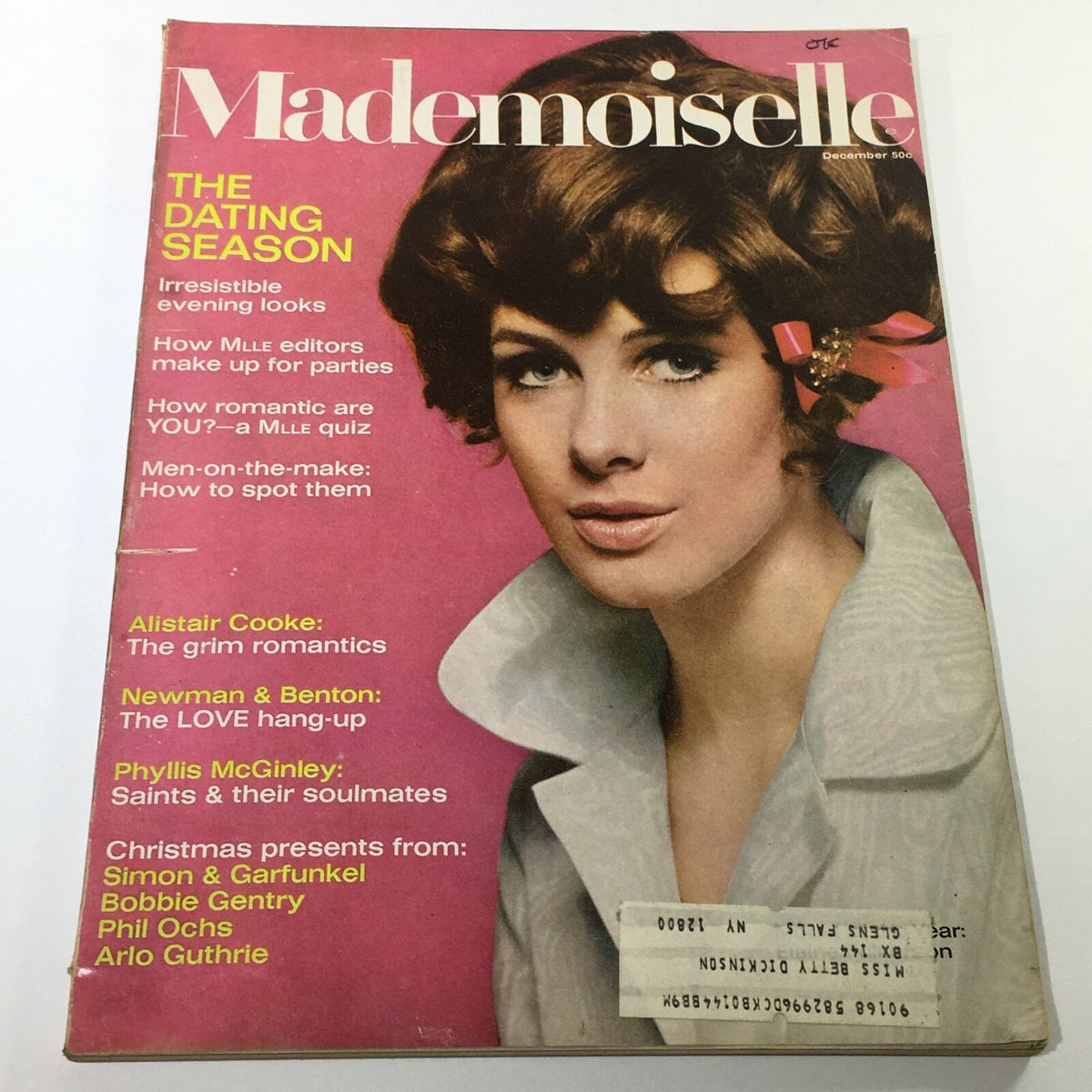

Description
Collector's Note – Why This Issue Matters
The December 1967 issue of Mademoiselle Magazine is a primary document of American popular music culture at one of its most creative and historically consequential moments — and the cover's "Christmas presents from: Simon & Garfunkel, Bobbie Gentry, Phil Ochs, Arlo Guthrie" is one of the most revealing single lines of editorial copy on any women's magazine cover of the entire decade. That Mademoiselle would organize a Christmas gift feature around four musicians as diverse as Simon & Garfunkel, Bobbie Gentry, Phil Ochs, and Arlo Guthrie in December 1967 is a primary piece of evidence about the specific cultural position that popular music occupied among young educated American women at the end of the most consequential musical year of the postwar era. The year 1967 had produced the Beatles' Sgt. Pepper's Lonely Hearts Club Band, the Monterey Pop Festival, the Summer of Love, and the emergence of a popular music culture that was now understood by the women's press as central rather than peripheral to the lives of its readership. The specific four names on this cover — the folk-pop precision of Simon & Garfunkel, the Southern Gothic mystery of Gentry's "Ode to Billie Joe," the political urgency of Phil Ochs, and the countercultural narrative humor of Arlo Guthrie's "Alice's Restaurant," which had been released just two months before this issue — collectively document the full tonal range of the music that educated young American women were listening to and gifting in December 1967. Collectors building a focused archive of Mademoiselle's most culturally specific issues will find the Mademoiselle magazine collection at OriginalMagazines.com the most comprehensive resource for issues across the publication's run.
The Alistair Cooke contribution — "The grim romantics" — deserves specific attention as another historically significant element of this cover's content. Cooke was by December 1967 one of the most respected Anglo-American cultural journalists working in print and broadcasting, and his presence in a Mademoiselle feature on romanticism reflects the specific editorial ambition that distinguished the magazine from purely fashion-focused competitors: the conviction that its readership of college-educated young women was interested in serious cultural journalism alongside the dating advice, fashion features, and beauty content that the cover also promised. A Cooke essay on "the grim romantics" in December 1967 was engaging with the specific literary and cultural atmosphere of a year whose most characteristic mood was precisely that combination of romance and darkness — the Summer of Love's idealism shadowed by the Vietnam War's escalating brutality, the counterculture's joy shadowed by its vulnerability. The "Newman & Benton" feature on "The LOVE hang-up" and Phyllis McGinley's piece on "Saints & their soulmates" complete a coherent editorial theme organized around love in its multiple registers — romantic, religious, political — that gives this December 1967 issue a surprising intellectual coherence beneath its holiday surface. The 1967 magazines collection at OriginalMagazines.com gathers publications from one of the most culturally consequential years of the entire postwar era.
The "Dating Season" theme framing the cover's fashion content — "Irresistible evening looks," "How Mlle editors make up for parties," and the "How romantic are YOU?" quiz — places this editorially ambitious issue within a genuinely warm and accessible holiday package that reflects Mademoiselle's specific gift: the ability to combine serious cultural journalism with the practical and playful content that made it genuinely useful to its readership rather than merely impressive. The juxtaposition of Alistair Cooke and "Men-on-the-make: How to spot them" on the same cover is not a contradiction but a precise statement of editorial identity — a magazine that took its readers seriously enough to offer both, without apology for either.
About the Publication
Mademoiselle was founded in 1935 and had established itself by the mid-1960s as one of the most intellectually distinguished women's fashion magazines in the United States — a publication that combined serious literary and cultural journalism with fashion, beauty, and lifestyle content in a specifically college-educated, career-oriented editorial voice that distinguished it from both the luxury positioning of Vogue and the purely practical approach of Seventeen. The magazine was notably committed to featuring significant literary and cultural figures in its pages — its College Issue had launched the careers of numerous writers, including Sylvia Plath, who served as a guest editor in 1953 — and by December 1967 this literary seriousness was being applied to the full range of 1960s cultural transformation, with popular music treated as a subject worthy of the same editorial attention the magazine gave to fiction, poetry, and criticism.
Key Highlights Inside
- "Christmas presents from: Simon & Garfunkel, Bobbie Gentry, Phil Ochs, Arlo Guthrie" — a holiday gift feature organized around four of the most culturally significant musicians of 1967, whose collective range — from folk-pop to Southern Gothic to protest music to countercultural narrative — documents the full tonal spectrum of the music that educated young American women were engaging with at the end of the decade's most musically consequential year, including Guthrie whose "Alice's Restaurant" had been released just two months earlier.
- Alistair Cooke: "The grim romantics" — an essay by one of the most respected Anglo-American cultural journalists of the era, whose presence in a December 1967 Mademoiselle reflects the magazine's consistent commitment to serious cultural journalism alongside its fashion and beauty content, engaging with the specific combination of romance and darkness that characterized the decade's most characteristic cultural mood.
- "The Dating Season" holiday fashion and beauty content — a comprehensive holiday package organized around "Irresistible evening looks," party makeup guidance from the magazine's own editors, and the relational psychology of a romantic quiz, representing the warm and accessible register that balanced the issue's more intellectually ambitious features.
- Phyllis McGinley: "Saints & their soulmates" — a feature by the Pulitzer Prize-winning poet whose wit and moral seriousness made her a frequent contributor to the kind of women's magazine journalism that took its readers' intelligence seriously, engaging with the theme of love in its most elevated and spiritually inflected register.
- "Newman & Benton: The LOVE hang-up" — a feature that, alongside the Cooke and McGinley pieces, contributes to the issue's coherent December theme of love examined across its romantic, psychological, and spiritual dimensions, giving this holiday number an intellectual depth that purely seasonal content could not achieve.
- Address label on front — confirmed subscriber copy — the subscriber address label is present on the front cover, a condition attribute that collectors will assess against the cover photographs for its position relative to the primary cover imagery, as placement in the border area has less visual impact than a label intersecting the central portrait.
Condition & Rarity
Good condition with minor edge wear, possible small rips and marks, and an address label on the front cover represents honest and expected characteristics for a fifty-eight-year-old women's monthly that circulated actively among an engaged readership. The address label visible in the cover photograph appears on the lower right area of the cover, partially obscuring the corner of the image but leaving the central portrait and the primary cover lines fully legible — a placement that has less display impact than a label centered over the primary image. Minor wear on edges and marks are standard condition attributes at this age and do not materially reduce the issue's value as a historical and cultural document when its structural integrity is sound. The plastic protective covering indicates deliberate preservation effort. For a December 1967 issue with the specific musical and cultural content documented on this cover — Simon & Garfunkel, Bobbie Gentry, Phil Ochs, and Arlo Guthrie alongside Alistair Cooke and Phyllis McGinley — condition grades in the good range retain genuine collector relevance for both fashion history researchers and popular music culture historians.
Looking for More Issues Like This?
Mademoiselle issues from the late 1960s that combined serious cultural journalism with fashion content — and the December 1967 number, with its Simon & Garfunkel to Arlo Guthrie music feature and its Alistair Cooke essay, is among the most culturally specific and most editorially revealing of the decade's run — are consistently rewarding finds for collectors who understand the magazine's specific ambition and its unique position in the women's press landscape. If you're building a collection of its most culturally instructive issues from this period, the Mademoiselle magazine collection at OriginalMagazines.com is the most comprehensive place to explore what's available. The 1967 magazines collection offers essential context from one of the most consequential years in postwar American cultural history — well worth browsing for any serious collector of the period.