


Description
Collector's Note – Why This Issue Matters
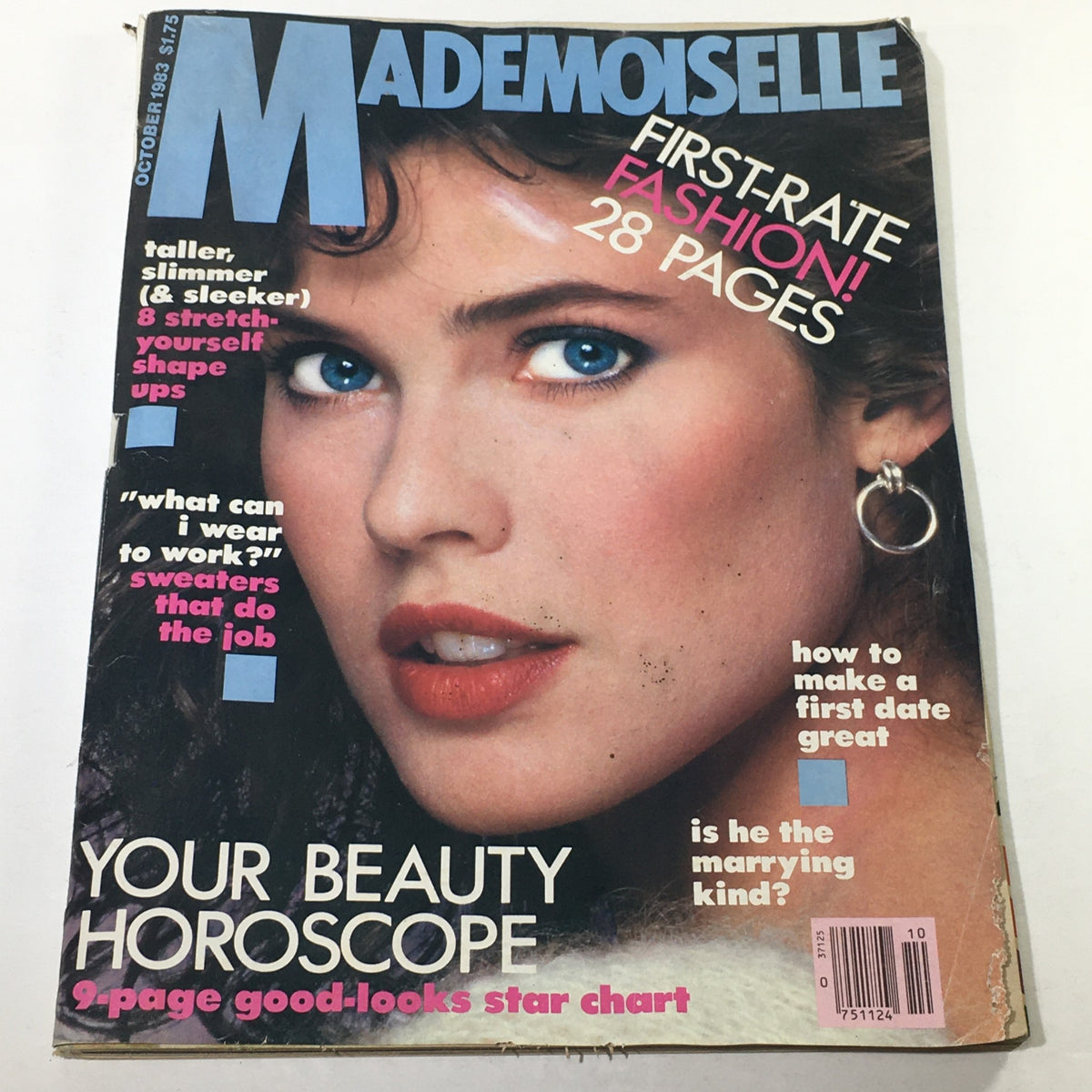
October 1983 captures Carol Alt on the cover of Mademoiselle in what was by this point becoming a familiar and commercially reliable pairing — Alt had appeared on the magazine's cover multiple times in 1983 alone, a concentration of appearances that reflects the remarkable saturation of her visibility in the American fashion magazine market during this specific year. By October 1983, Alt had accumulated more major fashion magazine cover appearances than almost any model of her generation, her Sports Illustrated swimsuit success had made her a crossover celebrity, and the specific combination of classical American beauty and athletic physique she represented had become one of the defining visual templates of the early-eighties fashion moment. An October fall issue with Alt on the cover was a statement of seasonal authority — the magazine's editorial judgment that her face was the appropriate representative of what fall 1983 fashion looked like and aspired to. For collectors building a comprehensive archive of her extensive cover career across the decade's major publications, the Carol Alt magazine archive provides the most systematic resource for tracking her appearances, and this October issue represents a later-in-the-year entry in what was one of the most dense single-year cover runs of the early-eighties modeling era.
October 1983 as a fashion season sits at the mid-point of the decade's most assertive and commercially confident aesthetic phase. The early-eighties vocabulary had by this point fully consolidated: power dressing was doctrine, the fitness-influenced body ideal was reshaping both clothing design and beauty standards, and the color and photographic sensibility of the era had achieved the immediately recognizable quality that distinguishes it from what came before and after. A fall Mademoiselle from October 1983 was the magazine's seasonal statement to a readership of young, college-educated American women whose professional aspirations and personal style were both being shaped by the decade's particular cultural moment — the Reagan-era combination of economic confidence, aesthetic assertiveness, and career-focused ambition that made the early-to-mid eighties one of the most coherent cultural periods of the postwar era. The 1983 magazine collection provides the cross-title context that makes this issue's specific editorial choices legible within the larger publishing conversation of a year that defined the decade's midpoint. The broader context of the magazine's early-eighties publishing identity is traceable across the Mademoiselle magazine collection, which documents the publication's evolving cover aesthetic and editorial approach across the decade.
The loose binding noted in this listing is a condition attribute worth specific attention for collectors of early-eighties Mademoiselle issues. These magazines were produced with staple binding that is susceptible to stress over four decades of storage, and loose binding can range from a slightly weakened staple connection to a more actively separating page block — the difference matters significantly for the issue's long-term structural stability and its suitability for reading versus display purposes. The provided photographs are the essential reference for assessing the degree of binding stress, as its extent determines whether the issue is better characterized as display-quality, research-quality, or primarily a completionist-collecting artifact.
About the Publication
Mademoiselle was a Condé Nast publication founded in 1935 and directed consistently at young, educated American women — college students, recent graduates, and young urban professionals for whom fashion was one dimension of a broader, intellectually engaged life. Its editorial identity distinguished it from competitors through a sustained commitment to literary quality alongside fashion and beauty content, with a publishing history that included notable early or significant work from writers including Sylvia Plath, Truman Capote, Joyce Carol Oates, and Cynthia Ozick. By October 1983 it was navigating the early-eighties cultural transformation with nearly five decades of publishing experience behind it, its editorial voice balancing the career-focused aspirations of its readership with the fashion and beauty authority that had always been central to its identity. Its early-eighties issues are collected both for their fashion documentation and for their record of how a serious women's publication was speaking to an audience whose professional and personal expectations were being reshaped by the decade's particular combination of economic ambition and stylistic assertiveness.
Key Highlights Inside
- Carol Alt October 1983 fall cover — one of multiple Mademoiselle cover appearances by Alt in the same calendar year, documenting the peak of her commercial visibility and the magazine's editorial endorsement of her as the face most representative of fall 1983 fashion at a moment when the decade's aesthetic was operating at its most confident and fully realized.
- Fall 1983 fashion editorial content — the silhouettes, colors, fabrics, and styling approaches that defined the early-eighties aesthetic in its fall expression, presented through Mademoiselle's characteristic combination of aspirational photography and practical guidance aimed at the college-educated young professional woman of the era.
- Beauty and lifestyle content consistent with Mademoiselle's October 1983 fall format — the seasonal beauty directions and practical lifestyle features that addressed the early-eighties young woman's particular concerns and aspirations at a moment when the decade's defining aesthetic values were being communicated with full commercial and cultural confidence.
- Period advertising pages representing the fashion, beauty, and lifestyle brands marketing to young American women in the fall of 1983 — a primary document of early-eighties consumer culture that reflects the specific commercial landscape of a decade defined by brand-consciousness, fitness culture, and the aesthetics of professional aspiration.
- Note: Specific article titles, bylines, fiction contributors, and additional named interior features beyond those indicated in the listing have not been confirmed from available sources. The highlights above reflect what is documented in the listing and Mademoiselle's well-established editorial format for this period.
Condition & Rarity
Surviving copies of the October 1983 Mademoiselle carry a condition profile that requires careful evaluation from collectors, and this issue has several specific attributes that warrant direct attention. Edge and binding wear alongside marks on the front cover are expected and honest attributes of an original, unrestored magazine that has passed through four decades without institutional preservation. The loose binding is a more specific structural concern that the provided photographs are the essential reference for assessing — its degree will determine whether the issue is stable enough for regular handling or whether it requires careful archival treatment to prevent further separation. The no-label, newsstand origin is a genuine positive within this condition context: the Carol Alt cover image survives without subscriber label obscuration, preserving the full photographic composition as originally designed. The protective plastic sleeve is the appropriate conservation measure for a magazine of this age and construction, stabilizing further surface deterioration, though it does not address underlying binding stress. Collectors should evaluate this issue's condition profile against their specific collecting purposes — display, research, or completionist archiving — before assessing its suitability for their collection.
Looking for More Issues Like This?
A no-label newsstand copy of Mademoiselle's October 1983 issue with Carol Alt on the cover is a significant entry in the year's most concentrated single-model cover run of the early-eighties era, and collectors building a comprehensive Alt archive or an early-eighties Mademoiselle run will want to account for this fall issue alongside the spring and summer appearances from the same year. If this particular issue is no longer available, the Carol Alt magazine collection is the best starting point for finding other cover appearances that document her career across the decade's major titles. The full Mademoiselle magazine archive covers the complete run of the title, and the 1983 magazine collection provides the broader context for anyone building an archive of the early-eighties cultural and fashion moment across multiple publications.