

Description
Collector's Note – Why This Issue Matters
September 1964 is one of the most significant dates in the annual publishing calendar of any major American women's fashion magazine, and for Mademoiselle specifically, the Fall Fashion Issue represented the editorial counterpart to the spring College Issue — the year's second great seasonal statement, arriving as summer ended and the fashion industry's most important selling season began. The fall 1964 collections documented in this issue were being presented at a moment of unusual creative energy in American and European fashion: the mod revolution originating in London was beginning to make serious inroads into American mainstream style, hemlines were in active negotiation, and the color and graphic sensibility that would define the decade's most iconic imagery was fully emerging. A September fall fashion issue from this precise moment captures the aesthetic transition between the early sixties and the high-sixties look that would dominate 1965 through 1968, making it a primary document for fashion historians and researchers tracking that shift in real time rather than in retrospect. The broader publishing context of this pivotal year is well documented across the 1964 magazine archive, which brings together multiple titles from a year that sits at a genuine turning point in both American fashion history and American social history.
The September 1964 issue also arrives in a politically and culturally charged moment that gives its fashion content additional historical texture. The Civil Rights Act had been signed into law just two months earlier, in July 1964, and the presidential election between Lyndon Johnson and Barry Goldwater was weeks away — an election whose outcome would shape the legislative agenda of the following years more decisively than almost any other postwar contest. The young, college-educated women who were Mademoiselle's core readership were living through these events while simultaneously navigating the transition back to campus that September represented, and the magazine's fall fashion coverage existed within that context whether or not it addressed it directly. The gap — or the connection — between the aspirational world of fall fashion and the turbulent world its readers were inhabiting is precisely what makes a September 1964 Mademoiselle a richer document than it might appear at first glance. The full scope of the magazine's editorial voice across this period is visible in the Mademoiselle magazine collection, which allows collectors to trace how the publication navigated the decade's increasing complexity issue by issue.
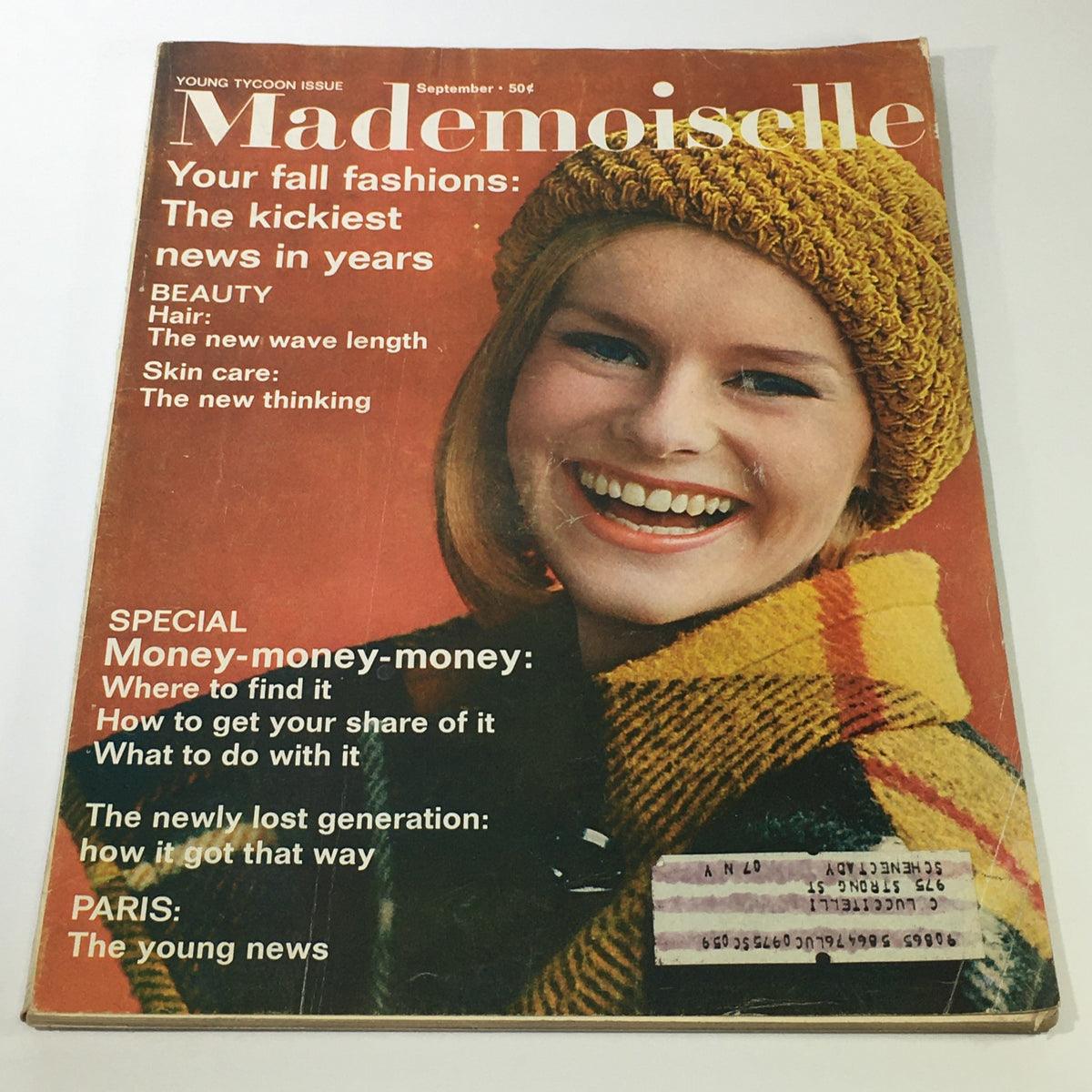
The Fall Fashion Issue format gave September editions of Mademoiselle a physical and editorial substance that exceeded standard monthly issues. Fall fashion issues typically ran longer, carried more advertising, and featured more elaborate photography than routine months — the industry invested heavily in these issues because they drove the most significant retail activity of the year. A surviving September 1964 copy is therefore a more substantial physical artifact than a typical month's edition, reflecting the full weight of the fashion industry's fall 1964 creative and commercial efforts in a single volume. The address label on the front cover identifies this as a subscription copy, mailed directly to a reader who was heading into or returning from a summer in 1964 — a provenance detail that connects the physical object to its original moment of receipt with unusual specificity.
About the Publication
Mademoiselle was a Condé Nast publication founded in 1935 and directed consistently at young, educated American women — college students, recent graduates, and young urban professionals for whom fashion was one dimension of a broader, intellectually engaged life. Its editorial identity distinguished it from competitors through a genuine and sustained commitment to literary quality alongside fashion and beauty content, with a publishing history that included notable early or significant work from writers including Sylvia Plath, Truman Capote, Joyce Carol Oates, and Cynthia Ozick. By September 1964 the magazine was twenty-nine years into its publishing history and had developed a fall fashion issue tradition that was among the most anticipated annual events in its editorial calendar — a richly produced, visually ambitious issue that documented the season's most important trends and served as both a fashion resource and a cultural record for the young women who formed its loyal readership.
Key Highlights Inside
- The full Fall Fashion Issue editorial package for 1964 — Mademoiselle's most visually ambitious seasonal format, documenting the fall collections and trend directions at a moment when American fashion was absorbing the full initial impact of the mod revolution and moving toward the high-sixties aesthetic that would define the decade's most iconic imagery.
- Fall 1964 fashion editorial content covering the silhouettes, fabrics, colors, and styling approaches that defined the transitional aesthetic of this specific season — the precise moment when early-sixties collegiate restraint was giving way to the bolder, more experimental visual language that would characterize 1965 and beyond.
- Beauty and lifestyle content consistent with Mademoiselle's September 1964 editorial format — the fall beauty preview and lifestyle features addressing the concerns and aspirations of the young, college-educated American woman heading into the fall semester of one of the most consequential academic years of the postwar era.
- Period advertising pages representing the fashion, beauty, and lifestyle brands investing in Mademoiselle's fall issue audience in September 1964 — a cross-section of early-sixties consumer culture at its most concentrated seasonal moment that functions today as its own primary document alongside the editorial content.
- Note: Specific article titles, bylines, fiction contributors, and additional named interior features beyond those indicated in the listing have not been confirmed from available sources. The highlights above reflect what is documented in the listing and Mademoiselle's well-established editorial format for its annual Fall Fashion Issue during this period.
Condition & Rarity
Surviving copies of the September 1964 Mademoiselle Fall Fashion Issue display the characteristic condition profile of a subscription-origin periodical that has passed through six decades without archival preservation. The address label on the front cover identifies this as a subscription copy — a distinction that experienced collectors weigh carefully, as the label partially obscures the original cover design and distinguishes it from the label-free newsstand copies that display-focused collectors typically prefer. Minor edge wear, potential rips or marks, and the general patina of sixty years are expected and honest attributes of an original, unrestored magazine from this vintage, and experienced collectors read them as evidence of authenticity rather than as meaningful detractions. Fall Fashion Issues, which tended to run longer and more heavily produced than standard monthly editions, can be more prone to binding stress and spine wear over decades of storage due to their greater page count and weight. The protective plastic sleeve on preserved copies is the correct conservation measure for a magazine of this age and paper stock, stabilizing further deterioration from handling and environmental exposure without requiring any alteration to the original item.
Looking for More Issues Like This?
A September 1964 Mademoiselle Fall Fashion Issue in good condition is a genuinely substantive find — the fall fashion issues were among the most richly produced entries in the magazine's annual calendar, and sixty-year-old copies with intact page blocks and displayable covers surface less frequently than their original print runs would suggest. If this particular issue is no longer available, the full Mademoiselle magazine collection at OriginalMagazines.com is the most comprehensive source for exploring other issues across the title's long publishing history, with strong representation in the sixties decades that collectors and fashion researchers prioritize most highly. For anyone building a broader archive of the mid-sixties moment, the complete 1964 magazine collection brings together fashion, culture, news, and lifestyle titles from a year that stands as one of the genuine turning points in twentieth-century American history.