



Description
Collector's Note – Why This Issue Matters
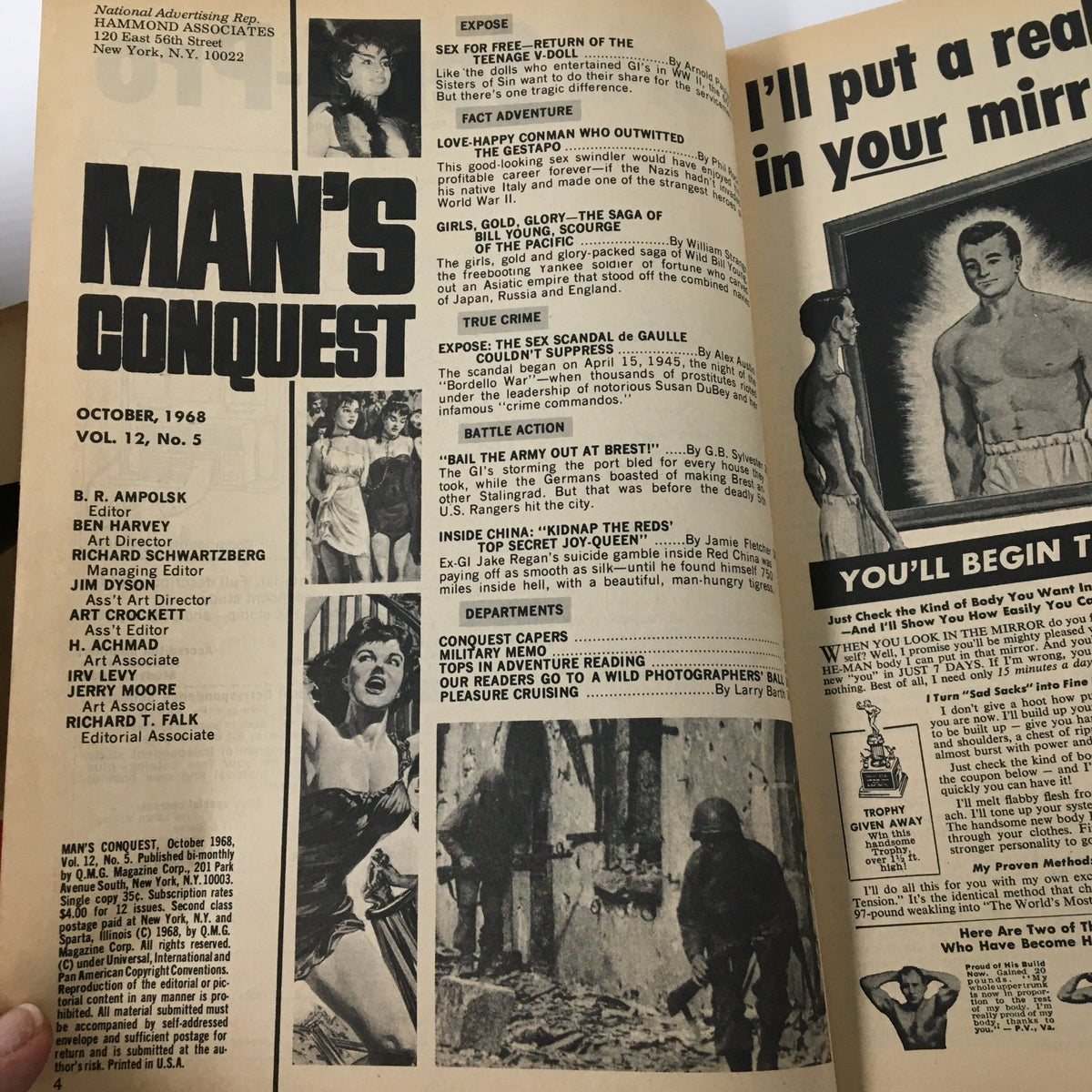
The October 1968 issue of Man's Conquest Magazine, with its "Inside China" and "Kidnap the Reds" cover stories, is a primary document of American men's adventure magazine journalism at one of the most historically charged moments of the Cold War era. October 1968 falls in the final weeks of one of the most tumultuous years in modern American history — the Tet Offensive had shaken American confidence in the Vietnam War in February, Martin Luther King Jr. and Robert Kennedy had been assassinated in April and June, the Democratic National Convention had erupted in violence in August, and the Nixon-Humphrey presidential election was just weeks away. The specific geopolitical framing of the cover stories — China and the Reds — reflects the specific Cold War anxieties of 1968 with precision. The Cultural Revolution in China was at its most destructive and chaotic phase, with Mao's Red Guards having dismantled China's institutional structures and with the country operating as a deeply opaque and threatening presence in the American strategic imagination. The "Inside China" framing promised readers access to a country that was genuinely impenetrable to Western journalism in 1968, and the "Kidnap the Reds" story reflects the specific genre conventions of men's adventure publishing — the fantasy of direct, violent American action against Communist adversaries — that gave these publications their specific readership appeal. Collectors building a focused archive of Cold War American popular culture and the men's adventure magazine genre will find that 1968 magazine issues document one of the most historically extraordinary years in American political and cultural life with the primary source immediacy that contemporaneous journalism uniquely provides.
The men's adventure magazine genre that Man's Conquest inhabited deserves recognition as a specific and historically significant category of American popular publishing that is increasingly studied by cultural historians. Publications in this genre — which flourished from roughly the late 1940s through the early 1970s — combined geopolitical adventure narratives, World War II combat stories, Cold War thriller content, and the masculine self-assertion that the genre's readership found emotionally satisfying. They were consumed primarily by working-class and lower-middle-class male readers who were not the target audience for more prestigious general interest publications, and their editorial content reflected both the genuine anxieties of the Cold War period and the specific fantasies that those anxieties generated — fantasies of American competence, direct action, and superiority over Communist adversaries. The "Inside China" and "Kidnap the Reds" stories in October 1968 are primary documents of those fantasies at a specific historical moment when the actual American experience of confronting Communist adversaries in Vietnam was producing precisely the opposite narrative — one of frustration, attrition, and mounting doubt about American invincibility. The genre's fantasy of direct, successful action against Communist enemies in late 1968 carries a specific resonance in relation to the actual news of the war that surrounded this issue's publication and readership.
Man's Conquest and publications like it also functioned as vehicles for a specific kind of journalism that is genuinely valuable as historical documentation despite its sensationalized framing. The articles about China and Soviet-bloc adversaries published in men's adventure magazines in the late 1960s drew on a combination of actual intelligence reporting, informed speculation, defector accounts, and the synthesis of publicly available geopolitical analysis into a popular narrative form. The result was not always accurate, but it documented what American popular understanding of these adversaries looked like — what the reading public was being told and what they were prepared to believe — in ways that complement the more carefully sourced reporting of mainstream journalism with a direct window into how the Cold War was imagined at the popular level.
About the Publication
Man's Conquest Magazine was an American men's adventure publication operating in the mid-twentieth-century genre that combined geopolitical thriller content, World War II combat narratives, Cold War adventure stories, and the masculine action fantasy that defined the category. Its editorial format combined sensationalized first-person adventure accounts, geopolitical analysis presented in accessible and dramatic narrative form, and the visual content of wartime and adventure photography that gave the genre its immediate impact on newsstands. Its readership was primarily working-class and lower-middle-class American men who consumed the genre for entertainment and the emotional satisfaction of narratives in which American men confronted and overcame the Communist and other adversaries whose threat defined the Cold War era's masculine imagination.
Key Highlights Inside
- "Inside China" feature — Cold War journalism engaging with the most opaque and threatening Communist adversary in the American strategic imagination of 1968, during the Cultural Revolution's most chaotic phase when genuine information about China's internal conditions was almost entirely unavailable to Western observers, reflecting the men's adventure genre's promise of inside access to forbidden knowledge.
- "Kidnap the Reds" cover story — a primary document of the men's adventure genre's specific fantasy of direct American action against Communist adversaries, appearing in October 1968 at the precise moment when the actual American experience of the Vietnam War was generating its maximum disillusionment about the reality of confronting Communist enemies in the field.
- October 1968 publication date — placing this issue at one of the most historically extraordinary moments in American political life, in the final weeks of the tumultuous year that had included the Tet Offensive, two assassinations, the Democratic convention violence, and the approaching Nixon-Humphrey election that would shape American politics for the subsequent decade.
- Newsstand origin confirmed by the absence of a mailing label — a meaningful collector attribute for a men's adventure publication from this period, preserving the full integrity of the cover without adhesive damage and documenting the retail circulation pathway through which the genre's readership was primarily reached.
- Note: Specific additional article titles, authors, and other editorial content beyond what is indicated by the cover stories and listing description are unconfirmed for this issue. The above reflects what is verifiable from the publication, cover story titles, date, and the documented historical context of American Cold War popular culture in October 1968.
Condition & Rarity
Good condition with minor wear throughout is an honest and appropriate assessment for a Man's Conquest Magazine from October 1968 now more than fifty-five years old. Good condition accurately describes a publication that retains its structural integrity, legible cover image, and complete interior content despite the expected physical aging of paper across more than five decades of storage and handling. Men's adventure magazines of this era were produced on relatively modest paper stock and distributed through the newsstand channels that subjected them to the handling typical of popular periodicals, and minor wear for a publication of this age is the honest record of that history rather than evidence of inadequate preservation. The newsstand origin confirmed by the absence of a label preserves the full surface integrity of the cover without adhesive damage. A protective plastic covering applied to a surviving copy indicates deliberate preservation intent appropriate for a publication being maintained as a collectible artifact of Cold War American popular culture.
Looking for More Issues Like This?
Men's adventure magazine issues from late 1968 with Cold War geopolitical cover stories documenting the specific anxieties and fantasies of one of the most historically turbulent years in American political life are among the more atmospherically specific and historically interesting finds in the mid-century popular magazine collector market — a genre that is increasingly studied by cultural historians as a primary document of how the Cold War was imagined and consumed at the popular level. Collectors building a comprehensive picture of 1968 across American popular culture, political journalism, and the full spectrum of the newsstand press will find the complete 1968 magazine collection an invaluable resource for locating other titles and issues that document this extraordinary year from the multiple perspectives that serious historical research requires.