


Description
Collector's Note – Why This Issue Matters
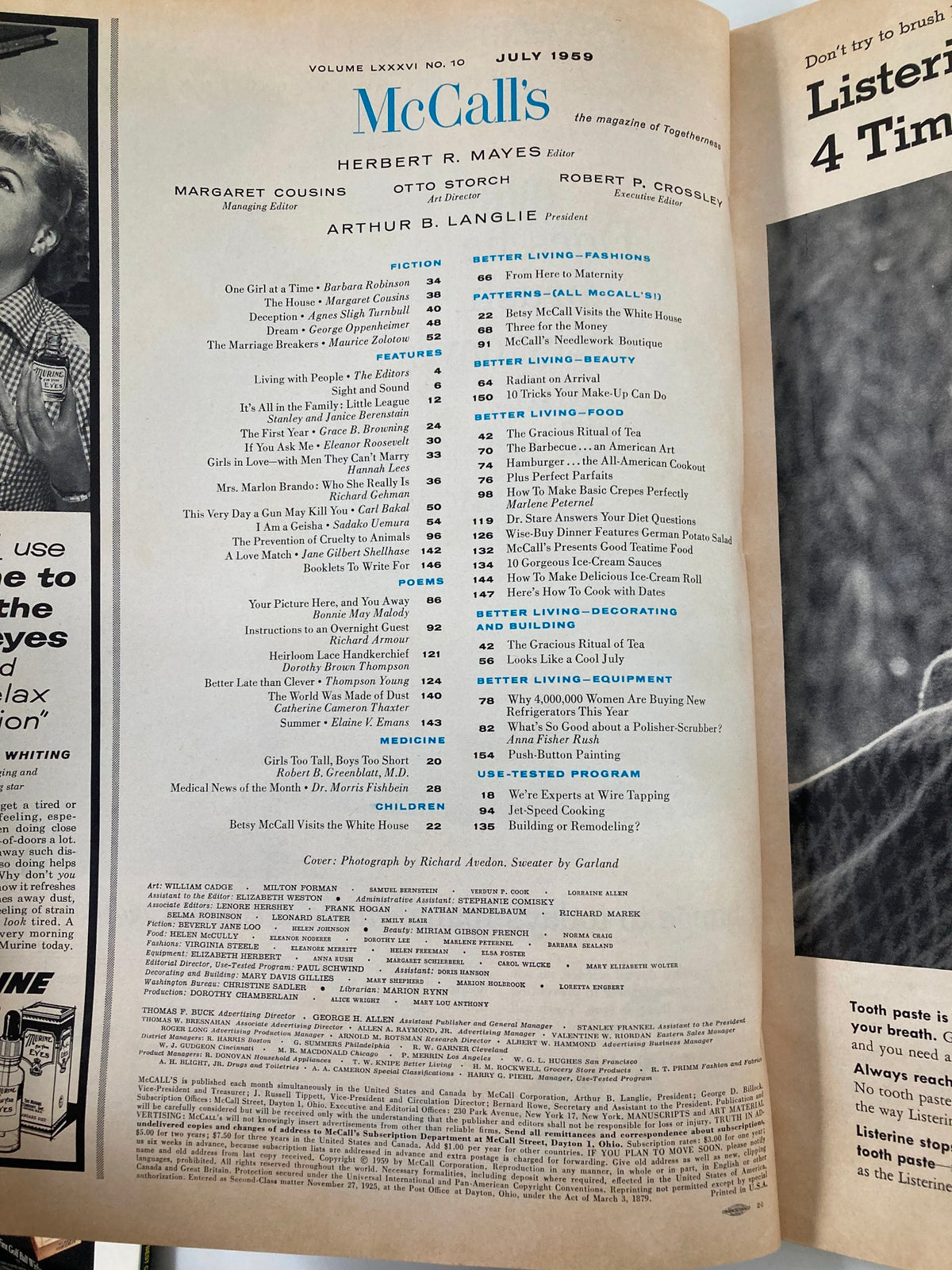
The July 1959 issue of McCall's, Volume 86, Number 10, carries Eleanor Roosevelt's long-running "If You Ask Me" column at a point when it had already been a fixture of the magazine for a full decade. Roosevelt had brought the column to McCall's in June 1949 after originating it at Ladies' Home Journal in 1941, and she would continue writing it without interruption until her death in November 1962, making this July 1959 installment one of several hundred columns she produced over more than two decades of answering reader questions on everything from politics and civil rights to marriage, religion, and parenting. The column's enduring format, drawn from real reader letters and answered with a candor unusual for a public figure of her stature, gave McCall's a genuine point of editorial distinction among the era's women's magazines, and this issue captures that feature in the middle of Roosevelt's final, most settled years writing it.
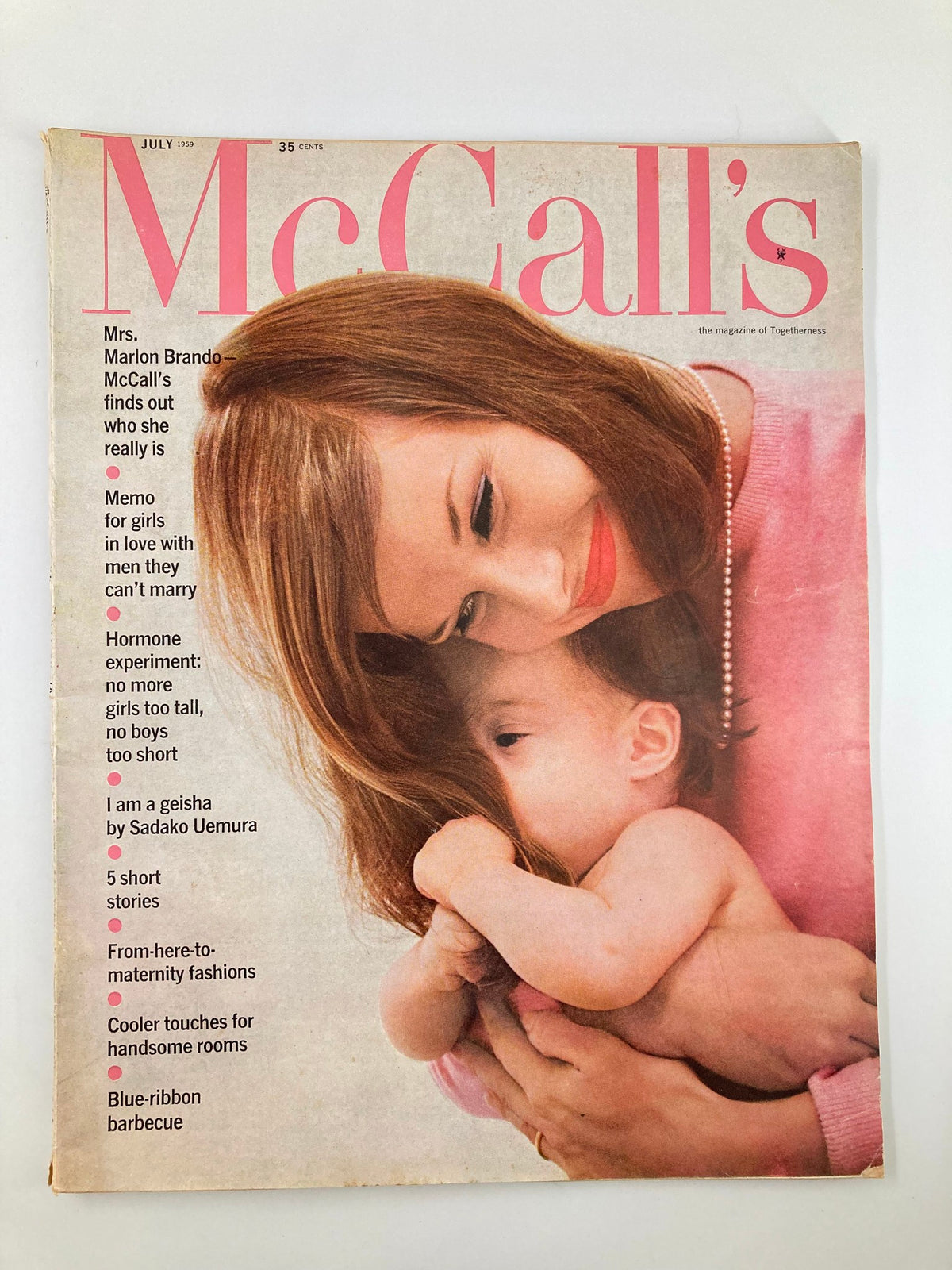
This issue's feature "Mrs. Marlon Brando: Who She Really Is," by Richard Gelman, arrived at an unusually well-timed moment relative to the real-life drama it covered. Brando's first wife, actress Anna Kashfi, had divorced him just months earlier, with the split finalized on April 22, 1959, following a tempestuous eleven-month marriage marked by public disputes and a bitter, ongoing custody battle over their infant son, Christian. Kashfi's own background had been a subject of considerable public fascination and confusion since before her marriage, since she had built her early Hollywood career on a claimed Indian heritage that a Welsh couple publicly disputed shortly after her wedding, asserting she was in fact their daughter, Joan O'Callaghan, born and raised in Cardiff. A feature promising to reveal "who she really is," published just three months after her headline-making divorce from one of the biggest movie stars in the world, situates this issue squarely within the celebrity press coverage of one of the more sensational Hollywood marriages and divorces of the late 1950s.
The issue's broader contents reflect McCall's well-established mid-century format of pairing substantial fiction with the kind of practical "Better Living" service journalism the magazine had built its identity around. The fiction lineup includes the title story "One Girl at a Time" by Barbara Robinson, alongside contributions from established names including Agnes Sligh Turnbull and Maurice Zolotow, while the magazine's lighter "It's All in the Family" feature on Little League was written by Stanley and Janice Berenstain, the husband-and-wife team who would go on to create the Berenstain Bears children's book series beginning in 1962, making this a notable early example of their published work predating their best-known creation by several years.
For collectors, this issue offers a particularly rich snapshot of late-1950s American women's magazine publishing, combining a historically significant ongoing feature from a former First Lady, a celebrity story tied to real, dateable Hollywood news, fiction from established mid-century writers, and an early published credit from creators who would later become major figures in American children's publishing, all within a single issue's covers.
About the Publication
McCall's traced its origins to 1873, when it was founded as The Queen, a pattern-focused publication tied to the McCall Pattern Company, before evolving over subsequent decades into one of the major general-interest women's magazines of twentieth-century America. By the mid-twentieth century, the magazine had established itself as one of the so-called "Seven Sisters" of American women's service magazines, alongside titles including Good Housekeeping, Ladies' Home Journal, and Redbook, distinguished by a format combining substantial short fiction and serialized novels with practical "Better Living" content covering food, fashion, beauty, decorating, and household equipment. The magazine's decision to bring on Eleanor Roosevelt as a columnist in 1949, securing her from Ladies' Home Journal where "If You Ask Me" had originated in 1941, reflected McCall's ambition to position itself as a publication willing to engage readers on substantive political and social topics alongside its more conventional domestic content. The magazine's editorial approach throughout the 1950s combined this kind of serious content with lighter celebrity coverage and entertainment features, a balance clearly reflected in this July 1959 issue's pairing of Roosevelt's column with its Anna Kashfi feature. McCall's circulation grew substantially during this period, and the magazine continued to compete directly with its fellow "Seven Sisters" titles for the attention of mid-century American women navigating marriage, motherhood, and household management. The magazine would continue publication for decades afterward, undergoing various editorial transformations before ceasing publication in 2002 when it was merged into Rosie magazine. For collectors, this late-1950s period represents McCall's at a high point of its cultural relevance, combining substantive political commentary, celebrity journalism, and the practical service content that defined the broader "Seven Sisters" category of American women's publishing.
Key Highlights Inside
- "If You Ask Me" by Eleanor Roosevelt, the former First Lady's long-running reader question-and-answer column, which ran continuously in McCall's from June 1949 until her death in November 1962. This July 1959 installment falls within the well-documented, decades-long run of one of the most historically significant advice columns in American magazine history.
- "Mrs. Marlon Brando: Who She Really Is" by Richard Gelman, a feature on actress Anna Kashfi published roughly three months after her highly publicized April 1959 divorce from Marlon Brando. The piece arrived amid ongoing public fascination with Kashfi's disputed ethnic background and the bitter custody battle over her and Brando's infant son.
- "One Girl at a Time," the issue's title fiction piece by Barbara Robinson, appearing alongside short stories from established contributors including Agnes Sligh Turnbull, Margaret Cousins, George Oppenheimer, and Maurice Zolotow, reflecting McCall's substantial commitment to short fiction during this period.
- "It's All in the Family: Little League" by Stanley and Janice Berenstain, an early published feature from the husband-and-wife illustrating and writing team who would go on to create the long-running Berenstain Bears children's book series beginning in 1962, several years after this issue's publication.
- Extensive "Better Living" service content spanning food, fashion, beauty, and home equipment, including features on summer entertaining, barbecue cooking, and a notable piece on the surge in refrigerator sales titled "Why 4,000,000 Women Are Buying New Refrigerators This Year," reflecting the consumer appliance boom of the late 1950s.
- A cover photograph by Richard Avedon, reflecting the use of major fashion photographers for magazine cover work that was increasingly common among leading women's titles during this period.
Condition & Rarity
Surviving copies of late-1950s McCall's issues are generally evaluated using collector standards consistent with other glossy monthly periodicals of the era. The absence of a mailing label on this copy indicates it likely reached its original owner through newsstand purchase rather than subscription delivery, a trait collectors typically favor since it preserves the Avedon cover photograph and masthead without obstruction from address labels or adhesive residue. Beyond label status, the central considerations for a periodical now over sixty-five years old are the completeness of interior pages, the condition of the binding, and whether the spine has held up without significant cracking or separation. Magazines from this era were generally produced on moderately glossy stock that holds up reasonably well against brittleness compared to earlier mid-century periodicals, though cover color and photographic sharpness can still fade or dull if a copy was exposed to direct light over an extended period. Collectors also look for creasing, corner wear, and any soiling that may have accumulated during decades of storage, along with whether any patterns or inserts referenced in the issue's "Patterns" section remain intact, since McCall's was historically tied to its pattern-company origins and complete pattern inserts are sometimes specifically sought by collectors. Protective plastic sleeving, as provided with this copy, represents a sensible and standard precaution for preserving a periodical of this vintage against further handling wear. Given this issue's combination of a historically significant Eleanor Roosevelt column and a well-timed celebrity feature on Anna Kashfi, well-preserved surviving copies hold particular interest for collectors of both political and entertainment history ephemera, beyond the general collector interest in vintage McCall's issues.
Looking for More Issues Like This?
Original issues of McCall's magazine carrying Eleanor Roosevelt's "If You Ask Me" column are a genuinely significant area for collectors interested in her postwar career and her long-running relationship with American readers across more than two decades of monthly columns. The broader McCall's collection offers a useful resource for tracing how the magazine's content evolved across different decades, situating this issue within a much longer publishing history that spans the magazine's origins as a pattern company publication through its years as one of the "Seven Sisters" of American women's magazines. Readers drawn to this issue's Anna Kashfi feature may also find related interest in other late-1950s entertainment magazines covering the Brando-Kashfi divorce and its aftermath, given how extensively the story was covered across the era's celebrity press. For collectors building a year-specific archive rather than a title-specific one, the 1959 magazines collection offers a wider cross-section of what was being published that year across multiple titles and genres, situating this issue within the broader media landscape of the period. Browsing other 1959 titles can offer useful context for how different publications covered the year's major political and entertainment stories alongside this particular issue's mix of content. Because magazines of this vintage were not always systematically archived, locating specific issues in strong surviving condition can require some persistence. Both the McCall's and 1959 collections are reasonable starting points for collectors pursuing either a title-focused or year-focused approach to material from this era.