
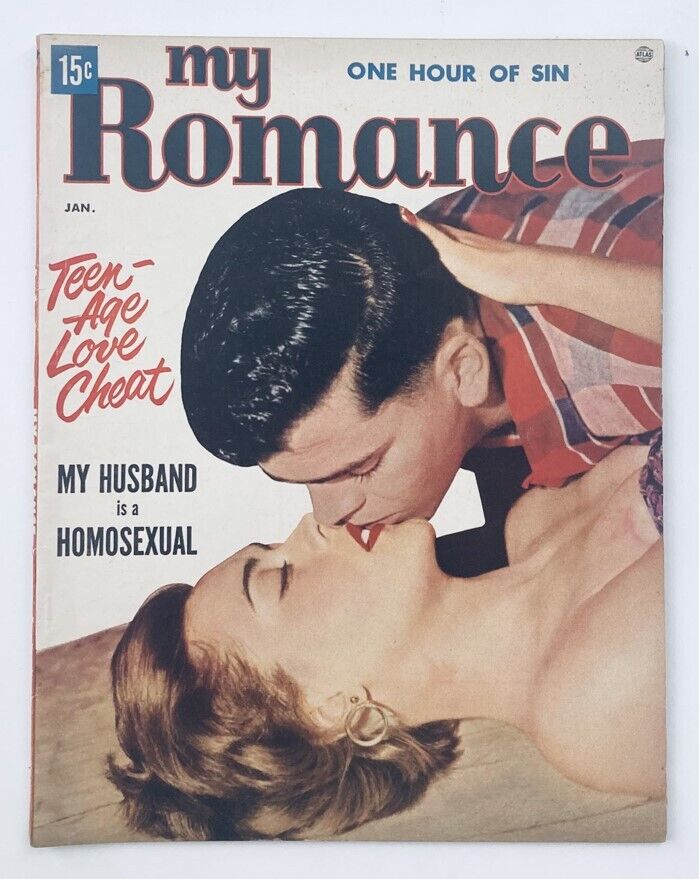
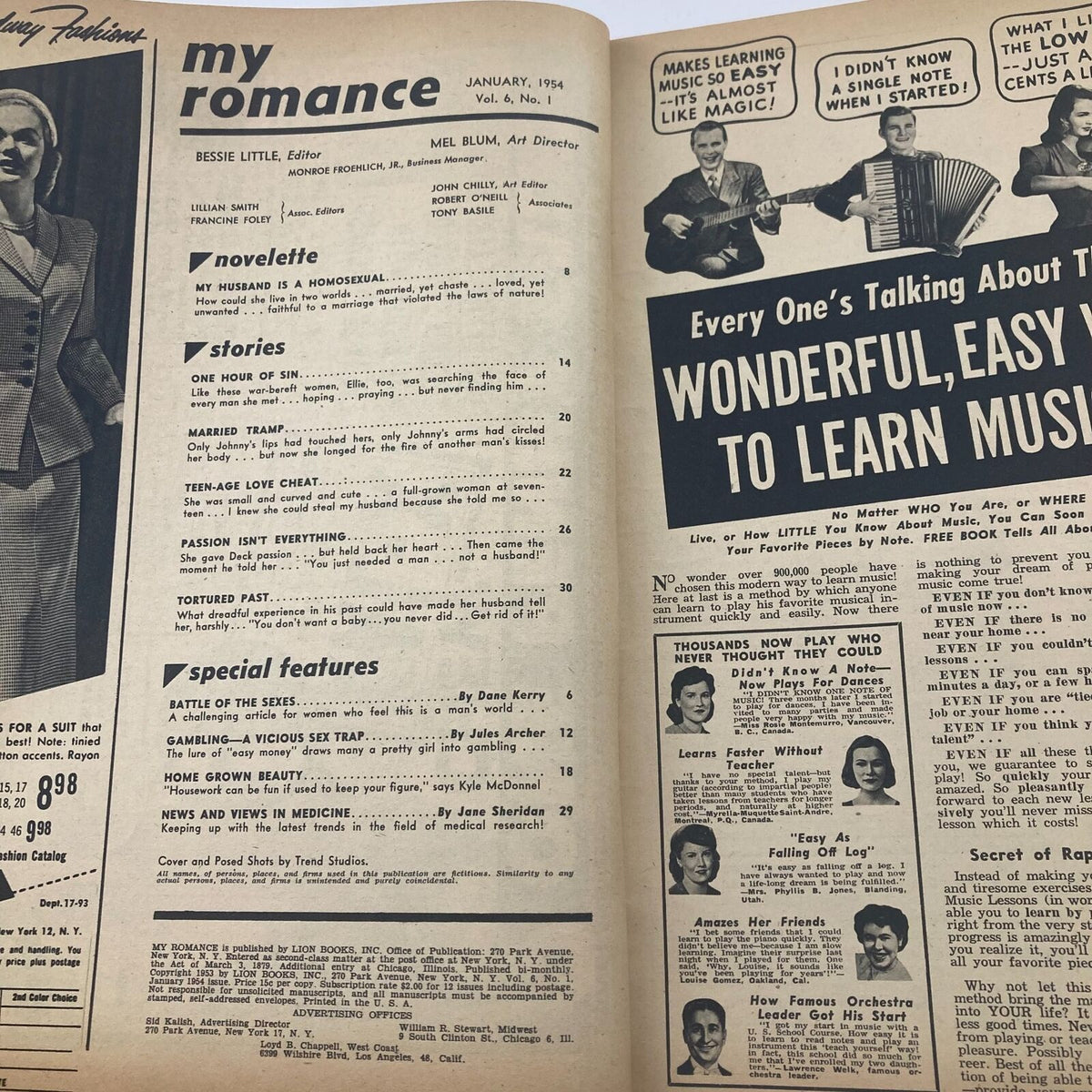


Description
Collector's Note – Why This Issue Matters
The January 1954 issue of My Romance Magazine, featuring the article "My Husband is a Homosexual," is a primary document of one of the most consequential and least-discussed dimensions of mid-twentieth-century American social history: the lived experience of gay men and their wives in a period of intense legal, medical, and social persecution of homosexuality. In January 1954, American gay men faced criminalization under sodomy laws in every state, psychiatric classification as mentally ill under the American Psychiatric Association's Diagnostic and Statistical Manual (first published in 1952), and active persecution under the federal government's security clearance system, which had expanded its targeting of gay employees under the Eisenhower administration's Executive Order 10450, signed in April 1953. The "Lavender Scare" that accompanied McCarthyism had resulted in thousands of federal employees being dismissed on grounds of homosexuality, and the social pressure on gay men to marry women and maintain heterosexual appearances was at its maximum intensity in precisely this historical moment. A first-person account in a romance confession magazine from January 1954 titled "My Husband is a Homosexual" is therefore a primary document of extraordinary historical rarity and significance — a woman's direct account of a reality that was simultaneously widespread in the social landscape and almost entirely absent from any mainstream publication. Collectors building a focused archive of mid-century American social history, LGBTQ+ history, and the history of American print culture will find that 1954 magazine issues document a year of considerable political and social intensity with the primary source authority that no retrospective account can replicate.
The romance confession magazine genre that My Romance inhabited is itself historically significant as a documentary form. The confession magazine — pioneered by True Story and its imitators across the first half of the twentieth century — operated on the premise of first-person accounts of personal and romantic experience told with emotional directness and moral seriousness, addressed primarily to working-class and lower-middle-class female readers whose experiences and concerns were largely absent from the more aspirational women's publications. These magazines documented the actual texture of American women's lives — their marriages, their sexual anxieties, their family crises, their encounters with social norms and their violations — with a frankness that the more respectable women's press could not or would not match. An article about a wife's discovery of her husband's homosexuality, published in this format in January 1954, is therefore not simply a curiosity — it is a document of lived experience presented for a readership that was assumed to be capable of engaging with it seriously. The decision by the magazine's editors to publish this account in the specific political and social climate of 1954 reflects either considerable editorial courage or a calculation that the subject matter's sensationalism would attract readers regardless of its content — and in either case, the resulting artifact is a primary source of exceptional rarity for the history of how same-sex experience was discussed, disclosed, and processed in mid-century American popular culture.
The specific historical significance of this issue for LGBTQ+ history research deserves explicit recognition. Primary sources from the pre-Stonewall era that document gay experience and its social consequences from the perspective of contemporaries — rather than from police records, psychiatric case histories, or legal proceedings — are extraordinarily rare. A first-person account published in a mass circulation periodical in 1954, whatever its specific framing and narrative arc, represents a form of disclosure and documentation that was almost without parallel in the popular press of the period. Social historians, LGBTQ+ scholars, and collectors of marginalized social history will recognize this issue as occupying a specific and exceptional place within the archive of mid-century American experience.
About the Publication
My Romance Magazine was a mid-twentieth-century American romance confession publication operating in the tradition established by True Story and its many competitors, addressing a broad working-class and lower-middle-class female readership with first-person accounts of romantic and personal experience that combined emotional frankness with the moral seriousness that characterized the genre at its best. Its editorial format centered on the confession narrative — accounts told in the first person, typically involving romantic complications, family crises, and the specific emotional dilemmas of women navigating marriage, desire, and social expectation in mid-century America. By 1954, the confession magazine genre had been a significant force in American popular publishing for more than three decades, and its accumulated archive of first-person accounts constitutes one of the most direct primary source records available for the lived experience of American women across the first half of the twentieth century.
Key Highlights Inside
- "My Husband is a Homosexual" first-person account — a primary document of extraordinary historical rarity: a woman's direct account of her marriage to a gay man, published in a mass circulation periodical in January 1954 during the height of the Lavender Scare and at the peak of legal, medical, and social persecution of gay Americans, representing one of the almost non-existent examples of this experience entering the popular press in its own era.
- January 1954 publication date — placing this issue at the most intense period of mid-century American anti-gay persecution, when the Eisenhower administration's security policies, the APA's psychiatric classification, and the universal criminalization of same-sex conduct created the specific social conditions that made both the experience documented in the article and its publication as a confession account historically extraordinary.
- Romance confession magazine format — a genre that provided the first-person, emotionally direct narrative framework through which a subject almost entirely absent from mainstream American publishing in 1954 could appear in a mass circulation periodical, making the editorial decision to publish this account within this specific format an additional dimension of the issue's historical interest.
- Newsstand origin confirmed by the absence of a mailing label — a meaningful collector attribute for a mid-century confession magazine, preserving the full surface integrity of the cover without adhesive damage and documenting the retail circulation pathway through which this specific issue reached its original readership.
- Note: Specific additional articles, other first-person accounts, and editorial content beyond what is indicated by the featured article and listing description are unconfirmed for this issue. The above reflects what is verifiable from the publication, featured article title, date, and the documented historical context of American social and political life in January 1954.
Condition & Rarity
The listing does not specify a precise condition grade beyond confirming the absence of a label and the presence of a protective plastic covering, and collectors evaluating this issue should examine the provided photographs carefully to assess its specific physical state. What can be stated with confidence is that a My Romance Magazine issue from January 1954 is now more than seventy years old, placing it in the category of vintage periodicals where physical aging — yellowing, edge wear, and the natural brittleness of paper from this era — is expected and does not compromise the extraordinary historical and documentary significance of the content. The absence of a mailing label confirms newsstand origin, preserving the full integrity of the cover without the adhesive damage that subscription labels cause. The protective plastic covering indicates deliberate preservation intent appropriate for a publication whose historical and research significance extends well beyond its entertainment value as a mid-century romance magazine.
Looking for More Issues Like This?
January 1954 issues of romance confession magazines documenting aspects of American social experience that were almost entirely absent from the mainstream press of the period are among the most historically specific and archivally significant finds in the mid-century popular magazine collector market — publications that preserved, in the specific format of the first-person confession account, dimensions of lived experience that would otherwise be entirely unrepresented in the primary source record. Collectors building a comprehensive picture of 1954 across American popular culture, social history, and the full spectrum of periodical publishing will find the complete 1954 magazine collection a valuable resource for locating other titles and issues that document this particular year's complex social and political landscape from the multiple perspectives that serious historical research requires.