
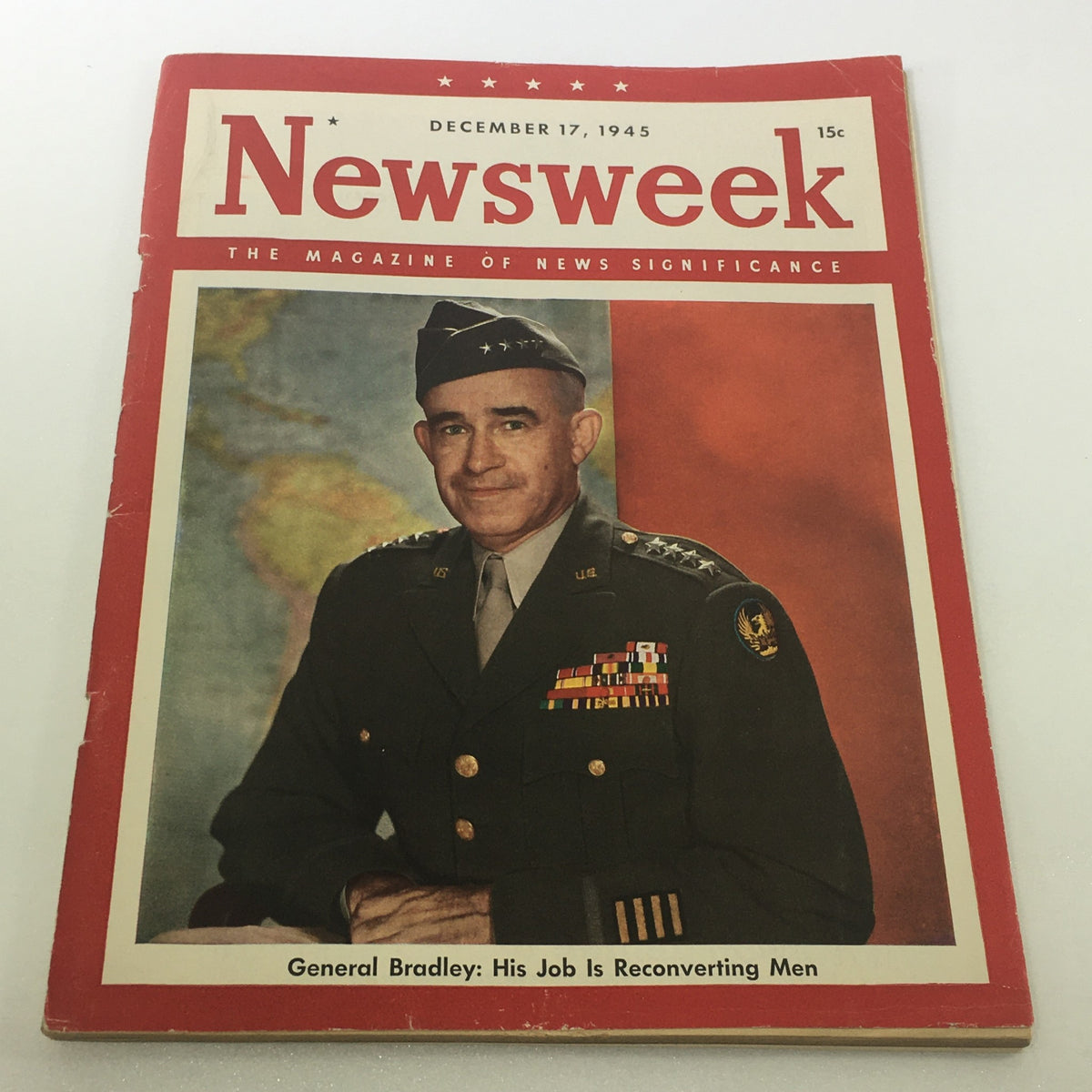

Description
Collector's Note – Why This Issue Matters
The December 17, 1945 issue of Newsweek featuring General Omar Bradley on the cover arrives at one of the most psychologically and politically complex moments in modern American history. World War II had ended just four months earlier — Germany surrendered in May, Japan in September — and the United States was in the earliest, most disorienting phase of postwar reconversion. The men who had led the Allied armies to victory were now the most celebrated figures in American public life, and General Omar Bradley occupied a particularly distinctive place among them. Unlike the more flamboyant George Patton, who had died just days before this issue's publication date following injuries sustained in a car accident on December 9, 1945, or the politically ambitious Douglas MacArthur, Bradley had cultivated a reputation throughout the war as a soldier's general — methodical, unpretentious, and genuinely attentive to the welfare of the enlisted men under his command. War correspondent Ernie Pyle had famously characterized him as exactly that, and the label had defined his public image. A Newsweek cover in December 1945 was a natural recognition of a man whose stock in American public esteem had never been higher. For collectors building a longitudinal archive of Newsweek across the wartime and postwar decades, this issue sits at one of the most historically weighted moments in the magazine's entire publishing history.
The timing relative to George Patton's death adds a layer of historical resonance that a reader in December 1945 would have felt acutely. Patton had been injured in the automobile accident on December 9 and died on December 21 — meaning this issue was published while Patton lay dying in a Heidelberg hospital, though before his death was publicly known. Bradley and Patton had been intertwined throughout the European campaign — Bradley had served under Patton early in the war, then risen to command above him, and their relationship combined genuine mutual respect with notable personal and professional friction. A Bradley cover in the final weeks of 1945 is therefore implicitly a document of a particular moment in how America was beginning to sort out the legacy and hierarchy of its wartime commanders, a process that would unfold over the following decades through memoirs, histories, and public commemorations. The December 17 date also places this issue squarely within the first anniversary window of the Battle of the Bulge — the massive German counteroffensive that had begun on December 16, 1944, tested Bradley's command under extraordinary pressure, and ultimately confirmed the Allied position in Western Europe. That anniversary context would not have been lost on Newsweek's editors or its readers. Collectors focused on the full documentary record of American life across the remarkable year of 1945 will find this December issue a particularly resonant closing chapter.
Omar Bradley's cover appearance also signals something important about where American civil-military relations stood in the immediate postwar moment. The country was in the middle of a rapid and often chaotic demobilization — millions of servicemen were returning home, the wartime industrial economy was reconverting to civilian production, and the question of what role the military and its leaders would play in peacetime American life was genuinely open. Bradley would go on to become the first Chairman of the Joint Chiefs of Staff in 1949 and a key figure in the early Cold War military establishment, but in December 1945 that future was not yet written. The Newsweek cover catches him at the hinge point between his identity as a wartime commander and his not-yet-defined postwar role — a figure of enormous prestige and uncertain future purpose in a country that was itself navigating the same transition from wartime mobilization to an entirely new kind of global responsibility.
About the Publication
Newsweek was founded in 1933 and had established itself by the mid-1940s as one of the two dominant American newsweekly magazines alongside Time, offering comprehensive weekly coverage of national and international affairs to a broad, educated American readership. Its wartime issues — particularly those from 1942 through 1945 — represent some of the most historically significant journalism the magazine ever produced, covering the full arc of American involvement in World War II from the shock of Pearl Harbor through the surrender ceremonies of September 1945. The editorial format combined political and military reporting with international news, business, science, and cultural coverage organized into consistent weekly departments, giving regular readers a reliable and comprehensive digest of the week's most significant events. By December 1945, Newsweek was navigating the same transition its readers were — shifting from the urgent, crisis-driven rhythms of wartime journalism to the more complex and ambiguous demands of covering a postwar world whose shape was still being determined. Issues from the final months of 1945 capture that transitional editorial moment with particular clarity, documenting a publication and a country simultaneously processing the relief of victory and the anxiety of an uncertain peace.
Key Highlights Inside
- A cover feature on General Omar Bradley, celebrated as the "GI's General" throughout the war for his reputation as an approachable and soldier-focused commander, appearing on newsstands in the immediate aftermath of the Allied victory and just days before the death of his fellow commander George Patton on December 21, 1945 — a coincidence of timing that gives this issue an unintended elegiac dimension.
- Postwar military and political coverage consistent with the major questions occupying American public life in December 1945 — demobilization, the emerging shape of the postwar international order, the early negotiations that would eventually produce the United Nations, and the first stirrings of what would become Cold War tension with the Soviet Union.
- First anniversary context surrounding the Battle of the Bulge, which had begun on December 16, 1944 — a date that would have been prominently in the memory of Newsweek's editors and readers as this issue went to press, and which represented one of the defining command challenges of Bradley's wartime career.
- Domestic news coverage reflecting the complex realities of postwar American life in late 1945 — including the ongoing demobilization of millions of servicemen, the labor disputes and economic adjustments accompanying industrial reconversion, and the housing and social pressures generated by the return of veterans to civilian life.
- Advertising content from the period documenting the consumer economy of immediate postwar America — a country in the earliest stages of the consumer and suburban boom that would define the following decade, with advertising that captures the aspirations, products, and visual culture of this transitional moment in ways that are historically valuable alongside the editorial content.
- Note: Specific individual article titles, columnists, and additional interior features beyond the Bradley cover story have not been confirmed for this issue. The above reflects only what is verifiable from the listing, the cover, and the well-documented historical context of this publication date.
Condition & Rarity
This issue is noted as showing wear and tear consistent with a publication now approaching eighty years of age, with potential marks, rips, and edge deterioration that are entirely expected and historically honest for American newsweekly magazines from the final months of World War II. The paper stock used in American periodicals throughout the war years was frequently of reduced quality due to wartime material restrictions and rationing, making issues from 1945 particularly susceptible to the accelerated acidic breakdown, brittleness, and edge fragility that characterize surviving copies from this period. The absence of a mailing label on the cover is a meaningful preservation detail for a title with Newsweek's large subscriber base — newsstand copies that survived without label adhesive damage are proportionally less common in the surviving pool than their original distribution numbers might suggest, and a clean cover adds measurable value for display-focused collectors. The plastic protective covering present on surviving copies in this condition provides an important barrier against further environmental degradation, which is especially critical for paper from 1945 that is already in advanced stages of natural deterioration. When evaluating any surviving copy of this December 17, 1945 issue, collectors should pay careful attention to the staple condition and surrounding paper — saddle-stitched newsweeklies from this era frequently show significant staple oxidation and associated rust staining — as well as the overall page tanning and brittleness levels throughout the interior, the spine fold integrity, and whether any pages have separated or show the advanced fragility that requires careful handling to prevent further damage.
Looking for More Issues Like This?
Late-1945 Newsweek issues in any collector-grade condition are among the more genuinely challenging finds in the postwar American magazine market — the combination of wartime paper quality, the passage of nearly eight decades, and the limited number of collectors who preserved newsweeklies with the intentionality applied to glossy monthlies means that surviving copies from this period surface infrequently and in widely varying states of preservation. The December 17, 1945 Omar Bradley cover occupies a specific and historically resonant position at the close of the most consequential year of the twentieth century, making it a document that serious collectors of both the title and the era pursue with real dedication. If this issue has already found a home, the full Newsweek magazine archive at OriginalMagazines.com is the most reliable place to search for other issues from across the magazine's wartime and postwar run. For collectors working through the extraordinary documentary record of 1945 specifically — a year that encompassed the deaths of Roosevelt and Hitler, the liberation of the concentration camps, the atomic bombings of Hiroshima and Nagasaki, and the formal end of the deadliest conflict in human history — the complete 1945 magazine collection represents one of the most historically significant single-year archives available to serious collectors of American print media.