



Description
Collector's Note – Why This Issue Matters
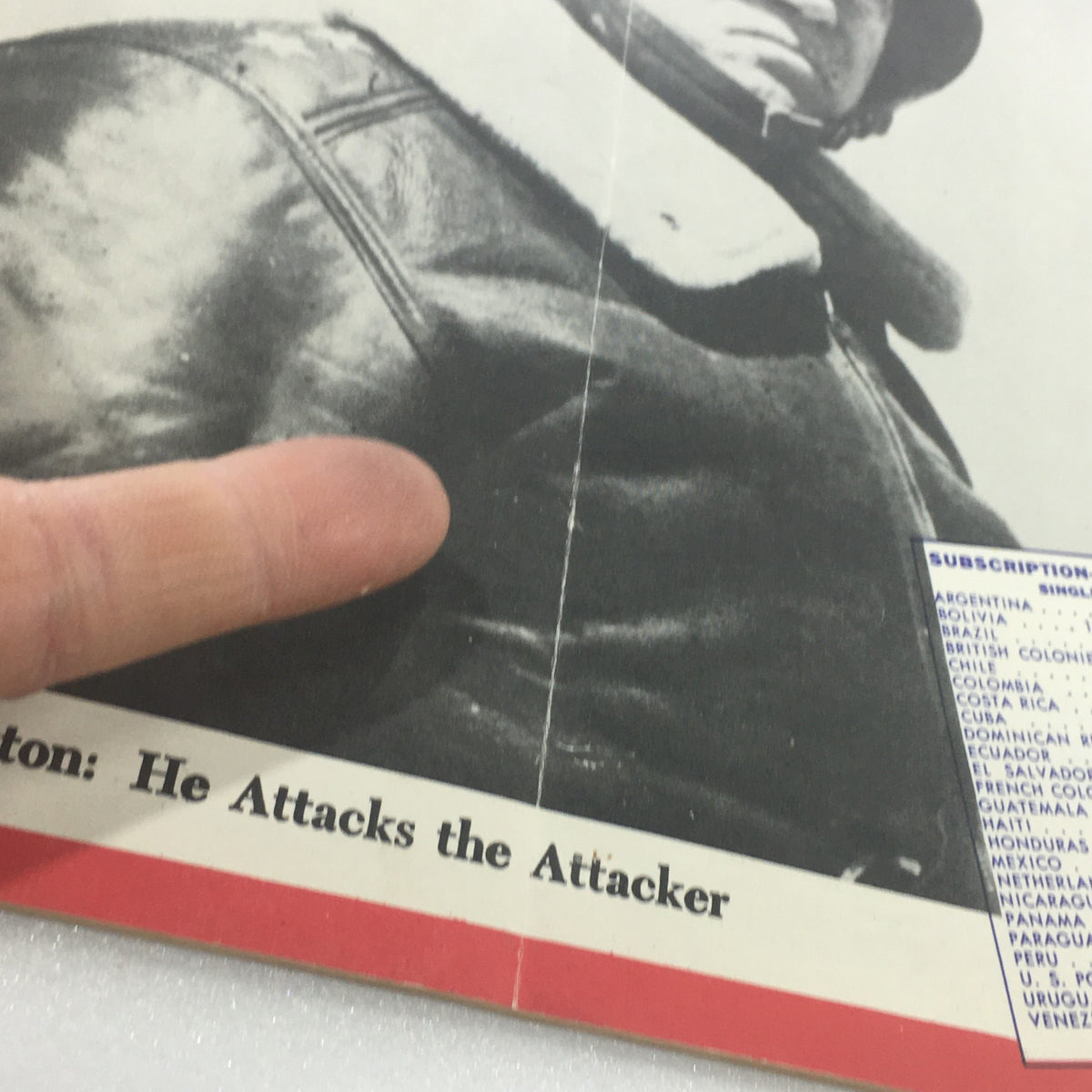
The January 8, 1945 issue of Newsweek featuring General George S. Patton under the headline "He Attacks The Attacker / By Air" arrives at one of the most dramatic turning points of the entire European theater of World War II. The Battle of the Bulge — Germany's last major offensive on the Western Front — had begun on December 16, 1944, just three weeks before this issue's cover date. Within days of the German breakthrough, Patton had executed one of the most celebrated operational maneuvers in military history: he turned his entire Third Army ninety degrees north in the middle of winter and drove it at full speed toward the besieged town of Bastogne, relieving its defenders on December 26. The speed and audacity of that movement — reorienting an army of hundreds of thousands of men in forty-eight hours across frozen roads in blizzard conditions — became instantly legendary, and the American press was still processing and celebrating it when this Newsweek cover was published. For collectors who follow General Patton's wartime magazine coverage, a January 1945 Newsweek cover story represents some of the most historically charged documentation of his career — published at the precise moment his reputation reached its absolute peak.
The cover's dual headline — "He Attacks The Attacker / By Air" — suggests the feature covered both Patton's ground offensive response to the German attack and the role of Allied air power in the Battle of the Bulge, including the critical contribution made when clearing weather in late December 1944 finally allowed air support to operate over the battlefield. That combination of ground and air strategy coverage reflects the integrated operational nature of the Allied campaign and the particular analytical ambitions of Newsweek's wartime military journalism. Patton in January 1945 was not merely a battlefield commander — he was the most celebrated American military personality of the war, a figure whose flamboyance, profanity, and undeniable results made him simultaneously the most controversial and the most popular general in the public's imagination. A Newsweek cover story on him at this moment is a document of that celebrity as much as a piece of military reporting. For anyone assembling a documentary record of 1945 through its print culture, this issue captures the American home front processing one of the war's final great dramatic narratives in real time.
About the Publication
Newsweek, founded in 1933, was one of the two dominant American weekly newsmagazines throughout the mid-twentieth century, competing directly with Time for the educated general readership that consumed national and international news in long-form weekly synthesis. During World War II, the magazine's military coverage was extensive and serious, reflecting both the enormous public appetite for war news and the editorial ambition to provide analytical context rather than simply reporting events. Its covers during the war years functioned as weekly statements of significance — placing military commanders, heads of state, and battlefield developments in front of millions of readers who were simultaneously following the war as news and living with its consequences as participants. The January 8, 1945 issue represents the publication at the height of its wartime editorial mission, covering the war's decisive final phase for an American readership that was both exhausted by the conflict and urgently invested in its outcome.
Key Highlights Inside
- "Patton: He Attacks The Attacker" cover story: The central feature covers General Patton's Third Army response to the Battle of the Bulge — including his celebrated ninety-degree pivot and drive to relieve Bastogne — published three weeks after the German offensive began and approximately two weeks after the relief of Bastogne on December 26, 1944.
- Air power coverage — "By Air": The cover's secondary headline indicates the feature addressed Allied air operations in the Battle of the Bulge, likely including coverage of the critical role of air support when weather cleared in late December 1944, allowing ground attack aircraft to operate against German supply lines and armor.
- Battle of the Bulge as ongoing story: Published during the battle's final phase — German forces were being pushed back but the engagement had not yet concluded — the issue documents the campaign as current events rather than retrospective history, capturing the uncertainty and urgency of the moment as American readers were experiencing it.
- Broader January 1945 war coverage: As with all Newsweek issues of the period, additional departmental content would have reflected the full global scope of the war as it stood in early January 1945 — including the ongoing Pacific theater and the Soviet winter offensive on the Eastern Front. Specific additional interior content is unconfirmed beyond what is stated in the listing.
Condition & Rarity
The no-label status of this issue is its most significant positive condition attribute, identifying it as a newsstand rather than subscriber copy and presenting the Patton cover without the disruption that mailing labels cause. The honestly disclosed condition profile — edge and binding wear, marks, rips, and a bent crease on the front — is consistent with an eighty-year-old newsstand weekly that was read and handled rather than archived. These attributes are standard for surviving wartime Newsweek issues, which circulated heavily and were rarely preserved with collector intent at the time of publication. The protective plastic covering indicates subsequent deliberate preservation. When evaluating any surviving copy of this issue, the degree of the front crease and its impact on the Patton cover portrait are the primary visual grading considerations — followed by the extent of binding damage, edge wear, and the stability of interior pages. Wartime newsmagazines were printed on paper stock that ages to moderate tanning under average storage conditions over eight decades, and structural integrity at the spine is a common failure point for issues that were read repeatedly.
Looking for More Issues Like This?
Wartime Newsweek covers featuring Patton in no-label newsstand condition are a specific and historically significant category — this issue in particular captures the general at the absolute peak of his public reputation, in the immediate aftermath of his most celebrated operational achievement. If this issue has already found a home, the dedicated archive of General Patton magazine appearances is the best starting point for collectors focused on his wartime print legacy. The full Newsweek collection covers landmark wartime and postwar issues across the publication's history, and the 1945 magazine archive is worth exploring for anyone building a comprehensive documentary record of the war's final year.