

Description
Collector’s Note – Why This Issue Matters
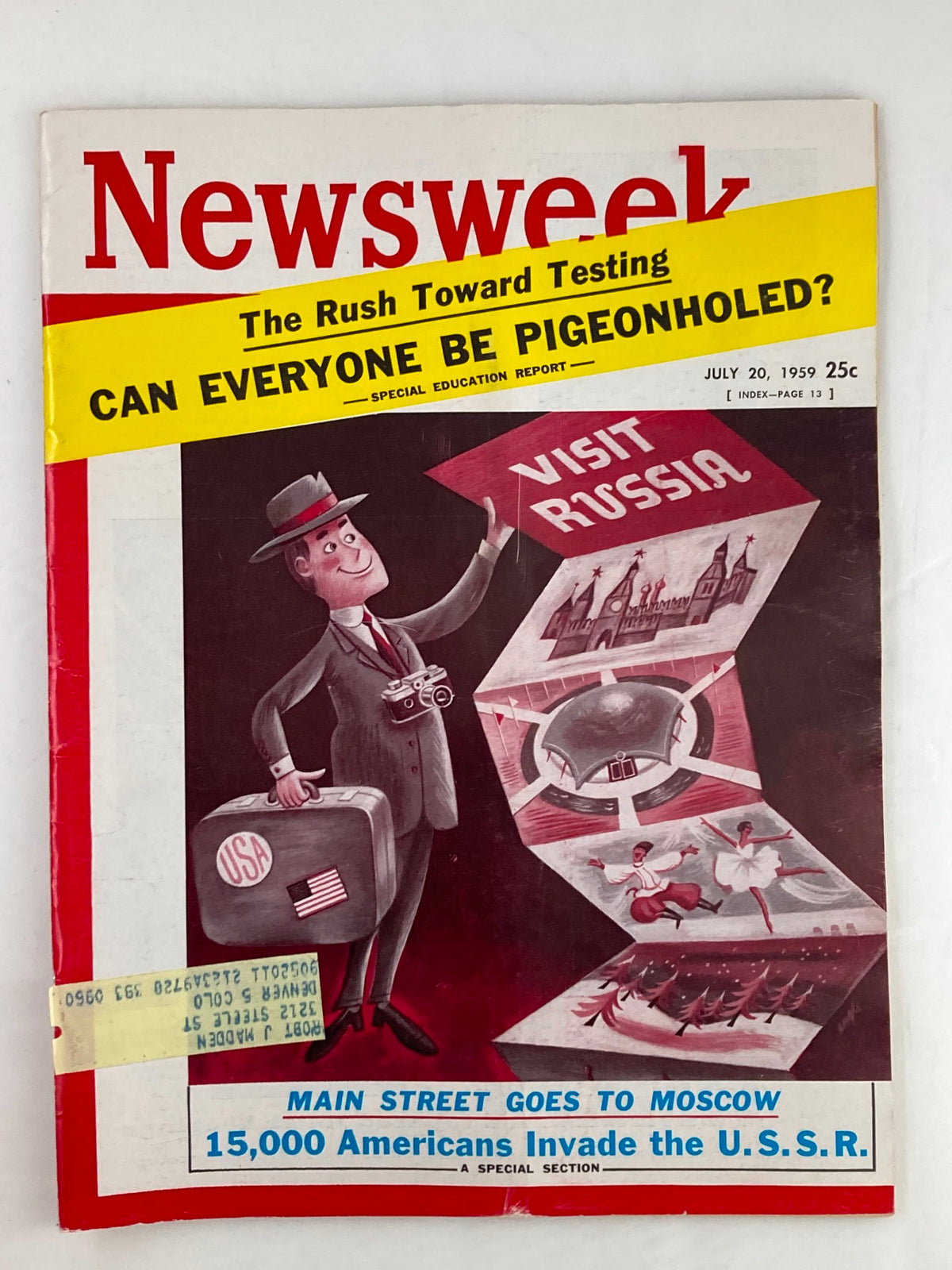
The July 20, 1959 issue of Newsweek presents “The Rush Toward Testing” as a special report on education rather than as a discussion of nuclear-weapons testing. Its prominent upper banner asks, “Can Everyone Be Pigeonholed?” and frames the subject around the expanding use of tests to measure and classify individuals. That wording reflects a period when schools, colleges, employers, psychologists, and government institutions were placing growing confidence in standardized forms of evaluation. The question on the cover also introduces a note of skepticism by asking whether complicated human abilities and personalities could be reduced to categories or scores. Such concerns remain historically important because testing increasingly influenced educational placement, admissions, occupational decisions, and ideas about individual potential during the mid-twentieth century. Newsweek’s decision to promote the subject on its cover demonstrates that testing had become a matter of national interest rather than an issue confined to classrooms or professional psychology. The report can therefore be studied as evidence of both the enthusiasm and uncertainty surrounding measurement, classification, and institutional decision-making in 1959. It preserves a moment when Americans were reconsidering how intelligence, achievement, aptitude, and personal characteristics should be assessed.
The same cover also promotes a substantial special section titled “Main Street Goes to Moscow,” accompanied by the dramatic line “15,000 Americans Invade the U.S.S.R.” The central illustration depicts an American tourist carrying a suitcase marked with United States symbols, wearing a camera, and unfolding a colorful travel brochure labeled “Visit Russia.” The word “invade” is used figuratively to describe civilian visitors rather than a military action, creating a playful contrast with the tense language normally associated with the Cold War. The issue appeared during an important expansion of cultural, educational, scientific, technical, and tourist contacts between the United States and the Soviet Union. It was dated only five days before the American National Exhibition formally opened in Moscow’s Sokolniki Park on July 25, 1959. That exhibition would become especially remembered for the public exchange between Vice President Richard Nixon and Soviet leader Nikita Khrushchev in a model American kitchen. The timing places this Newsweek edition within a brief period when personal travel and cultural display were being used as instruments of diplomacy alongside military competition and political negotiation. Within the archive of historical Newsweek issues, it offers a particularly revealing combination of domestic education concerns and changing East–West contact.
Taken together, the testing report and Soviet tourism section capture two different forms of classification and comparison operating in late-1950s America. One examines attempts to measure individuals through tests, while the other considers how ordinary citizens encountered a nation usually represented through ideology, military power, and official propaganda. This pairing illustrates the wide editorial range expected from a weekly news magazine serving a general audience. It also shows how Newsweek used bold headlines, urgent questions, illustrations, and special sections to make complicated subjects accessible at a glance. A complete table of contents has not been supplied for this issue, so specific interior articles beyond the documented cover features should not be identified without examination of the original pages. The remaining departments may preserve additional reporting, photography, commentary, advertisements, and cultural material from the week, but their precise subjects remain unconfirmed. Even with that limitation, the cover provides unusually strong evidence of the debates and international developments chosen for emphasis by the editors. The issue belongs naturally within the broader record of magazines published in 1959, a year shaped by educational reform, the Space Race, Cold War rivalry, consumer prosperity, and expanding cultural exchange.
About the Publication
Newsweek originated in 1933 under the title News-Week and was founded by journalist Thomas J. C. Martyn. Martyn had previously worked as a foreign-news editor at TIME and developed the publication as a weekly survey of domestic and international events. In 1937, News-Week merged with Raymond Moley’s magazine Today and removed the hyphen from its name. The publication subsequently became one of the leading American weekly news magazines of the twentieth century. Its editorial structure combined national affairs, international reporting, business, science, medicine, education, religion, books, entertainment, and cultural commentary. Newsweek competed for readers by offering concise reporting, analysis, photography, illustrations, maps, and visually forceful cover presentations. Cover headlines frequently converted complicated political or social questions into direct phrases that could be understood immediately. The magazine also used special reports to devote extended attention to subjects considered too complex for a brief weekly summary. By 1959, Newsweek was an established interpreter of Cold War politics, American government, education, technological development, and changing social behavior. Its coverage regularly placed foreign leaders and diplomatic crises beside developments affecting schools, families, businesses, and individual citizens. Advertising within surviving issues provides a parallel record of automobiles, travel, household goods, financial services, consumer technology, and the commercial language of the period. Historical editions now function as primary sources for studying journalism, public opinion, graphic design, news photography, advertising, and the concerns emphasized for a mass American readership.
Key Highlights Inside
- “The Rush Toward Testing” is identified on the cover as a special education report rather than a feature about atomic or nuclear testing. Its principal question, “Can Everyone Be Pigeonholed?,” challenges the idea that tests can place every individual into a reliable category. The exact tests, institutions, experts, and examples discussed inside require confirmation from the complete article.
- The testing feature reflects the growing influence of standardized measurement in American education and institutional life. Its cover language suggests an examination of the benefits and limitations of using test results to judge ability, achievement, aptitude, or potential. No particular examination or testing organization should be attributed to the report without inspecting the original pages.
- The main illustrated feature is titled “Main Street Goes to Moscow,” with the additional line “15,000 Americans Invade the U.S.S.R.” The accompanying artwork depicts an American tourist with a camera, a suitcase, and an unfolding “Visit Russia” brochure. This presentation frames civilian travel as a notable development in relations between two rival Cold War powers.
- The Soviet travel section appeared during an expanding program of cultural, educational, scientific, and technical exchanges between the United States and the Soviet Union. Its timing also places it immediately before the opening of the American National Exhibition in Moscow later that week. The section offers a period view of how increased personal contact with the Soviet Union was explained to American readers.
- The cover’s combination of education and Soviet tourism demonstrates Newsweek’s broad weekly editorial approach. A domestic debate about human measurement appears beside an international story involving travel, diplomacy, and cultural contact. Together, the subjects preserve both the institutional concerns and geopolitical interests occupying public discussion in the summer of 1959.
- A complete table of contents has not been provided for this edition, so other interior departments remain unconfirmed. The magazine may contain the recurring national, foreign, business, science, cultural, and review sections typical of Newsweek, but their individual subjects should not be invented. Direct examination of the contents page would be necessary for a more extensive article-by-article record.
Condition & Rarity
The supplied description classifies this July 20, 1959 Newsweek issue as being in Good overall condition. Minor wear is reported throughout the magazine, reflecting earlier handling, reading, mailing, and storage. The exact locations and severity of the wear are not fully itemized in the written description. An address label is present on the front cover and forms part of the issue’s surviving mailing history. The label partially interrupts the original cover presentation but also identifies the magazine as an example that was distributed to a subscriber. It should not be removed without considering the possibility of surface damage to the paper beneath it. The accompanying photographs should be treated as the primary source for evaluating the cover, corners, spine, page edges, and visible marks. No detailed information has been provided concerning tears, missing pages, clipping, detached sections, writing, staining, tape, or restoration. Those characteristics should remain unconfirmed unless they can be established through the photographs or direct physical examination. A plastic protective covering is reported to accompany the magazine and can help limit exposure to dust and unnecessary handling. That covering is a later storage accessory rather than an original component of the 1959 publication. Newsweek was widely circulated, so the issue’s historical and collector interest is more accurately connected with its education report, Soviet travel section, Cold War timing, address-label history, and actual condition than with unsupported claims of exceptional rarity.
Looking for More Issues Like This?
Additional political reports, social debates, and illustrated weekly covers can be examined through the Newsweek magazine archive. Comparing nearby issues can show how the publication followed American–Soviet relations, educational policy, scientific competition, presidential politics, and social change. Consecutive editions may also reveal how Newsweek reported the American National Exhibition, Nixon’s visit to Moscow, and the evolving climate of cultural exchange. Readers researching education can compare the testing feature with later reports on standardized examinations, college admissions, intelligence measurement, and school reform. Those comparisons may help trace how confidence in testing changed as questions of fairness, accuracy, and individual difference became more prominent. The archive also provides examples of Newsweek’s changing cover typography, illustration, photography, and use of banner headlines. Period advertisements can be studied alongside the editorial pages to understand how commercial messages interacted with reporting about national and international affairs. A wider historical comparison is available through the 1959 magazine collection. Publications from that year document the Space Race, Cold War diplomacy, expanding consumer culture, entertainment, fashion, education, and technological optimism. Examining several magazine categories reveals how the same year was interpreted differently for news readers, business audiences, families, film enthusiasts, and specialized hobbyists. The July 20 Newsweek issue contributes a distinctive perspective by connecting the classification of individuals through testing with the movement of American travelers across the Cold War divide.