
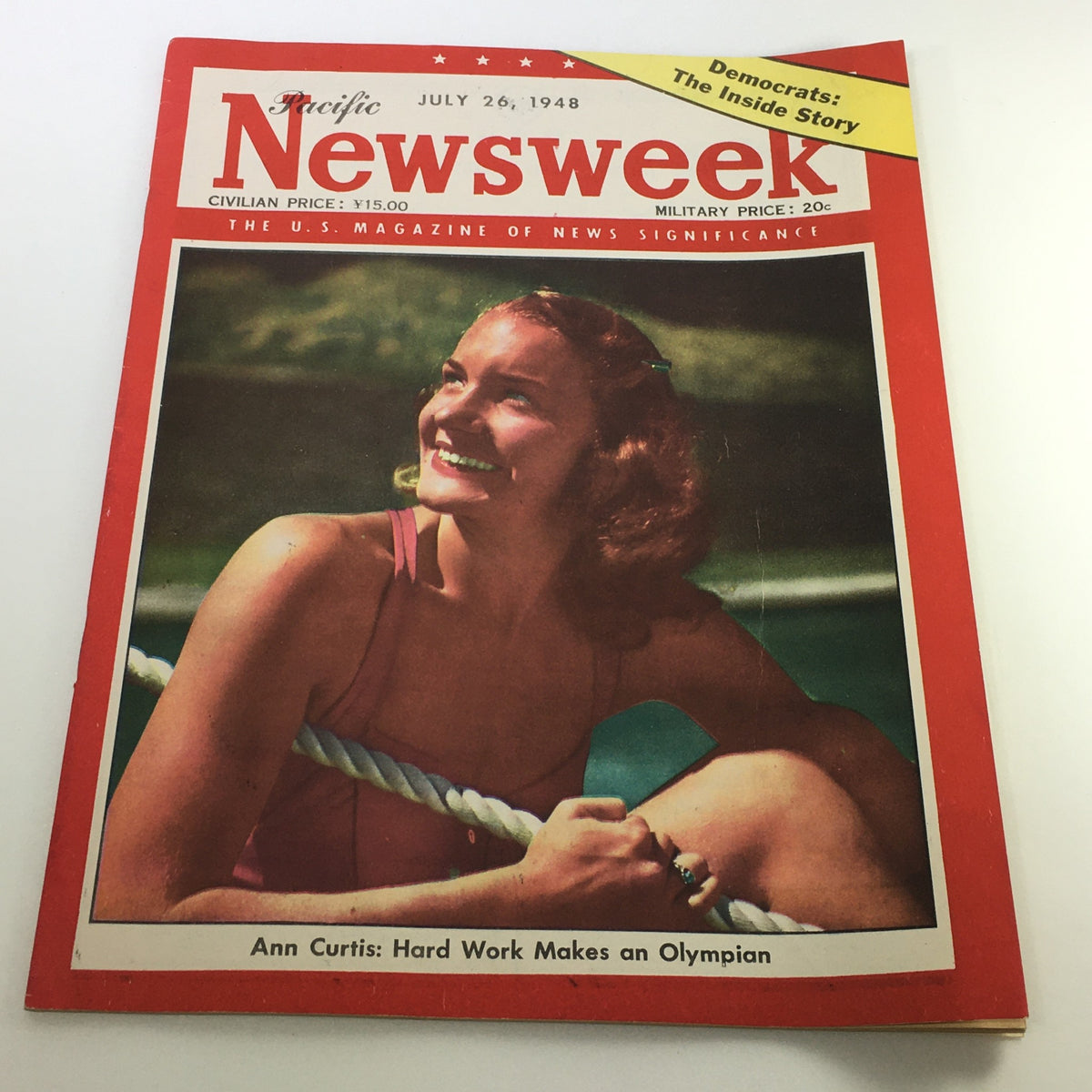

Description
Collector's Note – Why This Issue Matters
The July 26, 1948 issue of Newsweek featuring Ann Curtis on the cover is a primary document of American athletic achievement and postwar cultural identity at a historically specific and genuinely significant moment — and the figure at its center is one of the most accomplished and underrecognized American athletes of the mid-twentieth century. Ann Curtis was, in the summer of 1948, the finest female swimmer in the United States and one of the finest in the world, and the timing of this Newsweek cover — appearing in late July, just as the London Olympics were opening — places it at the precise threshold of what would prove to be her defining moment on the world stage. Curtis had dominated American swimming throughout the mid-to-late 1940s, setting multiple world records in freestyle events and winning the Sullivan Award in 1944 as the outstanding amateur athlete in the United States — an honor that had rarely gone to a woman and that reflected the extraordinary regard in which the swimming community and the broader American sports world held her abilities. The 1948 London Olympics — the first Games since the Berlin Olympics of 1936, delayed twelve years by the Second World War — were invested with a particular emotional and symbolic weight by athletes, spectators, and the American public alike, representing the return of peaceful international competition after the most devastating conflict in human history. Ann Curtis would go on to win gold in the 400-meter freestyle and a silver in the relay at those Games, cementing her place in American swimming history. A Newsweek cover at the opening of those Olympics documents her at the precise moment of maximum national expectation and anticipation. For collectors building around vintage Newsweek issues with a focus on American sports history and postwar culture, this cover is a primary document of one of the most decorated female athletes of her era at her most historically specific moment.
The Pacific reference in the listing title adds a dimension of geopolitical and strategic history to this issue that gives it a documentary richness extending well beyond the Curtis cover story. In late July 1948, the Pacific and Asia-Pacific region was one of the most consequential and rapidly evolving theaters in global affairs. The Chinese Civil War was entering what would prove to be its final decisive phase — by the summer of 1948, the military situation was turning decisively in the Communists' favor, and the outcome that would produce the People's Republic of China in October 1949 was becoming, to careful observers, increasingly inevitable. The American occupation of Japan under General Douglas MacArthur was continuing to reshape Japanese society, politics, and economics in ways whose long-term implications remained genuinely uncertain. The emerging Cold War competition for influence across Southeast Asia and the Pacific was producing the strategic calculations and alliance structures that would define the region's political landscape for decades. A Newsweek feature on Pacific affairs in late July 1948 would have engaged these developments with the analytical depth and editorial authority that positioned the magazine as essential reading for its educated American audience. For collectors focused on magazines from 1948, this issue provides primary documentation of the Pacific's strategic significance at one of its most historically charged and consequential postwar moments.
The broader historical context of July 26, 1948 in American and world affairs gives this issue a density of significance that collectors of late-1940s periodicals will find particularly rewarding to appreciate. The 1948 London Olympics, opening in these final days of July, were themselves a document of the postwar world's attempt to restore normalcy and international community — held in an austerity Britain still rationing food five years after the war's end, in a city still visibly scarred by the Blitz, drawing athletes from nations whose political relationships were already being reshaped by the Cold War that was hardening around them. The Berlin Blockade and Airlift had begun just a month earlier, in June 1948, making the summer of 1948 one of the most geopolitically tense of the entire early Cold War period. And the 1948 presidential election — which would produce Truman's famous upset victory over Dewey — was beginning its final phase, with the party conventions having taken place in July and the fall campaign about to begin. A late July 1948 Newsweek exists within all of these overlapping historical contexts simultaneously, making it a document of unusual richness and documentary depth for the serious collector who engages with it fully.
About the Publication
Newsweek was founded in 1933 and had established itself by the late 1940s as one of the two or three most authoritative and widely read news magazines in the United States, competing directly with Time for the allegiance of the educated, civically engaged American readership that consumed weekly news analysis as a matter of regular civic habit. Its editorial format organized the week's news into clearly defined sections covering national and international affairs, business, science, medicine, and culture, written with the assumption that its readers were intelligent adults who wanted both information and interpretation. Its cover choices were deliberate editorial statements about who and what mattered in American public life at a given moment, and a cover appearance in Newsweek in July 1948 carried genuine cultural authority in a media landscape where the major newsweeklies functioned as the primary intermediaries between the week's events and the educated American public's understanding of their significance. The magazine's sports coverage in this period was substantive and contextually serious — a reflection of the genuine role that athletic achievement played in postwar American national identity and self-understanding — and a cover devoted to Ann Curtis at the opening of the 1948 London Olympics reflects the editorial seriousness with which Newsweek understood the Olympic Games as an event of cultural and political as well as athletic significance.
Key Highlights Inside
- Ann Curtis cover feature and 1948 London Olympics coverage: A Newsweek cover appearance timed to the opening of the 1948 London Olympics would almost certainly have been accompanied by substantial interior coverage of Curtis's Olympic prospects, her career achievements, and the broader context of the first postwar Games — the austerity conditions in which they were being held, their symbolic significance as a restoration of international athletic competition after twelve years of interruption, and the American team's preparation and medal expectations.
- Pacific region geopolitical coverage: The "Pacific" reference in the listing indicates interior coverage of the Asia-Pacific region's postwar political and strategic landscape — likely engaging with the Chinese Civil War's evolving military situation, the American occupation of Japan and MacArthur's administration, and the broader Cold War competition for influence across Southeast Asia and the Pacific that was shaping American foreign policy throughout this period.
- Berlin Blockade and early Cold War coverage: A late July 1948 Newsweek would have been produced in the second month of the Berlin Blockade and Airlift — one of the most dramatic and consequential confrontations of the early Cold War — and any issue from this date would have engaged that developing crisis with the urgency and analytical depth that its strategic significance demanded.
- 1948 presidential election coverage: The party conventions having just concluded in July, a late July Newsweek would have been assessing the fall presidential campaign and its prospects — the Truman-Dewey contest that would produce one of the most famous upsets in American electoral history, and the Strom Thurmond Dixiecrat candidacy that was beginning to reshape the political geography of the American South.
- Period advertising and domestic coverage as historical document: The advertising and domestic news content of a July 1948 Newsweek constitutes primary historical material reflecting the commercial landscape and everyday aspirations of Americans in the third year of postwar prosperity, at a moment when the consumer economy was expanding and the rhythms of peacetime American life were being reestablished after nearly a decade of depression and war.
- Note: Specific interior articles, column subjects, and individual features beyond the Ann Curtis cover story and Pacific coverage have not been confirmed from available listing details. The above reflects what is verifiable from the cover subject, the Pacific reference, the publication date, and the well-documented editorial practices and news environment of Newsweek in July 1948.
Condition & Rarity
A seventy-seven-year-old weekly newsmagazine surviving in original newsstand condition without a mailing label is a meaningful archival result, and the condition attributes described — possible marks or small rips on edges and binding — place this issue in the honest range that collectors of late-1940s newsweeklies understand and accept as the authentic marks of survival across nearly eight decades. Newsweek in July 1948 was printed on standard newsweekly paper stock — not archival quality, produced to be read and in the vast majority of cases discarded within weeks of purchase — which means that surviving copies in any collectible condition represent a genuinely small fraction of the original print run. The newsstand origin with no mailing label is the most significant positive condition attribute for any surviving copy of this issue. Subscriber copies of Newsweek from 1948 were mailed directly to readers and frequently sustained permanent label adhesive damage to the cover that detracts substantially from both visual presentation and collector appeal. A clean, label-free newsstand copy preserves the full visual integrity of the Ann Curtis cover image — the primary collectible draw for an issue timed to the opening of the 1948 London Olympics — without the label damage that a mailed copy would have sustained. Edge and binding wear in a copy of this age should be evaluated primarily in terms of whether the spine retains sufficient structural integrity to hold the issue together as a complete unit, and whether the interior pages — including any feature coverage of Curtis, the Olympics, and the Pacific — remain present and legible. The protective plastic covering provides the appropriate preservation format going forward, stabilizing the issue against further deterioration and environmental exposure.
Looking for More Issues Like This?
A July 1948 Newsweek with Ann Curtis on the cover at the opening of the London Olympics — the first postwar Games, held in an austerity Britain against the backdrop of the Berlin Blockade and the hardening Cold War — is a primary document that appeals simultaneously to American swimming history collectors, 1948 Olympics enthusiasts, and serious Newsweek cover specialists, making it sought after across a broader collector market than most single-subject newsweekly covers from this period. If this particular issue has already been claimed, the broader Newsweek collection at OriginalMagazines.com spans the magazine's long run and regularly surfaces issues from the late 1940s that document the postwar American moment — the early Cold War, the 1948 elections, the London Olympics, and the remarkable density of historical events that made 1948 one of the most consequential years of the entire postwar era — with the editorial authority and journalistic seriousness that made Newsweek essential reading for engaged Americans throughout this period. Collectors with a specific focus on 1948 will find the 1948 magazine archive an exceptionally rich source of primary material from one of the most historically significant years of the twentieth century.