




Description
Collector's Note – Why This Issue Matters
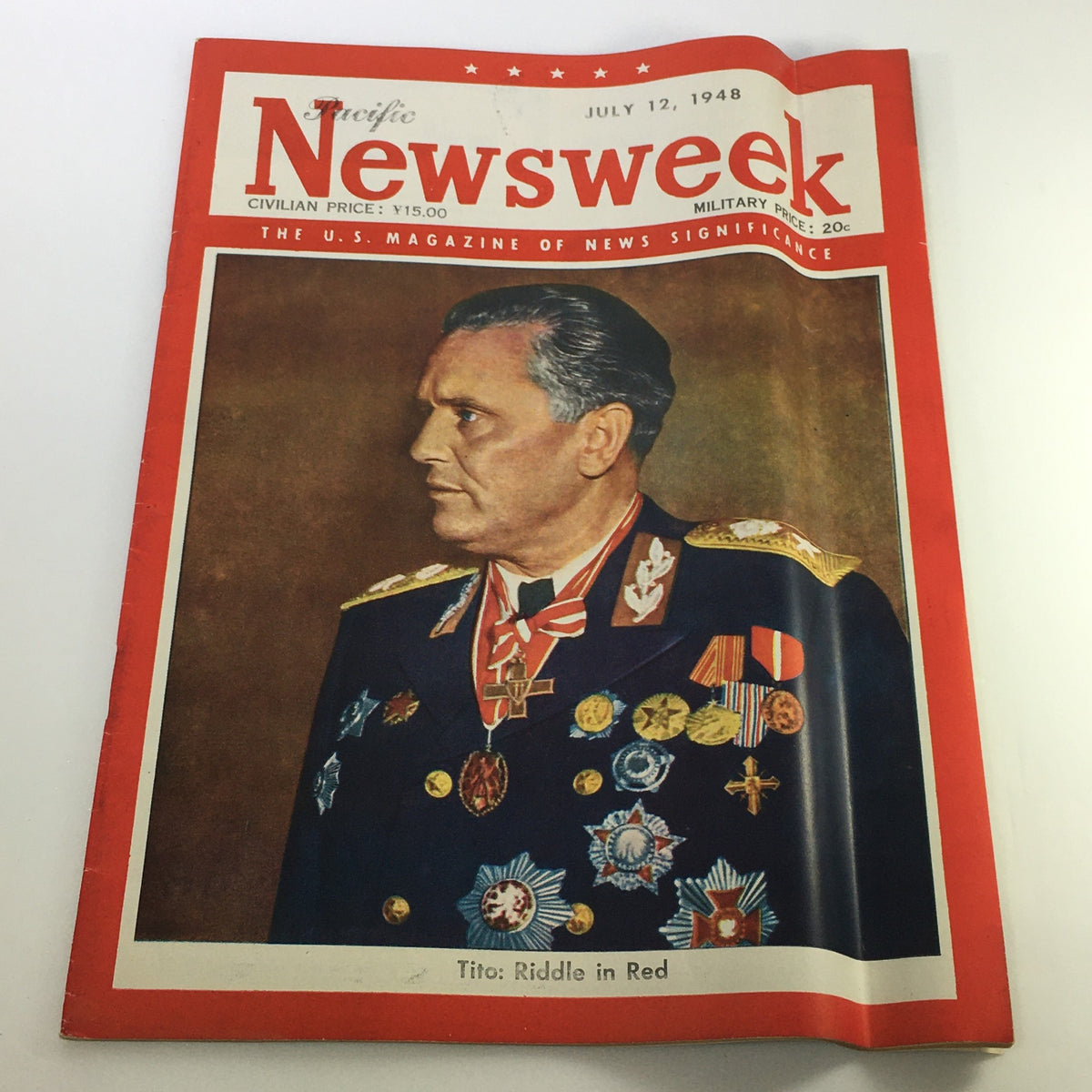
The July 5, 1948 issue of Newsweek featuring Thomas E. Dewey on its cover arrives at one of the most consequential and, in retrospect, most ironic moments in twentieth-century American political history. By the first week of July 1948, Dewey had just secured the Republican presidential nomination at the Republican National Convention in Philadelphia, completing his return to national prominence after his 1944 defeat by Franklin Roosevelt and positioning himself as the overwhelming favorite to win the presidency in November. The political consensus of the summer of 1948 — shared by virtually every major pollster, political analyst, editorial board, and newsweekly in the country — was that Dewey would defeat the incumbent Harry Truman with relative ease. Truman was presiding over a fractured Democratic Party, burdened by inflation, labor unrest, Cold War anxieties, and a public that seemed ready for a change in administration. Dewey, by contrast, projected an image of competent, modern, businesslike governance that seemed perfectly calibrated for the moment. A Newsweek cover placing him at the center of American political attention in early July 1948 is therefore a document of almost painful historical irony — the portrait of a man whom every observer believed was about to become the thirty-fourth President of the United States, produced five months before one of the greatest electoral upsets in American history would prove them all wrong. For collectors who focus on vintage Newsweek issues documenting mid-century American political history, this cover is a primary document of that extraordinary moment of collective miscalculation.
Thomas Dewey's place in American political history is defined almost entirely by what did not happen in November 1948, and that makes a July 1948 cover appearance — produced at the peak of his perceived inevitability — a document of unusual biographical and historical weight. He had been a nationally prominent figure since his celebrated career as a racket-busting prosecutor and Manhattan District Attorney in the late 1930s, had served as Governor of New York since 1943, and had run a competitive if ultimately unsuccessful race against Roosevelt in 1944. By 1948, he was the most experienced and best-organized Republican candidate in a generation, running against an opponent that his own party and most of the press had effectively written off. The Newsweek cover in early July captures him at the moment of maximum political confidence and national expectation — a moment that the famous photograph of a grinning Truman holding the "DEWEY DEFEATS TRUMAN" Chicago Tribune headline would render permanently and poignantly historical. Collectors building archives around the magazines of 1948 — one of the most electorally dramatic and geopolitically consequential years of the entire twentieth century — will find this issue an essential acquisition for understanding the political atmosphere that made Truman's victory so shocking to the world that had confidently expected his defeat.
The Pacific reference alongside Dewey's cover story adds a geopolitical dimension that places this issue within the full scope of 1948's extraordinary historical density. July 1948 was a month of intense and consequential activity on multiple Cold War fronts simultaneously: the Berlin Blockade had begun in late June, the United States was engaged in the extraordinary logistical effort of the Berlin Airlift, and the Pacific theater of the emerging Cold War — encompassing the American occupation of Japan, the rapidly deteriorating situation in China as the Communists gained the upper hand in the Civil War, and the broader question of American strategic commitments in Asia — was demanding serious and sustained analytical attention. A Newsweek issue that pairs Dewey's presidential campaign cover with Pacific reporting in July 1948 captures the full, simultaneous weight of the electoral and geopolitical crises that defined this extraordinary year, and that context elevates this issue well beyond a simple political profile into a document of American life and thought at one of its most consequential postwar crossroads.
About the Publication
Newsweek, founded in 1933, had by the late 1940s firmly established itself alongside Time as one of the two dominant American newsweeklies, reaching millions of readers weekly through a format built around in-depth reporting, analytical commentary, and cover features capable of dedicating substantial editorial space to a single developing story or political figure. The magazine's audience consisted primarily of educated, professionally engaged Americans who expected their newsweekly to provide more context, analysis, and interpretive depth than daily newspapers could consistently supply — readers who wanted to understand not just what had happened in a given week but what it signified about the direction of American political life and the broader world order. Newsweek's political coverage in the late 1940s was particularly consequential: the 1948 presidential election was one of the most intensely covered and consequential in American history, and the magazine's confident predictions of a Dewey victory — predictions shared by nearly every major press outlet in the country — became, in retrospect, one of the most famous collective failures of political journalism in the twentieth century.
Key Highlights Inside
- A major cover feature on Thomas E. Dewey arriving immediately after his second Republican presidential nomination — examining the candidate whom virtually every political observer in the country believed was on a direct path to the White House, and whose confident, well-organized campaign reflected the Republican Party's conviction that 1948 was their year to reclaim the presidency after sixteen years of Democratic rule.
- Reporting almost certainly engaging with the state of the 1948 presidential race as it stood in early July — including Truman's political vulnerabilities, the fractures in the Democratic coalition that had produced the Dixiecrat and Progressive Party splits, and the strategic calculations of the Dewey campaign that were being universally interpreted as the management of an inevitable victory rather than the prosecution of a contested race.
- Pacific affairs coverage reflecting the state of American strategic commitments in Asia in mid-1948 — including the ongoing occupation of Japan, the accelerating Communist advance in the Chinese Civil War, and the broader question of how American Cold War containment strategy, which had been articulated primarily in the European context, would be extended to the rapidly changing Asian strategic landscape.
- Reporting on the Berlin Airlift, which had begun in late June 1948 and was actively underway as this issue went to press — the first major direct confrontation between Western powers and the Soviet Union in the Cold War era, and a crisis whose management by the Truman administration was providing the incumbent president with one of the few clear foreign policy victories available to him in a politically difficult summer.
- Standard Newsweek front-of-book reporting covering the full landscape of domestic and international affairs from the first week of July 1948, providing a contemporaneous snapshot of an extraordinary news environment in which electoral drama, Cold War crisis, and geopolitical transformation were unfolding simultaneously.
Note: Specific interior article titles, bylines, and additional feature details beyond the cover subject are unconfirmed for this issue from available sources. The highlights above reflect verifiable historical context drawn from the cover subject, publication date, and the well-documented editorial priorities of Newsweek during this period.
Condition & Rarity
This copy originates from newsstand distribution rather than the magazine subscription system — the consistently preferred provenance among serious periodical collectors — and arrives without a mailing label, preserving the cover surface as originally printed. The noted condition attributes for this issue include edge wear, binding wear, occasional marks or rips, and a previous fold — the fold being the most distinctive and notable condition detail, as it indicates a crease in the paper stock that will be visible in the overall presentation and that collectors should assess carefully in the provided photographs before drawing conclusions about display suitability. On a magazine now approaching eighty years of age, a fold is not an unusual survival characteristic — magazines of this era were sometimes folded for storage or transport in ways that left permanent creases — but it is a meaningful condition disclosure that distinguishes this copy from flat, unfolded examples of the same issue and affects its value accordingly within the collector market's established grading framework. The plastic protective sleeve indicates deliberate preservation at some point in the copy's history, and the newsstand provenance remains a positive attribute regardless of the fold. Collectors whose primary interest is the historical and research value of the content rather than display-grade presentation will find a folded newsstand copy of this issue a perfectly functional acquisition; those seeking a display-quality example should weigh the fold's visual impact carefully against the photographs.
Looking for More Issues Like This?
A Thomas Dewey cover Newsweek from July 1948 — produced at the peak of his perceived electoral inevitability, five months before Truman's famous upset — is one of the more historically ironic and purposefully timed acquisitions available to collectors of mid-century American political history, and if this particular example has already found a home, the broader vintage Newsweek collection at OriginalMagazines.com is an excellent resource for other significant political and Cold War-era covers from the magazine's consequential late-1940s run. Collectors focused on the extraordinary density of events — electoral, geopolitical, and diplomatic — that made 1948 one of the most actively collected years in the publication's history will find it well worth exploring the full 1948 magazine archive, which brings together publications from a year whose combination of Cold War crisis and democratic drama has never been surpassed in the postwar record.