
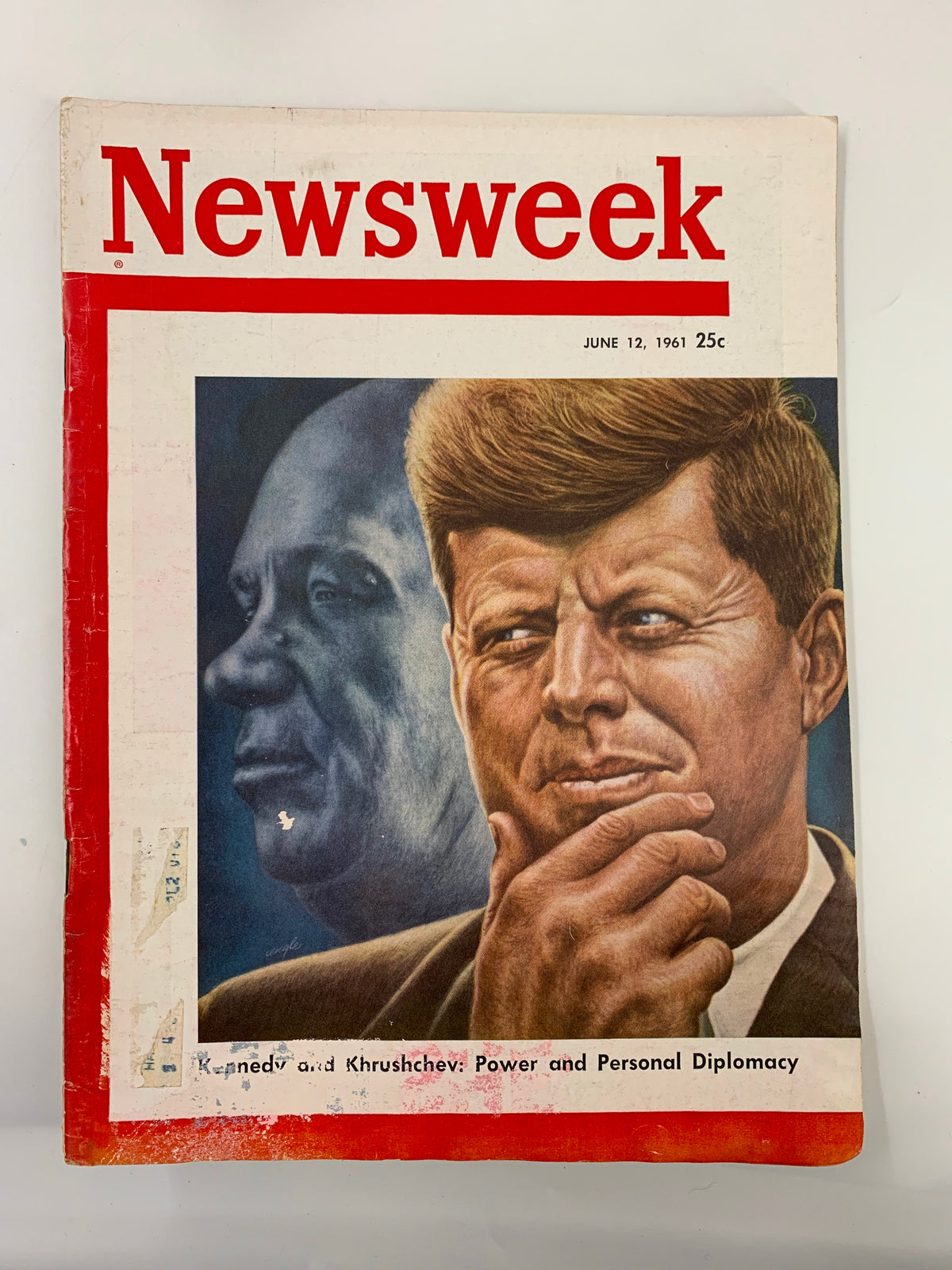

Description
Collector's Note – Why This Issue Matters
The June 12, 1961 issue of Newsweek captures John F. Kennedy and Nikita Khrushchev at one of the most electrically charged moments of the entire Cold War era. Just days before this issue's cover date, the two leaders had met face to face in Vienna on June 3 and 4, 1961 — a summit meeting that would prove to be one of the most consequential and psychologically fraught diplomatic encounters of the twentieth century. Kennedy, only four months into his presidency and still absorbing the catastrophic embarrassment of the Bay of Pigs invasion in April, arrived in Vienna hoping to establish a working relationship with the Soviet Premier. What he encountered instead was a Khrushchev who had read the Bay of Pigs disaster as evidence of weakness and who pressed his advantage with a sustained, aggressive series of ultimatums on Berlin, nuclear testing, and the global balance of power that left Kennedy visibly shaken. Eyewitness accounts and Kennedy's own private admissions to journalists afterward described the summit as a brutal experience. James Reston of the New York Times, who interviewed Kennedy immediately after the final session, later wrote that the President appeared shell-shocked. For collectors building an archive of John F. Kennedy magazines and historical publications, a Newsweek cover from the week immediately following the Vienna Summit is among the most historically significant single issues of the entire Kennedy presidency.
The Vienna Summit's consequences extended far beyond the meeting itself. Historians have drawn a direct line from Khrushchev's assessment of Kennedy's weakness in Vienna to the construction of the Berlin Wall in August 1961 — just two months after this issue appeared on newsstands — and ultimately to the Soviet decision to place nuclear missiles in Cuba, which produced the Cuban Missile Crisis of October 1962. The June 1961 Newsweek cover featuring these two men was not illustrating a routine diplomatic event. It was documenting the precise moment when the Cold War's most dangerous eighteen-month sequence was set in motion, even if the full implications were not yet visible to the press or the public. Newsweek's framing of their relationship as a study in "power" — the word used in the listing title — reflects the magazine's recognition that what had just occurred in Vienna was a confrontation of fundamental strategic and psychological significance rather than a conventional diplomatic exchange. For collectors of vintage Newsweek magazines, this issue stands alongside the Cuban Missile Crisis and Dallas covers as one of the essential Kennedy-era numbers in any serious run of the publication.
June 1961 also places this issue at a moment when Kennedy's presidency was being intensely scrutinized and reassessed both domestically and internationally. The Bay of Pigs failure had damaged his standing at home and emboldened adversaries abroad. The Vienna Summit had done nothing to restore confidence in his ability to manage the Soviet challenge. And yet Kennedy was simultaneously navigating the early stages of American involvement in Vietnam, the acceleration of the space race following Yuri Gagarin's historic April 1961 orbital flight, and the mounting pressures of the Civil Rights Movement that were beginning to force themselves onto the national agenda with growing urgency. The American press in June 1961 was engaged in a genuine, unresolved debate about the character and capability of the new President — a debate that Newsweek was positioned at the center of, with the editorial resources and Washington access to cover it with depth and authority. Issues from 1961 document that pivotal, anxious, consequential year with a contemporaneous vividness that no retrospective account can replicate.
About the Publication
Newsweek was founded in 1933 and had established itself by the early 1960s as one of the two dominant American weekly news magazines, competing directly with Time for the readership of educated, engaged Americans who wanted analytical context alongside their news coverage rather than bare wire-service reporting. Its editorial format combined hard news summaries with longer investigative features, political analysis, international correspondence, cultural criticism, and regular commentary from named columnists — a blend that gave it a distinctive voice distinct from the more institutionally conservative Time. By 1961, Newsweek's Washington bureau was among the best-staffed and most well-connected in American journalism, and its coverage of the Kennedy administration benefited from a relationship between the new President and the press corps that was closer and more candid than any since Franklin Roosevelt's time in office. Kennedy understood the power of weekly newsmagazines in shaping public opinion and cultivated relationships with their editors and correspondents accordingly, making Newsweek's coverage of his presidency particularly rich with access and insider perspective. Individual issues from the Kennedy years are among the most actively collected in the magazine's entire publishing history, and cover dates tied to specific historical events — the Vienna Summit foremost among them — carry a documentary weight that elevates them well above ordinary vintage periodical status.
Key Highlights Inside
- Cover feature on John F. Kennedy and Nikita Khrushchev in the immediate aftermath of the Vienna Summit of June 3–4, 1961 — one of the most consequential and psychologically significant diplomatic encounters of the Cold War, and a meeting whose direct consequences would include the Berlin Wall and the Cuban Missile Crisis within the following eighteen months.
- Analysis of the power dynamic between the two leaders at a moment when Khrushchev had aggressively tested Kennedy's resolve and the international press was engaged in an unresolved debate about the young President's ability to manage the Soviet challenge at the highest level of superpower confrontation.
- Cold War geopolitical coverage situating the Vienna Summit within the broader strategic contest of 1961 — a year that also encompassed the Bay of Pigs invasion, the construction of the Berlin Wall, the acceleration of the space race, and the early escalation of American involvement in Southeast Asia.
- Contemporaneous press assessment of Kennedy's presidential performance during the most difficult stretch of his first year in office, providing a primary source record of how his leadership was being evaluated in real time rather than through the retrospective lens that subsequent decades of historical scholarship have applied.
- International news coverage and political analysis consistent with Newsweek's early 1960s editorial standard, reflecting the magazine's well-staffed foreign correspondence network and its access to the Kennedy administration's foreign policy apparatus during a period of extraordinary global tension.
- Note: Specific interior article titles, bylines, and additional features beyond those referenced on the cover and in the listing description have not been independently confirmed for this issue. The above reflects only what is verifiable from the cover, the named subjects, and well-documented public knowledge of the events immediately surrounding this cover date.
Condition & Rarity
Newsweek issues from 1961 are now more than six decades old, printed on the standard wood-pulp paper stock of mid-century weekly newsmagazines — inherently acidic, prone to tanning and brittleness over time, and never intended by their publishers or original readers for long-term archival preservation. The survival rate for copies in genuinely collectible condition after sixty-plus years of storage, handling, and generational attrition is considerably lower than the original print run might suggest, and copies tied to specific high-profile cover events are subject to additional attrition from readers who kept them for sentimental rather than archival reasons and stored them accordingly. A Good condition grade on a magazine of this age is an honest assessment reflecting a copy that retains its completeness and historical legibility with the minor wear — edge softening, light surface marks, slight tanning of interior pages — that is entirely consistent with careful storage over six decades rather than neglect or damage. The presence of a small label on the front cover is a condition note that serious collectors weigh against the issue's historical significance — subscription labels are a common characteristic of surviving copies from this era and do not diminish the magazine's documentary value or its interior content, though they do affect cover presentation for display purposes. The protective plastic sleeve represents appropriate basic conservation, limiting further light oxidation and handling wear on a publication that has already demonstrated considerable survival longevity. For collectors evaluating any surviving copy of this issue, spine integrity, page block completeness, and the legibility of the cover portrait — Kennedy and Khrushchev face to face — are the primary condition attributes that determine suitability for display and archival preservation.
Looking for More Issues Like This?
A June 1961 Newsweek cover featuring Kennedy and Khrushchev in the direct aftermath of the Vienna Summit is one of the genuinely essential issues for any serious collector of Cold War-era press history or Kennedy administration memorabilia — it documents a specific, pivotal moment with a contemporaneous authority that no retrospective publication can replicate, and clean copies surface with the irregularity that sixty-plus years of attrition inevitably produces. If this particular issue has already been claimed, the John F. Kennedy magazine collection at OriginalMagazines.com is the most comprehensive single resource for continuing that search, spanning the full arc of Kennedy's political career and presidency across multiple publications and cover dates. The complete vintage Newsweek archive offers the broadest selection for collectors building a run of the publication through the Kennedy years specifically, while the full 1961 magazine collection provides the wider historical context of that extraordinary year for anyone assembling a thematically focused Cold War-era archive.