
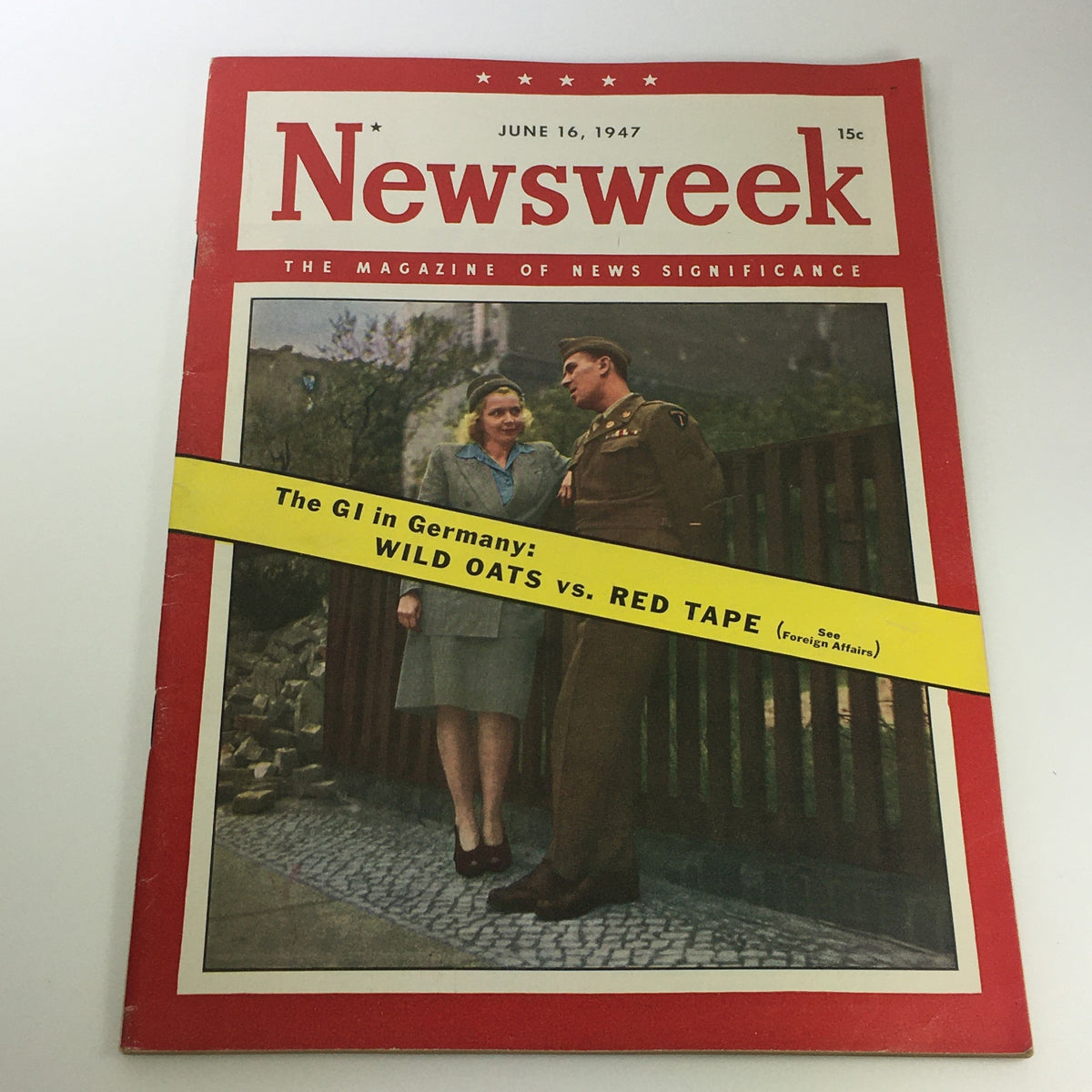

Description
Collector's Note – Why This Issue Matters
June 16, 1947 arrives at one of the most consequential and atmospherically distinctive moments in modern American history. The country was two years into the postwar era, and the extraordinary tensions of that transition were everywhere visible in public life. The wartime mobilization that had employed virtually every able-bodied American — in uniform, in factories, in administrative roles across the vast apparatus of the war effort — had given way to demobilization, and with it came a collision between the returning veteran's expectations of freedom and the bureaucratic infrastructure that the New Deal and the war had built and that showed no signs of dismantling itself simply because the fighting had stopped. The cover story of this issue — "Wild Oats vs Red Tape" — names that collision directly and evocatively: the wild oats of returning servicemen and a country eager to resume civilian life, set against the red tape of the regulatory and administrative apparatus that had grown enormously during the Depression and war years. This is not a peripheral editorial topic for June 1947 — it is the central political and social tension of the immediate postwar period, the debate that was reshaping American conservatism, energizing the Republican Congress that had swept into power in the 1946 midterm elections, and setting the terms for the domestic policy arguments that would define American politics for the next decade. A Newsweek cover story built around that tension in mid-June 1947 is a primary document of exactly how that debate was being framed and understood by one of the two most important American newsweeklies at a critical moment in its development. For collectors building a serious archive of postwar American journalism and political culture, the Newsweek vintage magazine collection is an essential resource for tracing how the publication's editorial voice engaged with the great domestic arguments of the late 1940s.
The specific framing of "Wild Oats vs Red Tape" rewards closer historical consideration, because it captures with unusual precision the ideological energy of the immediate postwar moment. The 80th Congress — the Republican-controlled body elected in November 1946 that Harry Truman would famously run against in 1948 as the "Do-Nothing Congress" — was in session in June 1947 and was actively engaged in dismantling or curtailing many of the New Deal and wartime regulatory structures that the cover story's "Red Tape" half represented. The Taft-Hartley Act, which significantly restricted union power and represented one of the most consequential pieces of domestic legislation of the entire postwar decade, was passed by Congress in June 1947 and vetoed by Truman on June 20th — just four days after this issue's cover date — in a confrontation that crystallized exactly the debate the cover story was describing. Newsweek, which was editorially more conservative than its primary competitor Time during this period, was covering that debate from a perspective generally sympathetic to the deregulatory impulse, and the "Wild Oats" framing — with its connotations of youthful energy and legitimate aspiration — suggests where the magazine's editorial sympathies lay. Understanding this issue's cover story in its full political context transforms it from a generic postwar piece into a specific and revealing document of how center-right American journalism was framing the great domestic policy battle of 1947. Collectors interested in the broader political and cultural landscape of the late 1940s will find the 1947 magazine archive invaluable for contextualizing this Newsweek issue within the larger story of a country negotiating the terms of its postwar identity.
The broader historical moment of June 1947 adds further layers of significance that any serious collector of this period's journalism will recognize and appreciate. The Marshall Plan — George Marshall's landmark proposal for European economic reconstruction — had been announced just eleven days before this issue's publication, on June 5th, in Marshall's commencement address at Harvard. The Cold War was crystallizing from a vague postwar tension into a structured geopolitical contest, with the Truman Doctrine having been announced in March 1947 and the institutional architecture of American Cold War foreign policy being assembled in real time. The National Security Act, which would create the CIA, the Joint Chiefs of Staff, and the modern Defense Department, was working its way through Congress in June 1947 and would be signed into law the following month. This single issue of Newsweek thus sits at the intersection of some of the most consequential domestic and international developments of the entire postwar decade — a moment when the shape of both American society and American foreign policy were being determined in ways that would define the country for the following half-century. That density of historical significance gives any well-preserved issue of a major American newsweekly from this specific week a documentary value that extends well beyond the particulars of its cover story.
About the Publication
Founded in 1933, Newsweek had established itself by June 1947 as one of the two dominant American newsweeklies alongside Time Magazine, competing for the readership of educated, politically engaged Americans who wanted comprehensive weekly coverage of national and international affairs presented with analytical depth and editorial perspective. The magazine's format combined domestic and international news coverage, political analysis, business reporting, cultural commentary, and the regular departments — medicine, science, education, religion, sports — that gave it a breadth of coverage matching the full range of its readers' interests. By the late 1940s, Newsweek had developed a somewhat more conservative editorial voice than its primary competitor, reflecting both the political sympathies of its ownership and the broader rightward shift in American journalism that followed the wartime consensus. Its readership in June 1947 was composed primarily of middle and upper-middle-class Americans who were deeply invested in the political and economic debates of the immediate postwar period — people who had lived through the Depression and the war and who cared intensely about what kind of country America would be now that both were over. Issues from this founding era of the Cold War and the postwar domestic settlement carry the particular energy of journalism produced in genuinely uncertain times, when the outcomes that historians now take for granted were not yet determined and when weekly magazines like Newsweek were performing the genuinely important function of helping their enormous readership make sense of a world that was changing faster than anyone could fully track.
Key Highlights Inside
- The cover story "Wild Oats vs Red Tape" — a feature that names and frames one of the central domestic political tensions of the immediate postwar period, the conflict between the deregulatory energy unleashed by demobilization and the administrative infrastructure built during the New Deal and wartime years. Published in the same week that Congress passed the Taft-Hartley Act and just days before Truman's veto, this cover story is a primary document of that debate at its most acute and consequential moment.
- News coverage and analysis consistent with Newsweek's June 1947 editorial scope — a publication covering a week in which the Marshall Plan had just been announced, the Taft-Hartley Act was being debated and passed, and the institutional architecture of American Cold War foreign policy was being assembled in real time. Any issue of a major American newsweekly from this specific week is a document of one of the most consequential seven-day periods in modern American history.
- Editorial content reflecting Newsweek's center-right perspective on the great domestic policy arguments of 1947 — coverage that illuminates how the magazine's editorial voice approached the conflict between New Deal regulatory governance and the deregulatory impulse of the Republican 80th Congress, providing researchers and collectors with a specific perspective within the broader spectrum of American journalistic opinion during the period.
- Photography and visual journalism consistent with Newsweek's late-1940s production standards — a publication that was competing directly with Time for both readers and advertising and that invested accordingly in the photographic and production quality that gave mid-century newsweeklies their immediate visual authority and their lasting value as documentary archives of the period they covered.
- Advertising pages that document the consumer culture of mid-June 1947 America — a country in the midst of the pent-up consumer demand of the postwar boom, with products, brands, and commercial imagery that capture the material aspirations and economic realities of a society transitioning from wartime austerity to the prosperity of the late 1940s with a specificity that no retrospective account can replicate.
Condition & Rarity
Surviving copies of Newsweek from June 16, 1947 are now approaching eighty years old, and their condition reflects the wide and largely unplanned range of circumstances through which a mass-circulation weekly newsmagazine has traveled across nearly eight decades of storage, moves, estate dispersals, and the gradual attrition that claims a significant portion of any original press run over time. The condition profile described for copies of this issue — newsstand origin with no label, plastic protective covering included, edges and binding showing signs of wear including marks and rips — places it in the Good range by standard periodical grading criteria for a mass-market weekly of this extraordinary age, which is an honest and appropriate assessment for a publication that has survived nearly eighty years largely without archival intervention. The newsstand origin with no address label is a meaningful positive condition attribute, preserving the full visual integrity of the cover without the subscriber label defacement that was applied to the majority of Newsweek's enormous circulation in this period — a distinction that matters for display purposes and that gives a label-free cover its additional collector value relative to subscriber copies of the same issue. The plastic protective covering indicates deliberate preservation at some point in the magazine's long history, which is a meaningful differentiator for a mass-circulation newsweekly of this age and original audience: most surviving copies of Newsweek from 1947 were not purpose-preserved, and copies that received protective treatment at any point in their history typically show better overall condition than those that did not. Edge wear, binding wear, marks, and rips are entirely expected and accepted characteristics of a nearly eighty-year-old weekly magazine, and experienced collectors of late-1940s periodicals evaluate these attributes in context rather than as isolated deficiencies. Complete and unclipped interior pages — particularly the cover story feature and any photography associated with the Taft-Hartley debate and Marshall Plan coverage — remain the most critical underlying condition variable for research and historical documentation purposes.
Looking for More Issues Like This?
Newsweek issues from June 1947 — one of the most historically dense weeks of the entire postwar decade, encompassing the Marshall Plan announcement, the Taft-Hartley debate, and the full crystallization of the domestic and foreign policy arguments that would define American politics for the following generation — are among the more historically significant pieces in the vintage American newsweekly collector market, and finding them in newsstand condition with protective covering and intact covers is a genuinely patient pursuit for issues approaching their eighth decade of existence. The specific "Wild Oats vs Red Tape" cover story gives this issue an editorial identity and a historical focus that researchers and political historians of the period will recognize immediately and value accordingly. If this June 16, 1947 issue has already found a home, the full Newsweek vintage collection is the most comprehensive place to explore what else has surfaced from across the magazine's long publishing history — including other late-1940s issues that document the great political and cultural arguments of the postwar settlement with the same combination of editorial perspective and period specificity that makes this issue such a rich historical document. Collectors building a broader portrait of late-1940s American political culture and journalism will find the 1947 magazine archive an invaluable companion resource, drawing together publications from across the full spectrum of American print journalism in one of the most consequential years of the entire postwar era.