
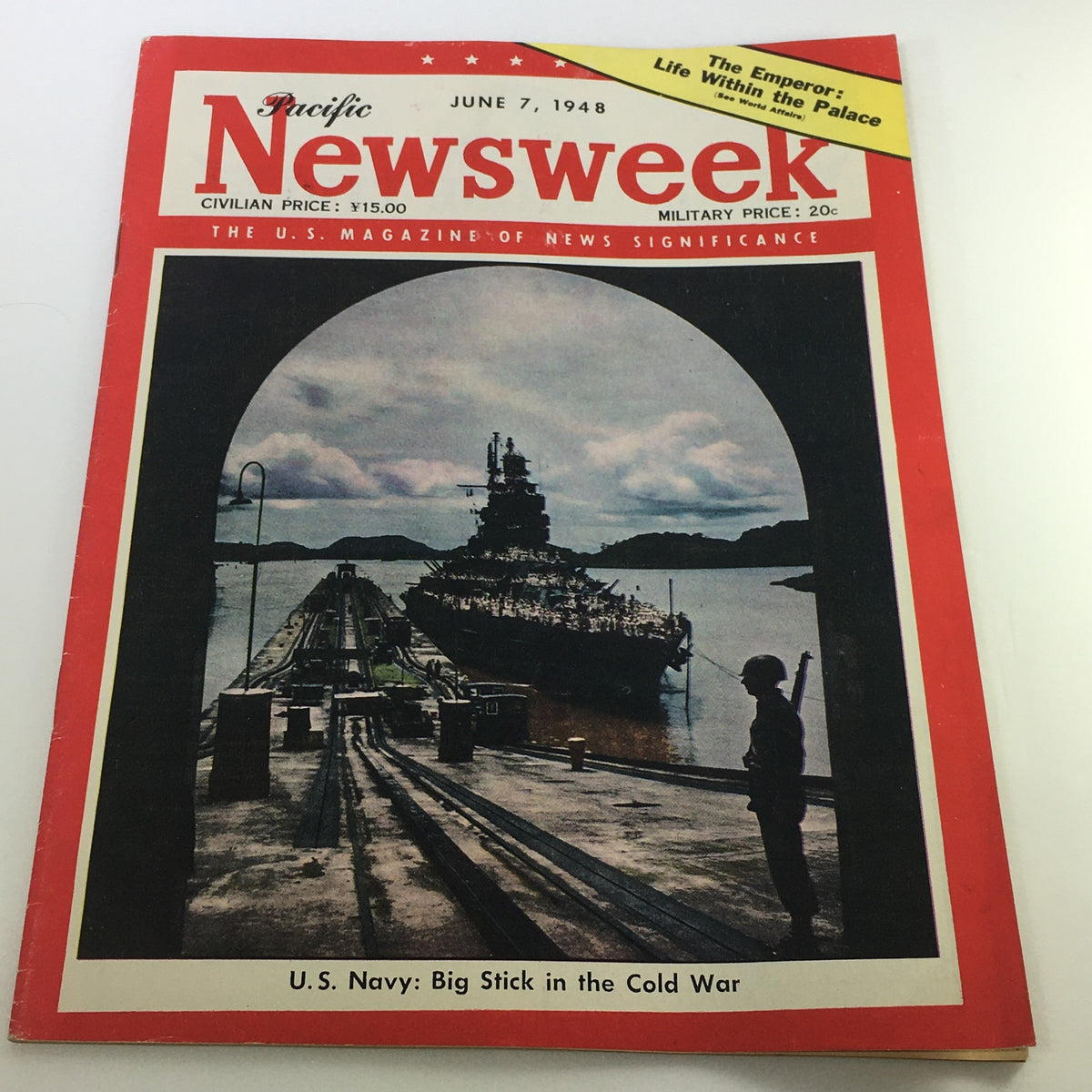

Description
Collector's Note – Why This Issue Matters
June 7, 1948 fell at one of the most consequential intersections in the history of American foreign and military policy. The United States was barely three years removed from the end of World War II, and the shape of the postwar world was still being contested, negotiated, and in some places actively fought over. In Europe, the Soviet Union had just initiated the Berlin Blockade on June 24 — though that particular crisis was still weeks away when this issue went to press, the underlying tensions that would produce it were already dominating diplomatic cables and newspaper front pages. In Asia, the Pacific Theater that had consumed so much American blood and treasure between 1941 and 1945 was being reconceived as a strategic arena for a new kind of conflict: not a declared war between uniformed armies, but the slow, grinding ideological and geopolitical competition that would come to be called the Cold War. A Newsweek cover story dedicated to the U.S. Navy and the Pacific in this precise month was not an accident of editorial scheduling. It reflected a genuine and urgent national conversation about what America's naval presence in the Pacific meant, what it was for, and how long it needed to be maintained in the absence of a formal enemy.
The U.S. Navy's role in the Pacific in 1948 was a subject of real political and strategic controversy. The National Security Act of 1947 had only just unified the American military under a single Department of Defense, and the fierce inter-service rivalries that followed — particularly between the Navy and the newly independent Air Force — were playing out in budget hearings, strategic planning documents, and the pages of magazines like Newsweek. Navy leadership was actively making the case for the continued centrality of carrier-based sea power in American strategic doctrine at a moment when advocates of strategic air power were arguing that long-range bombers had rendered surface fleets obsolete. A cover feature on the Navy and the Pacific in June 1948 lands squarely in the middle of that debate, making this issue a valuable primary document for researchers and collectors focused on early Cold War military history, the postwar reorganization of American defense policy, or the long arc of U.S. engagement in the Asia-Pacific region. Collectors building holdings around this era will find substantial context in the Newsweek magazine collection at OriginalMagazines.com, which spans decades of the publication's coverage of American and world affairs, as well as the broader 1948 magazine collection, where the full sweep of that pivotal postwar year comes into view across multiple titles and subjects.
What makes a specific dated issue of Newsweek from this period so valuable as a historical artifact is precisely its granularity. General histories of the early Cold War are abundant, but the week-by-week texture of how Americans were actually being informed about these developments — what framing was used, what concerns were foregrounded, what the cover image looked like on a newsstand in June 1948 — exists only in surviving physical copies of the magazines themselves. This issue captures not just the facts of American naval policy in the Pacific but the particular way those facts were being communicated to an educated general readership in the immediate postwar years, before the Korean War, before the fall of China, before the full architecture of the Cold War had fully solidified. That contemporaneity is the thing that cannot be replicated by any later secondary source, and it is what gives issues like this one their enduring value to serious collectors of twentieth-century American history.
About the Publication
Newsweek was founded in 1933 and by the late 1940s had established itself as one of the two dominant American weekly news magazines alongside Time, with a national circulation reaching into the millions and a readership that skewed toward educated, politically engaged adults interested in domestic politics, foreign affairs, business, and culture. Its editorial format combined long-form reported features with shorter departmental coverage across a consistent set of topic areas — national affairs, international news, business, science, the arts — and it was known for a somewhat more measured and less overtly opinionated tone than its chief rival. The cover story format, in which a single subject was given extended treatment and a full painted or photographic cover image, was central to Newsweek's identity throughout this era and made individual issues readily identifiable by subject to collectors and researchers. By 1948 the magazine had developed the visual language and editorial authority that would define it through the height of its influence in the postwar decades, and its coverage of military and foreign affairs carried genuine weight with policymakers and informed citizens alike.
Key Highlights Inside
- U.S. Navy and the Pacific as the cover story: The lead feature examines American naval presence and strategic posture in the Pacific in mid-1948 — a subject situated directly at the intersection of postwar demobilization debates, inter-service rivalry over defense budgets, and the emerging logic of Cold War containment in Asia.
- Early Cold War context throughout: Any issue of Newsweek from June 1948 would have been produced against the backdrop of rapidly deteriorating U.S.-Soviet relations in Europe, the ongoing civil war in China between Nationalist and Communist forces, and the first stirrings of what would become a decades-long American strategic commitment to the Pacific region.
- Postwar military policy debate: The summer of 1948 was an active period in the public and congressional debate over American defense organization and doctrine following the National Security Act of 1947, and Newsweek's coverage consistently engaged with those arguments in terms accessible to a general readership.
- Domestic and international news coverage: Consistent with its weekly format, this issue would have included Newsweek's standard departmental coverage of national politics, business, science, and culture as they stood in the first week of June 1948 — a presidential election year in which Harry Truman's prospects were widely considered uncertain, adding further political texture to any issue from this period.
- Period advertising as historical record: The commercial advertisements in a June 1948 issue of Newsweek constitute their own category of historical documentation, capturing the consumer economy, corporate messaging, and visual culture of postwar America at a specific and unrepeatable moment.
Condition & Rarity
Newsstand origin is the baseline condition attribute serious collectors prioritize in vintage weekly news magazines, and its significance here is straightforward: a copy that reached readers through newsstand distribution rather than postal subscription was never folded, rolled, or affixed with mailing labels, and was never subjected to the mechanical stress and moisture exposure that the postal system routinely inflicted on subscription copies. The absence of a label on a surviving copy of this issue is a meaningful positive indicator, preserving the cover art and masthead in the condition they were designed to be seen. Edge wear, binding stress, and minor marks are entirely expected in a magazine now approaching eighty years of age and should be read as evidence of honest survival rather than neglect — the relevant question for any surviving copy of this issue is always page integrity and legibility, not cosmetic perfection. The protective plastic sleeve currently housing this copy represents sound archival practice; the coated paper stock used in Newsweek's cover printing holds up reasonably well over time, but the interior pages, printed on lighter newsprint-grade stock, benefit considerably from being shielded from ongoing light and humidity exposure. Weekly news magazines from this era were produced for immediate consumption and discarding, not preservation — print runs were large, but survival rates in collectible condition after eight decades are a small fraction of original circulation, and copies retaining structural integrity with covers intact and pages readable occupy the upper tier of what the market typically produces.
Looking for More Issues Like This?
A June 1948 Newsweek with a U.S. Navy and Pacific cover story in clean newsstand condition is a specific find that rewards patience — these issues don't surface constantly. If this one has already moved on, the Newsweek collection at OriginalMagazines.com is the most productive place to continue the search, with issues spanning decades of the magazine's coverage of American and world affairs available to browse. For collectors whose interest extends to the broader sweep of postwar American print culture, the 1948 magazine collection offers a wide range of surviving titles from this pivotal year — one of the richest single years in twentieth-century American history for anyone willing to explore it through the magazines that were actually there.