
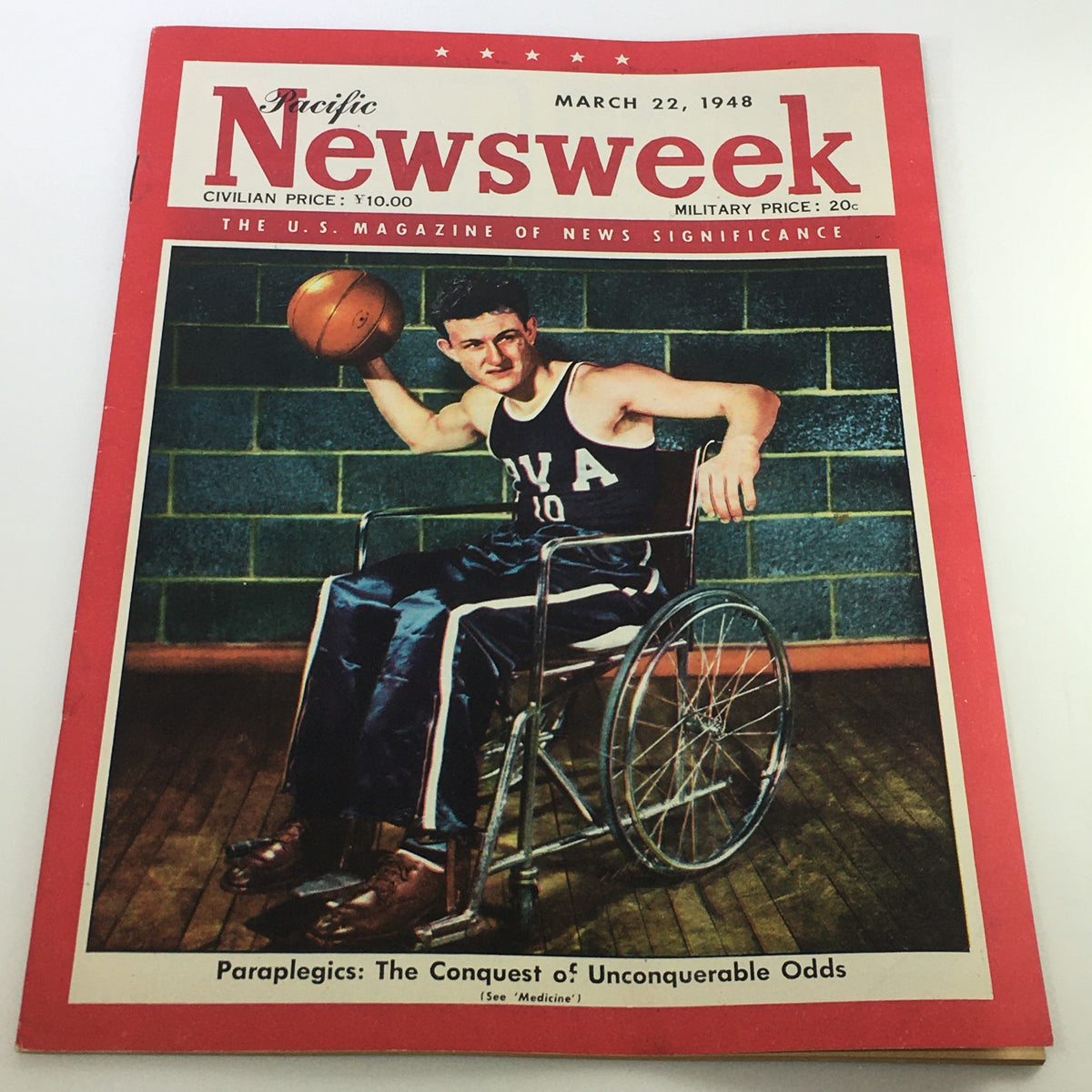

Description
Collector's Note – Why This Issue Matters
The March 22, 1948 issue of Newsweek magazine featuring paraplegics on the cover is a primary document of one of the most consequential and most politically underexamined aspects of the immediate postwar period — the return of severely wounded veterans to American civilian life and the specific challenge of integrating men with spinal cord injuries into a society that had no established infrastructure for their care, rehabilitation, or participation. The paraplegic veterans of the Second World War represented a new category of severely disabled survivors that previous wars had not produced in comparable numbers, because the same advances in battlefield medicine and surgical technique that were saving men who would previously have died from their wounds were also returning home men with permanent, profound disabilities. Spinal cord injury rehabilitation was in 1948 a field in its institutional infancy: the Paralyzed Veterans of America had been founded in 1946, the first spinal cord injury centers in American hospitals had been established only in the final years of the war, and the specific challenges of paraplegic veterans — housing accessible to wheelchairs, employment opportunities that accommodated permanent mobility limitations, the specific medical complications of long-term spinal cord injury — were being addressed by an American society that had celebrated these men's sacrifice without yet fully reckoning with the practical implications of their permanent disabilities. A Newsweek cover story on paraplegics in March 1948 was one of the primary vehicles through which the American mainstream press was bringing this specific population's challenges to public attention, and it represents a historically significant document of postwar disability awareness and advocacy at its earliest institutional phase. Collectors building a focused archive of postwar American press will find the Newsweek magazine collection at OriginalMagazines.com the most comprehensive resource for issues from this critical transitional period.
The broader historical context of March 22, 1948 gives this issue a significance that extends well beyond its paraplegics cover story. By March 1948, the Cold War was in the process of its most defining early crystallization: the Marshall Plan had been announced in June 1947 and was being debated in Congress as this issue appeared; the February 1948 Communist coup in Czechoslovakia had just occurred three weeks earlier, producing one of the most significant shocks to Western European democratic stability in the postwar period; and the Berlin Blockade — which would begin in June 1948 and produce the Berlin Airlift — was less than three months away. The "Pacific" reference in the listing's title suggests coverage of postwar Pacific affairs at a moment when the American occupation of Japan was in full operation, when the Chinese Civil War between Nationalist and Communist forces was approaching its decisive phase, and when the specific character of the postwar Pacific order was being determined by events that would shape the following decade's most consequential conflicts. A Newsweek issue in this specific week was therefore engaging simultaneously with the domestic challenge of veteran rehabilitation and the international crises that were defining the early Cold War, producing a document of unusual historical density. The 1948 magazines collection at OriginalMagazines.com gathers publications from one of the most consequential years in modern American political and international history.
The specific timing of the paraplegics cover in March 1948 also places it within an important legislative and advocacy context. The Servicemen's Readjustment Act of 1944 — the GI Bill — had begun transforming the economic prospects of returning veterans, but its provisions for disabled veterans were less comprehensive than they would become, and the specific medical and social needs of paraplegic veterans were in 1948 still being negotiated between advocacy organizations like the Paralyzed Veterans of America, the Veterans Administration, and Congress. A Newsweek cover story on this population at this specific moment was therefore participating in a live public policy conversation rather than documenting settled historical fact — making it a primary source for the history of disability rights, veterans advocacy, and the specific legislative and institutional responses to the postwar disabled veterans population.
About the Publication
Newsweek was founded in 1933 and had established itself by March 1948 as one of the two most authoritative American newsweeklies alongside Time, with a format combining cover stories and feature journalism with department coverage across national affairs, foreign news, business, science, medicine, education, the arts, and sport. By March 1948, the magazine's coverage of postwar domestic and international affairs was engaged with the full range of the transitional challenges that the end of the Second World War had produced — the veterans' return, the European recovery, the emerging Cold War, and the specific social and political questions that the war's aftermath was forcing onto the American national agenda.
Key Highlights Inside
- Paraplegic veterans cover story — primary document of postwar disability awareness — a major cover feature on the challenges facing paraplegic veterans in the immediate postwar period, published at the earliest institutional phase of American spinal cord injury rehabilitation and advocacy, providing primary documentation of how the mainstream press was engaging with this specific and previously invisible population's needs in 1948.
- Pacific affairs coverage — postwar Pacific order documentation — coverage of the postwar Pacific situation at the specific moment when the American occupation of Japan was in full operation, the Chinese Civil War was approaching its decisive phase, and the character of the postwar Pacific order was being determined by events that would produce Korea and the full Cold War's Asian dimension.
- Post-Czechoslovakia coup Cold War context — published three weeks after the February 1948 Communist coup in Czechoslovakia — one of the most significant shocks to Western democratic stability in the early postwar period — this issue appears in the specific atmosphere of maximum early Cold War anxiety that preceded the Berlin Blockade by less than three months.
- Newsstand edition, no label — confirmed clean cover presentation — the confirmed newsstand origin and absence of address label places this issue in the more desirable subset of surviving examples, preserving the cover design in its undisturbed state and distinguishing it from the labeled subscriber copies that represent the majority of what survives from any given Newsweek issue of this era.
- Note on additional interior content: Specific additional features, columns, and department coverage beyond the paraplegics cover story and Pacific coverage are unconfirmed from available sourcing for this individual issue. The highlights above reflect what is verifiable from the cover story, the listing's documented content references, the publication date, and Newsweek's thoroughly documented editorial format and priorities for the period.
Condition & Rarity
Surviving copies of this issue must be assessed with full appreciation of what seventy-eight years of existence means for a weekly newsweekly printed on the paper stock typical of late-1940s American periodical publishing. Paper from this era has been accumulating the effects of age, humidity, and handling for nearly eight decades, producing the yellowing, brittleness, and edge fragility that characterize postwar-era magazines in private rather than archival storage. The listing honestly discloses edge and binding wear with possible marks and rips — expected and authentic condition characteristics at this age that should be assessed against the accompanying photographs for location and extent. The absence of a newsstand address label is a positive condition attribute that preserves the cover in its undisturbed state. The plastic protective covering indicates deliberate preservation effort. For a cover of this specific historical significance — paraplegic veterans in March 1948, at the earliest phase of American disability advocacy, in the week after the Czechoslovak coup and three months before the Berlin Blockade — collector and historical relevance extends across a wide condition range for veterans history researchers, disability studies historians, and Cold War-era American press collectors.
Looking for More Issues Like This?
Early postwar Newsweek issues from 1948 that engaged with the specific domestic and international challenges of the transitional period between the war's end and the Cold War's full consolidation — and the March 22 paraplegics cover, documenting a historically underexamined population's challenges at the earliest phase of organized advocacy, is among the more historically specific and most humanly significant of these — are consistently sought by collectors engaged with veterans history, disability rights history, and the specific cultural and political landscape of postwar America. If you're building a collection of the magazine's most historically resonant early postwar covers, the Newsweek magazine collection at OriginalMagazines.com is the most comprehensive place to browse what's currently available. The 1948 magazines collection offers essential context from one of the most consequential years in modern American political and social history — the Berlin Blockade, the Truman election, the Marshall Plan, and the specific human costs of the war that the paraplegics cover was bringing to public attention.