
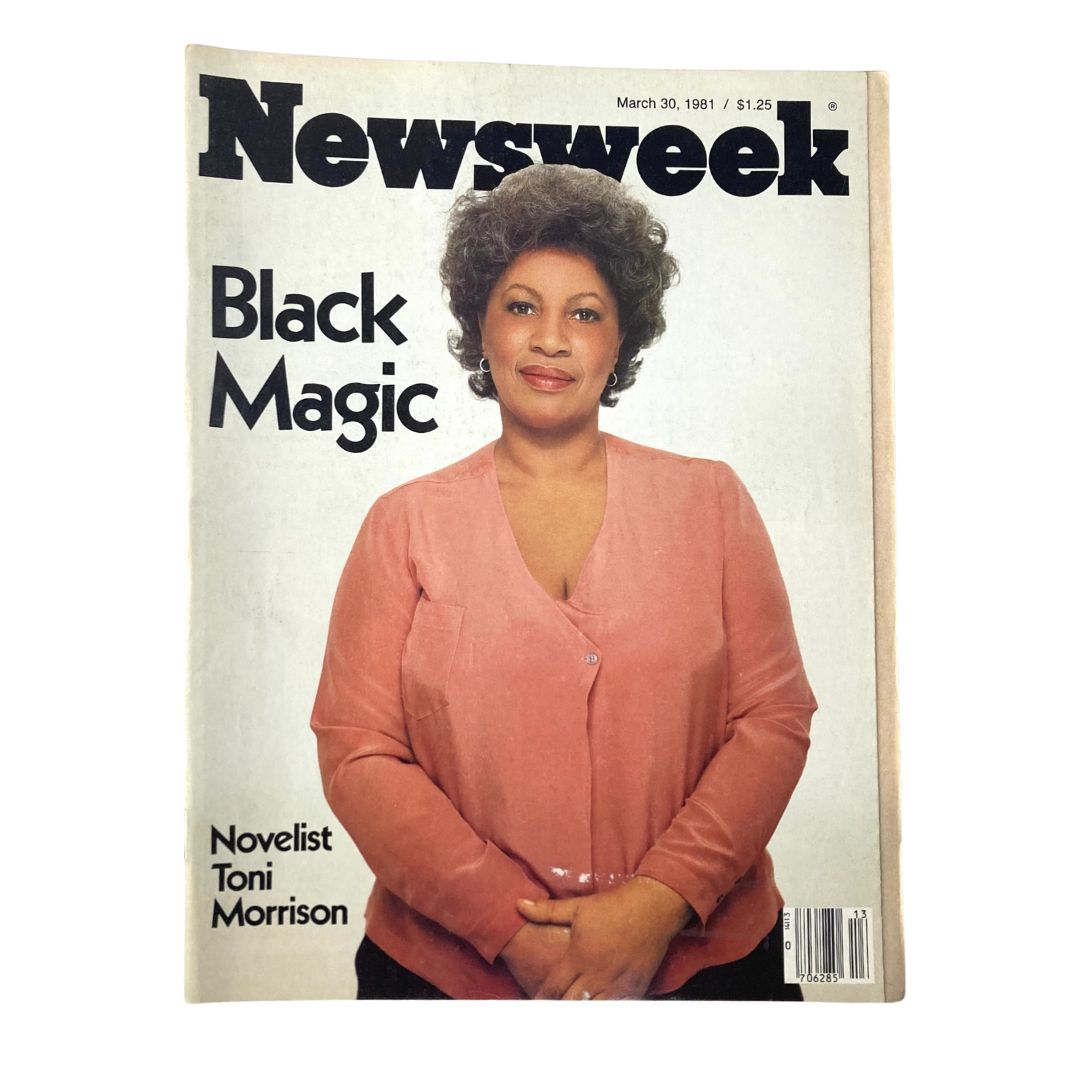


Description
Collector's Note – Why This Issue Matters
The March 30, 1981 issue of Newsweek featuring Toni Morrison on the cover is one of the most historically significant literary cover features in the publication's history — a primary document of the moment when American literary culture, and more specifically the mainstream media that interpreted it for a mass audience, fully recognized Morrison's stature as one of the most important living writers in the English language. By March 1981, Morrison had published four novels: The Bluest Eye (1970), Sula (1973), Song of Solomon (1977), and Tar Baby, which had been released just weeks before this issue appeared. Song of Solomon had won the National Book Critics Circle Award in 1977 and had been selected for the Book of the Month Club — the first novel by a Black American writer since Richard Wright to receive that distinction — and had established Morrison beyond any serious critical doubt as a writer of the first rank. Tar Baby's publication was itself a major literary event, and Newsweek's decision to put Morrison on its cover in connection with that publication reflects the full weight of a literary institution recognizing an artist whose achievement demanded the magazine's broadest possible acknowledgment. Placing a Black American woman novelist on the cover of the most widely read American news weekly was not an incidental editorial decision in 1981 — it was a statement about who mattered in American literature and American culture, and that statement had been earned by writing of extraordinary power and originality. Collectors building a serious archive of Toni Morrison's documented public presence across publications will find the Newsweek magazine collection a valuable resource for tracking how the publication engaged with the most significant literary and cultural figures of the postwar era.
The specific timing of this cover — March 30, 1981 — gives it a particular historical weight that deepens its significance beyond the literary context alone. The date falls one day before the assassination attempt on President Reagan on March 30, 1981, which means this issue was on newsstands at the precise moment when one of the most dramatic political events of the decade was unfolding. The Newsweek issue that readers were holding when they heard about the Reagan shooting was the one with Toni Morrison on the cover — a historical coincidence that makes surviving copies of this issue a specific kind of time capsule, present at both a major literary moment and an extraordinary political one simultaneously. That dual historical positioning is entirely invisible from the magazine's content but is part of the documentary context that gives primary sources from specific dates their particular character as artifacts. The listing's mention of a compelling interview with Morrison adds a specific research value to the issue beyond its cover significance — Morrison was a powerful and intellectually demanding interlocutor whose press interviews from the early 1980s are among the most substantive in the literary journalism of the period. Collectors focused on the early 1980s will find that 1981 magazine issues document a year of extraordinary political and cultural density with the immediacy that only contemporaneous journalism can provide.
Morrison's subsequent trajectory gives this 1981 Newsweek cover a retrospective historical significance that was not yet fully apparent at the time of publication. She would go on to publish Beloved (1987), which won the Pulitzer Prize for Fiction, and to receive the Nobel Prize in Literature in 1993 — the first Black American writer to be so honored. The Nobel citation's description of her as an author who "in novels characterized by visionary force and poetic import, gives life to an essential aspect of American reality" captures something of what the Newsweek cover in 1981 was already recognizing, even before the full scope of her achievement had been realized. A Newsweek cover from 1981 therefore documents Morrison at a specific point in a career whose ultimate magnitude was already visible to the most perceptive observers, but whose full dimensions were still being determined by the work that remained to be written.
About the Publication
Newsweek Magazine was founded in 1933 and had developed by 1981 into one of the two dominant American weekly news magazines alongside Time, reaching an educated, broadly engaged readership that relied on it as a primary framework for understanding national and international events. Its editorial format combined domestic and international news, political analysis, cultural coverage, arts journalism, and photography into a weekly package that functioned as both primary news source and interpretive framework for millions of American readers. By 1981, Newsweek's arts and cultural coverage — including its literary journalism — was among the most substantive in mainstream American magazine publishing, and its decisions about which cultural figures warranted cover treatment were influential indicators of mainstream cultural consensus about who and what mattered in American intellectual and artistic life. A Morrison cover in March 1981 represented Newsweek deploying its full institutional authority as the arbiter of mainstream cultural significance in service of an unambiguous statement about the importance of her work.
Key Highlights Inside
- Toni Morrison cover feature with interview — appearing in connection with the publication of Tar Baby, documenting Morrison at the moment of her fourth novel's release and providing one of the period's most substantive mainstream journalism engagements with her work and her thinking about race, literature, and American culture.
- March 30, 1981 publication date — placing this issue on newsstands on the day of the assassination attempt on President Reagan, giving surviving copies a specific historical positioning at the intersection of a major literary event and one of the most dramatic political moments of the decade.
- Newsweek cover recognition of a Black American woman novelist — a specific and historically significant editorial statement in 1981, representing mainstream American media's full acknowledgment of Morrison's stature at a moment when such recognition from the mainstream press carried genuine cultural weight beyond the literary world.
- Absence of a mailing label — confirming newsstand origin and preserving the full surface integrity of what is one of the more historically significant literary cover images in Newsweek's run, without the adhesive damage that subscription delivery would have caused.
- Note: Specific additional article titles, interview length and content, and other editorial details beyond what is indicated by the cover feature and listing description are unconfirmed for this issue. The above reflects what is verifiable from the cover subject, date, and the thoroughly documented history of Toni Morrison's career and the publication of Tar Baby in early 1981.
Condition & Rarity
Excellent condition with light wear typical for age is a strong and meaningful grade for a Newsweek from March 1981 now more than forty years old, and the specific preservation attributes noted make this a particularly well-maintained example within the surviving population of this historically significant issue. Excellent condition indicates a copy showing essentially no meaningful handling wear — light surface aging consistent with careful storage rather than active reading use, with overall presentation quality that reflects deliberate preservation. The absence of a mailing label is the most directly relevant positive condition attribute for collector evaluation: Newsweek's circulation in 1981 was predominantly subscription-based, and the statistical majority of surviving copies carry labels applied directly to the front cover — labels that cause adhesive damage or paper residue that permanently affects the visual presentation of what is, in this case, a historically significant cover portrait of one of the most important American writers of the twentieth century. A label-free newsstand copy preserves the full visual integrity of that cover image. A protective plastic covering applied to a copy in this condition indicates ongoing deliberate preservation consistent with the excellent overall grade.
Looking for More Issues Like This?
Label-free excellent-condition copies of the March 30, 1981 Newsweek featuring Toni Morrison are among the more specifically significant literary cover issues in the publication's history, and their combination of literary historical importance, specific cultural positioning, and honest excellent condition makes them worth careful attention when they surface. The broader Newsweek magazine collection is the most reliable starting point for finding other significant issues from across the publication's history, including other major literary and cultural cover features from the decades of its greatest mainstream authority. Collectors building a focused archive of 1981 across American cultural and political publications will find the complete 1981 magazine collection a valuable resource for locating other significant issues from this extraordinary year in American public life.