

Description
Collector's Note – Why This Issue Matters
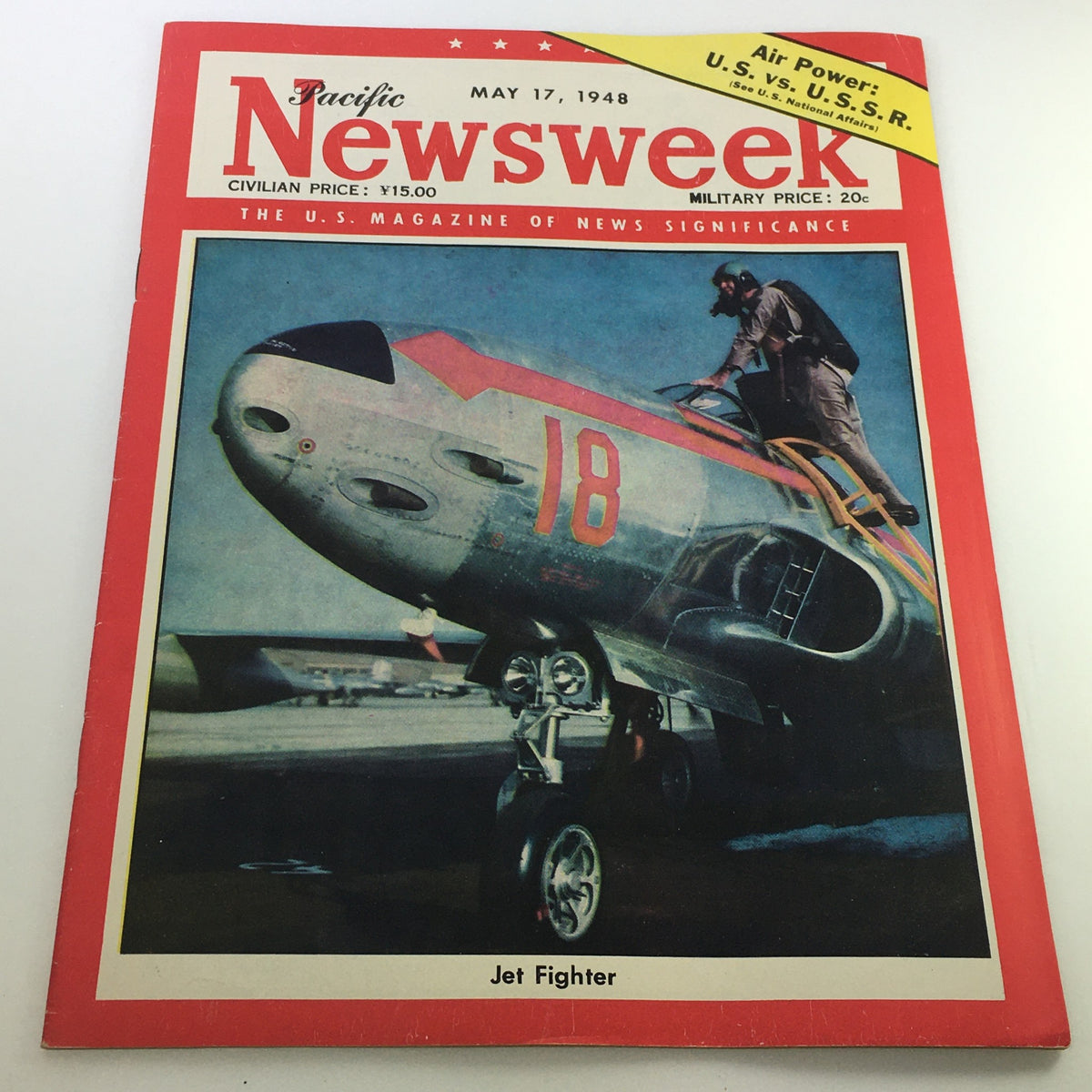
The May 17, 1948 issue of Newsweek magazine featuring a jet fighter on the cover is a primary document of American military aviation at one of the most consequential phases in the history of air power — the specific transition from piston-engine to jet propulsion that transformed warfare, commercial aviation, and the strategic balance of the early Cold War with extraordinary speed in the years immediately following the Second World War. The jet fighter on the cover of this May 1948 issue was not merely a technological novelty but a strategic reality whose implications were reshaping American military planning, defense budgeting, and alliance policy in real time. The United States Air Force had been established as an independent military branch just eight months earlier, in September 1947, and the specific question of how jet technology would define the new service's strategic doctrine — the relative roles of strategic bombing, tactical air support, and air superiority — was one of the most actively contested in American military policy. The Berlin Blockade was just weeks away, beginning on June 24, 1948, and the specific military and technological context that this May 1948 jet fighter cover was documenting would be immediately tested by the crisis that followed. A Newsweek cover on jet fighters in May 1948 was therefore engaging with the most dynamic and most strategically consequential technology in contemporary military affairs, at the precise moment when American air power's Cold War identity was being defined. Collectors building a focused archive of early Cold War-era American press documentation of military technology will find the Newsweek magazine collection at OriginalMagazines.com the most comprehensive resource for issues from this critical period.
The May 17, 1948 date places this issue at a specific and historically instructive moment in American aviation history. The United States had operational jet fighters by this point — the Lockheed P-80 Shooting Star had been in service since the final months of the Second World War — and the development of the more capable aircraft that would define the Korean War's air combat just two years later was in active progress. The Soviet Union's development of its own jet aircraft, informed substantially by the German wartime technology that Soviet forces had captured, was not yet public knowledge in May 1948, making the specific strategic implications of jet parity — and what it would mean for the American nuclear delivery capability that was the primary guarantee of Western security — a subject of considerable uncertainty and considerable importance to American strategic planners. The "Pacific" coverage referenced in the listing's title adds another dimension of postwar geopolitical complexity, likely engaging with either the American occupation of Japan, the Chinese Civil War's increasingly decisive phase, or the specific military architecture that American forces in the Pacific were maintaining as the region's Cold War alignment was being determined. The 1948 magazines collection at OriginalMagazines.com gathers publications from one of the most consequential years in the entire history of the Cold War's formation.
The broader significance of May 1948 as a moment in American history gives this issue's jet fighter cover its full contextual weight. The State of Israel had declared independence on May 14, 1948 — just three days before this issue appeared — producing the first Arab-Israeli War and one of the most significant geopolitical developments of the postwar period. The Marshall Plan had been signed into law by President Truman on April 3, 1948, just six weeks before this issue, committing the United States to the economic reconstruction of Western Europe as the primary instrument of its anti-communist strategy. In this atmosphere of multiple simultaneous crises, American air power — and the jet fighters that represented its most advanced technological expression — was the primary visible symbol of the military capability that American diplomacy was ultimately backed by, giving the May 1948 jet fighter cover a strategic resonance that extends well beyond its immediate military technology subject.
About the Publication
Newsweek was founded in 1933 and had established itself by May 1948 as one of the two most authoritative American newsweeklies alongside Time, with a format combining cover stories and feature journalism with department coverage across national affairs, foreign news, business, science, medicine, education, the arts, and sport. Its military technology and foreign affairs coverage in the immediate postwar period was among its most sustained and most consequential journalism, engaging with the specific developments — jet propulsion, atomic weapons, the emerging Cold War alliance structure — that were defining the postwar strategic balance with an analytical depth that its readership of educated American professionals demanded.
Key Highlights Inside
- Jet fighter cover — American air power in Cold War strategic context — cover story documentation of the jet aviation technology that was transforming American military capability in the specific period when the new United States Air Force was being established as an independent branch and when the Cold War's strategic logic was making air power — and specifically jet-propelled air power — the primary instrument of American military deterrence.
- Published three days after Israeli independence declaration — appearing May 17, 1948, three days after Israel declared independence on May 14 and the first Arab-Israeli War began, this issue documents the immediate postwar period's extraordinary geopolitical density, with a jet fighter cover story appearing simultaneously with one of the most significant political events in the modern Middle East's history.
- Six weeks post-Marshall Plan signing — Cold War strategy at maximum activity — published six weeks after Truman signed the Marshall Plan on April 3, 1948, in the specific atmosphere of maximum American Cold War strategic activity that characterized the spring of 1948, when the Berlin Blockade was just weeks away and every instrument of American power — including air power — was being assessed for its Cold War utility.
- Pacific affairs coverage — postwar Pacific order documentation — coverage of the postwar Pacific situation at a moment when the American occupation of Japan, the Chinese Civil War, and the emerging Pacific security architecture were all in active and consequential phases, providing primary documentation of the multiple simultaneous crises that characterized the early Cold War's global scope.
- Newsstand edition, no label — confirmed clean cover presentation — the confirmed newsstand origin and absence of address label places this issue in the more desirable subset of surviving examples, preserving the jet fighter cover design in its undisturbed state and distinguishing it from the labeled subscriber copies that represent the majority of what survives from any given Newsweek issue of this era.
Condition & Rarity
Surviving copies of this issue must be assessed with full appreciation of what seventy-eight years of existence means for a weekly newsweekly printed on the paper stock typical of late-1940s American periodical publishing. Paper from this era has been accumulating the effects of age, humidity, and handling for nearly eight decades, producing the yellowing, brittleness, and edge fragility that characterize postwar-era magazines in private rather than archival storage. The listing honestly discloses edge and binding wear with possible marks and rips — expected and authentic condition characteristics at this age that should be assessed against the accompanying photographs for location and extent relative to the jet fighter cover design. The absence of a newsstand address label is the most significant positive condition attribute, preserving the cover in its undisturbed state. The plastic protective covering indicates deliberate preservation effort. For a cover of this specific Cold War historical and aviation technological significance — jet fighters in May 1948, three days after Israeli independence and six weeks after the Marshall Plan — collector and historical relevance extends across a wide condition range for military history researchers, aviation history collectors, and early Cold War-era American press archivists.
Looking for More Issues Like This?
Early Cold War Newsweek covers from the extraordinary spring of 1948 — when the Marshall Plan, Israeli independence, the approaching Berlin Blockade, and the jet aviation revolution were all converging simultaneously — are among the most historically dense and most collecting-significant in the magazine's postwar run, and the May 17 jet fighter issue is a particularly consequentially timed example. If you're building a collection of the magazine's most historically resonant early Cold War covers, the Newsweek magazine collection at OriginalMagazines.com is the most comprehensive place to browse what's currently available. The 1948 magazines collection offers essential context from the most consequential year of the Cold War's formation — the year when the Berlin Blockade, the Marshall Plan, Israeli independence, and the Soviet atomic program's acceleration were all simultaneously defining the postwar world order.