
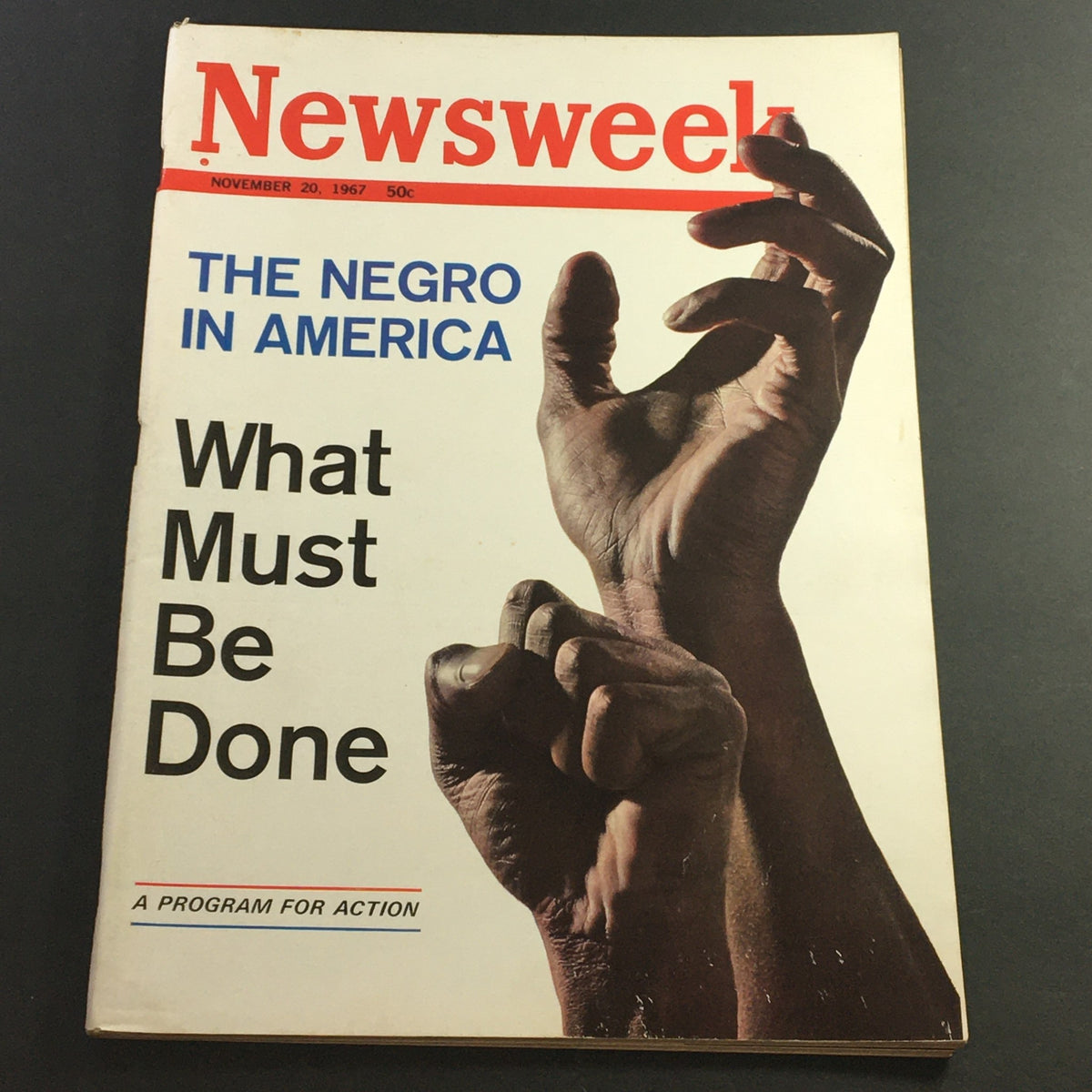


Description
Collector's Note – Why This Issue Matters
The November 20, 1967 issue of Newsweek — titled "The Negro in America" — stands as one of the most consequential newsweekly publications of the entire civil rights era, a document that captures American society at one of its most volatile and self-questioning moments. By the autumn of 1967, the United States was straining under the simultaneous pressure of multiple crises that refused to be separated from one another: a deeply unpopular and increasingly costly war in Vietnam that was disproportionately drafting young Black men, a wave of urban uprisings that had convulsed Detroit, Newark, Cincinnati, Atlanta, and more than 150 other American cities across that summer alone, and a national reckoning with systemic racial inequality that had been building for decades and could no longer be managed through incremental political gestures. The civil rights legislation of 1964 and 1965 had promised transformative change, but by late 1967 the gap between that promise and lived reality had become impossible for any honest observer to ignore. This issue of Newsweek arrived precisely at that inflection point — and for collectors who focus on vintage Newsweek issues documenting American social history, it remains among the most referenced and sought-after single issues the publication ever produced.
The framing of the cover — direct, unflinching, and deliberately stripped of the hedging language that had long characterized mainstream American journalism's approach to race — reflected a growing editorial recognition that so-called neutral coverage was itself a political act. The summer of 1967 had been called the "Long Hot Summer" by journalists and politicians alike, and it forced every major media institution in the country to confront its own complicity in the conditions it had spent decades underreporting. President Lyndon B. Johnson convened the National Advisory Commission on Civil Disorders — what would become known as the Kerner Commission — in July 1967, charging it with answering three deceptively simple questions: What happened? Why did it happen? What can be done to prevent it from happening again? The Commission's report, released in February 1968, would famously conclude that America was "moving toward two societies, one black, one white — separate and unequal," and would directly indict the mainstream American press for its failure to represent Black communities honestly or completely. This Newsweek issue predates that report's release by only a few months, placing it squarely in the charged and urgent atmosphere that made the Kerner findings both necessary and explosive. For collectors assembling archives around the pivotal magazines of 1967, this issue is consistently identified as a cornerstone acquisition — not a peripheral curiosity but a primary document of one of the most intensely examined years in modern American history.
What elevates this issue beyond a mere time capsule is the editorial courage it represented in its own moment. Placing this subject — framed in these terms, with this degree of directness — on the cover of a mass-circulation American newsweekly in November 1967 was a deliberate act that carried real cultural and commercial risk. Newsweek's readership was largely white, largely suburban, and in many cases deeply resistant to the kind of structural critique that serious reporting on this subject demanded. That the magazine made this choice anyway, at this particular moment, is precisely what gives surviving copies their weight as historical objects. They are not simply records of what was being discussed — they are evidence of how the discussion was being shaped, and by whom, and at what cost. Copies in genuinely collectible condition are correspondingly scarce; decades of storage, handling, and attrition have thinned the surviving pool considerably, and newsstand copies without mailing labels represent the cleanest and most desirable form in which the issue can be found.
About the Publication
Newsweek was founded in 1933 and over the following four decades established itself as one of the two dominant American newsweeklies alongside Time, reaching a combined audience of millions of readers each week through a format built around long-form reporting, in-depth cover packages, and analytical journalism aimed at educated, civically engaged general readers. Unlike the daily newspaper — constrained by deadline cycles and column-inch limitations — Newsweek's weekly format allowed editors to dedicate substantial editorial space to a single subject, producing cover features that functioned more like reported essays than news summaries. This structural characteristic made the magazine's civil rights-era issues particularly substantive as historical documents; when Newsweek committed its cover to a subject, it committed fully, with the depth and ambition that the weekly format uniquely allowed. By 1967, the magazine's circulation ran into the millions, its editorial voice carried genuine national authority, and a cover was never incidental — it was a public declaration about what the editors believed mattered most in American life at that precise moment in time. The magazine's willingness to engage seriously with race, politics, and social upheaval throughout the 1960s produced a run of issues that historians, journalists, and collectors continue to return to as primary sources for understanding how mainstream America processed — and sometimes failed to process — the most turbulent decade of the twentieth century.
Key Highlights Inside
- A major, dedicated cover feature examining the state of Black American life in 1967 in full — engaging directly and at length with questions of systemic inequality, urban housing conditions, economic exclusion, law enforcement, and the evolving and increasingly fractured civil rights movement at a moment of acute and widely felt national crisis.
- Reporting shaped by the immediate aftermath of the summer 1967 urban uprisings, which represented the most widespread and destructive wave of civil unrest in American history to that point and forced every major media institution in the country to reckon with the depth and breadth of racial inequality in ways that previous coverage had consistently avoided.
- Editorial context that places this issue in direct dialogue with the Kerner Commission investigation then actively underway — making it a contemporaneous primary source for the national conversation that would produce one of the most important government documents of the twentieth century just a few months later.
- Coverage reflecting the full complexity of a movement in transition: by late 1967, the civil rights coalition that had achieved legislative victories in 1964 and 1965 was navigating deep internal tensions between integrationist and Black Power frameworks, between nonviolent direct action and the politics of self-determination, and between the moral authority of the movement's earlier phase and the harder, more structural demands of its next one.
- Standard Newsweek front-of-book news reporting and analytical commentary covering the full breadth of late-1967 American and international affairs — including the Vietnam War, the Johnson administration's domestic agenda, and the early stirrings of what would become a dramatically transformed political landscape by the election year of 1968.
Note: Specific interior article titles, bylines, page counts, and additional feature details beyond the cover subject are unconfirmed for this issue from available sources. The highlights above reflect verifiable historical context drawn from the cover, publication date, and the well-documented editorial priorities of Newsweek during this period.
Condition & Rarity
This copy originates from newsstand distribution — meaning it was sold directly off the retail rack rather than delivered through the magazine subscription system — which is the strongly preferred origin point for serious periodical collectors, and for good reason. Subscription copies were processed through fulfillment centers that applied mailing labels directly to the cover, often with adhesives that caused lasting damage to the cover art, and were folded, bundled, and handled through postal sorting machinery in ways that introduced creases, spine stress, and edge wear before the issue ever reached its recipient. Newsstand copies, by contrast, arrived at retail outlets flat, unlabeled, and untouched by the subscription fulfillment process, leaving the cover image, masthead, and cover lines fully intact exactly as they were printed. The absence of a mailing label here is not a minor detail — it is a meaningful condition attribute that distinguishes this copy from the majority of surviving examples of any given mid-century newsweekly. The noted minor edge wear and isolated rips or marks are entirely consistent with a newsstand copy that is approaching sixty years old and has been stored rather than displayed or heavily handled; this level of wear falls within the expected range for the grade and does not compromise the structural integrity or readability of the issue. The presence of a plastic protective sleeve is a further positive indicator — it suggests that at some point in the copy's history, a previous owner recognized its value and took deliberate steps to preserve it, which typically correlates with better interior page condition, reduced light exposure damage, and less risk of the brittleness that unprotected paper of this age commonly develops. For a 1967 newsweekly of this specific cultural and historical significance, locating a copy with an unobstructed cover, intact spine, and fully readable interior is the primary condition benchmark that collectors work toward — and copies meeting that standard become measurably harder to find with each passing year as the surviving pool continues to thin.
Looking for More Issues Like This?
A Newsweek issue of this particular historical weight is genuinely difficult to locate in collectible condition, and clean newsstand copies without label damage surface only occasionally — so if this issue is no longer available, it is worth checking back periodically as new old-stock copies do come to market. In the meantime, the broader vintage Newsweek collection at OriginalMagazines.com is well worth exploring for other landmark issues from the magazine's remarkable civil rights and Cold War era run, including covers that documented the assassinations, elections, and social upheavals that defined the decade. Collectors with a specific focus on the cultural and political intensity of this particular twelve-month span will also find it rewarding to browse the full 1967 magazine archive, which brings together newsweeklies, general interest publications, and specialty titles from one of the most intensely documented — and most actively collected — years in modern American history.