
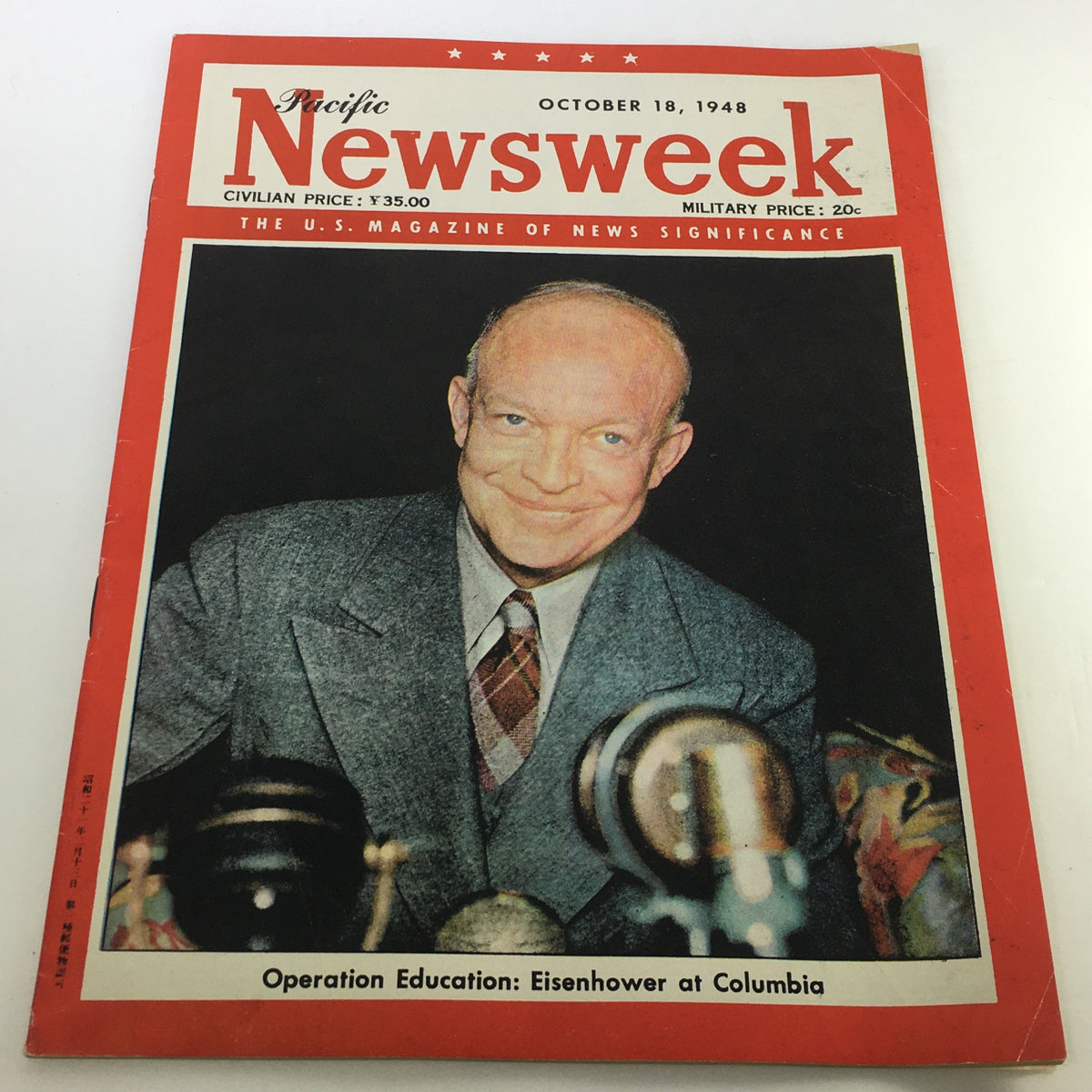

Description
Collector's Note – Why This Issue Matters
The October 18, 1948 issue of Newsweek featuring Dwight D. Eisenhower on its cover arrives at one of the most fascinating and consequential moments of ambiguity in his remarkable public life — a period when his political future was genuinely uncertain and both major political parties were actively seeking to claim him as their own. In the autumn of 1948, Eisenhower had been out of active military command since February of that year, having stepped down as Army Chief of Staff to become president of Columbia University. He had not yet declared any party affiliation, had deflected approaches from Democratic Party leaders including those who hoped he might replace the unpopular Truman on the Democratic ticket, and remained the most respected and admired military figure in the United States — a man whose potential presidential candidacy was being discussed with intense seriousness on both sides of the aisle. A Newsweek cover in mid-October 1948, just weeks before the presidential election in which Eisenhower was conspicuously absent, captures him at this precise moment of political suspension — revered, sought after, and deliberately uncommitted. For collectors who focus on vintage magazines featuring Dwight Eisenhower across his long public career, this pre-presidential cover from the height of his ambiguous political position is among the most historically interesting and biographically specific documents in that category.
Understanding what Eisenhower represented in October 1948 requires some appreciation of the extraordinary nature of his public standing in the immediate postwar period. He had commanded the Allied Expeditionary Forces in Europe, had presided over the liberation of Western Europe and the defeat of Nazi Germany, and had returned home to a level of public admiration that very few figures in American history had achieved. His five-star rank, his easy manner, and his genuine modesty about his own achievements had combined to create a public image that transcended normal political categories — he was not a partisan figure but a national one, and that quality made him simultaneously the most attractive potential presidential candidate in the country and the most elusive. The October 1948 Newsweek cover appears at a moment when the question of Eisenhower's political future was one of the most discussed topics in American public life, and when his decision to remain at Columbia rather than enter the 1948 race was still being processed by a political world that had genuinely hoped he might be persuaded to run. Collectors building archives around vintage Newsweek issues documenting the Eisenhower era will find this pre-presidential cover a document of the general at the threshold of the political career that would define his second chapter.
The Pacific reference alongside Eisenhower's cover story situates this issue within the full geopolitical density of October 1948 — a month of extraordinary consequence in the postwar world. The Chinese Civil War was approaching its decisive phase, with Communist forces gaining the upper hand in Manchuria and the broader strategic situation deteriorating rapidly for the Nationalist government; the Berlin Airlift was ongoing, testing Western resolve in the first major direct Cold War confrontation; and the American presidential election was three weeks away, with Truman and Dewey in what the entire political press was confidently predicting would be a Dewey victory. Eisenhower's presence on the cover in this context carries additional resonance: the most celebrated American military commander of the age, watching from the sidelines as a political campaign unfolded that many believed he could have won easily had he chosen to enter it. For collectors focused on the magazines of 1948 — one of the most consequential and dramatic years of the entire postwar era — this issue occupies a distinctive and historically rich position.
About the Publication
Newsweek, founded in 1933, had by the late 1940s firmly established itself alongside Time as one of the two dominant American newsweeklies, reaching millions of readers weekly through a format built around in-depth reporting, analytical commentary, and cover features capable of dedicating substantial editorial space to a single subject or developing story. The magazine's audience consisted primarily of educated, professionally engaged Americans who expected their newsweekly to provide more context, analysis, and interpretive depth than daily newspapers could supply — readers who wanted to understand not just what had happened in a given week but what it signified about the direction of American political life and the broader world order. Newsweek's coverage of major political and military figures in the late 1940s was particularly consequential, and its treatment of Eisenhower's post-military career and political ambiguity was among the most closely read journalism in the country during this period of intense national speculation about his intentions.
Key Highlights Inside
- A major cover feature on Dwight D. Eisenhower arriving at the height of public and political speculation about his presidential ambitions — examining the five-star general and Columbia University president whose refusal to enter the 1948 race had left both political parties without the candidate most of the country had hoped to see on the ballot, and whose political future remained the most discussed open question in American public life.
- Reporting almost certainly engaging with Eisenhower's post-military transition to academic life and the ongoing public conversation about whether and when he might enter politics — a conversation that would continue until his formal declaration as a Republican candidate in 1952 and his subsequent landslide presidential victory that year.
- Pacific affairs coverage reflecting the rapidly transforming geopolitical landscape of October 1948 — including the accelerating Communist advance in the Chinese Civil War, the American strategic position in the Pacific, and the broader challenge of constructing a coherent Asian policy within the Cold War containment framework that was simultaneously being tested in Europe by the Berlin Blockade.
- Reporting framed within the context of the 1948 presidential campaign's final weeks — the election between Truman and Dewey was less than three weeks away as this issue went to press, and the political atmosphere of near-universal expectation of a Dewey victory gave coverage of figures like Eisenhower — conspicuously absent from the ballot — a particular quality of speculation and anticipation.
- Standard Newsweek front-of-book reporting covering the full landscape of domestic and international affairs from the third week of October 1948, providing a contemporaneous snapshot of one of the most consequential and dramatically eventful weeks in postwar American history.
Note: Specific interior article titles, bylines, and additional feature details beyond the cover subject are unconfirmed for this issue from available sources. The highlights above reflect verifiable historical context drawn from the cover subject, publication date, and the well-documented editorial priorities of Newsweek during this period.
Condition & Rarity
This copy originates from newsstand distribution rather than the magazine subscription system — the consistently preferred provenance among serious periodical collectors for well-established practical and aesthetic reasons. Subscription copies of late-1940s newsweeklies were processed through fulfillment operations that applied mailing labels with adhesives frequently damaging to cover stock, and were routed through postal sorting systems that introduced mechanical wear, binding stress, and folding damage before ever reaching a reader. A newsstand copy arrived at retail flat, unlabeled, and entirely unprocessed, with the cover art, typography, and paper stock preserved exactly as printed and trimmed. On a magazine now approaching eighty years of age, the absence of a mailing label is a substantive condition attribute that meaningfully distinguishes surviving newsstand examples from the more commonly encountered subscription-processed copies in the collector market. The noted edge wear, binding wear, and potential marks or rips are entirely consistent with a newsstand copy of this vintage that has been stored rather than actively handled, and fall within the expected range for the grade without compromising the structural integrity or readability of the issue — collectors are well advised to examine the provided photographs closely to assess the specific nature and location of any wear. The plastic protective sleeve indicates deliberate preservation at some point in the copy's history, which generally correlates with better interior page condition, reduced light exposure damage, and lower rates of the paper brittleness that commonly affects unprotected late-1940s newsprint stock over time. For a 1948 Newsweek featuring Eisenhower at this specific and historically charged pre-presidential moment, a surviving newsstand copy in displayable condition is a meaningful and purposeful acquisition.
Looking for More Issues Like This?
An Eisenhower cover Newsweek from the height of his pre-presidential political ambiguity is a historically specific and genuinely rewarding find, and the dedicated Dwight D. Eisenhower magazine collection at OriginalMagazines.com is the natural first resource for collectors building a serious archive of his documented public presence across the full arc of his military and presidential career. The broader vintage Newsweek collection is worth exploring for other significant political and Cold War-era covers from the magazine's consequential late-1940s run, and collectors focused on the extraordinary density of events that defined the postwar years will find it well worth browsing the full 1948 magazine archive — a year whose combination of electoral drama, Cold War confrontation, and geopolitical transformation makes it one of the most actively collected in the publication's entire history.