
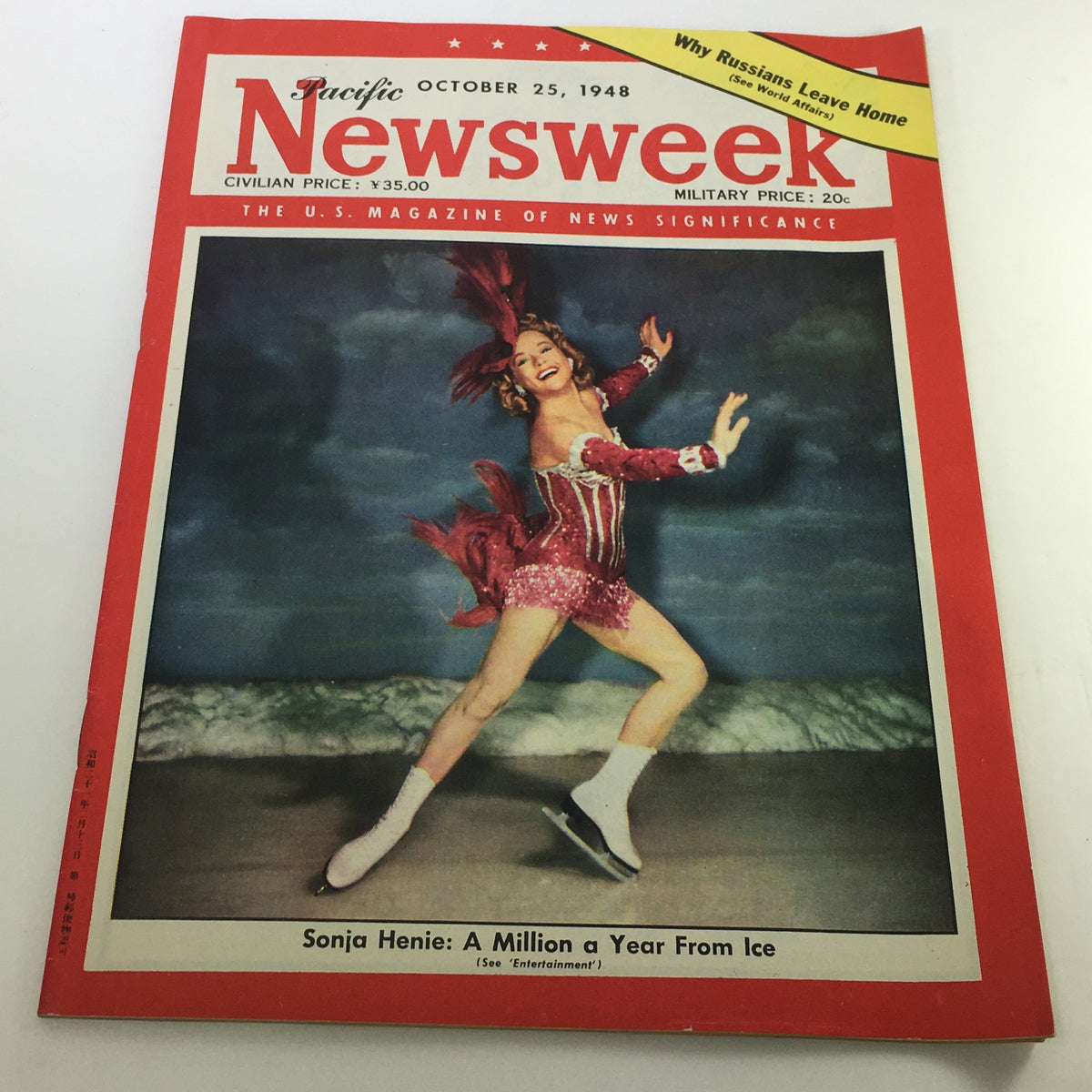

Description
Collector's Note – Why This Issue Matters
The October 25, 1948 issue of Newsweek featuring Sonja Henie arrives at a moment when she occupied a genuinely singular position in American popular culture — a position that had no real precedent and has had few true equivalents since. Henie was not simply a famous athlete or a successful entertainer; she was both simultaneously, and at a scale that made her one of the most recognizable and commercially powerful figures in the world during the late 1930s and 1940s. A three-time Olympic gold medalist in figure skating — winning at the 1928, 1932, and 1936 Winter Games — she had parlayed her athletic dominance into a Hollywood film career and a touring ice show enterprise that transformed professional ice skating from a niche competitive sport into a mass entertainment spectacle. By 1948, her Hollywood career was winding down from its peak years, but her ice show operation — the Hollywood Ice Revue — was still drawing enormous audiences across North America, and her name retained the kind of cultural recognition that only a handful of entertainers of any era achieve. For collectors who focus on vintage Newsweek issues documenting mid-century American entertainment and sports culture, a Sonja Henie cover from this period represents a primary document of one of the most unusual and underappreciated careers in twentieth-century popular culture.
The October 1948 cover date places this issue at a specific and interesting juncture in Henie's biography. The 1948 Winter Olympics had taken place in St. Moritz, Switzerland, in January and February of that year — the first Winter Games held since Garmisch-Partenkirchen in 1936, with the intervening years consumed by World War II — and the renewed international attention on figure skating that the Games generated would have made Henie, as the sport's defining competitive champion of the prewar era, a natural subject for renewed mainstream media attention. She had been a Norwegian citizen who had become an American cultural institution, and her complex relationship with her home country — she had been accused by many Norwegians of collaborating with the Nazi regime during the occupation, a charge she disputed — gave her story a biographical dimension that extended well beyond entertainment into the morally complicated territory of wartime Europe. A Newsweek cover in October 1948 engages with all of that accumulated biography and cultural weight. Collectors building archives around the magazines of 1948 will find this issue a rewarding and somewhat unexpected document — Henie is not a figure who surfaces frequently in collector-focused discussions of the era, which makes a cover appearance of this prominence correspondingly distinctive.
The Pacific coverage noted alongside Henie's cover story adds a further layer of historical context that is worth examining carefully. By October 1948, the Pacific in the geopolitical sense was an arena of rapid and consequential transformation: the Chinese Civil War was in its decisive final phase, with Mao Zedong's Communist forces having gained the strategic initiative against the Nationalist government; the American occupation of Japan under General Douglas MacArthur was actively reshaping Japanese society and political institutions; and the emerging Cold War competition between the United States and the Soviet Union was being mapped onto Asian geography in ways that would define the region's politics for decades. A Newsweek issue that pairs a Sonja Henie entertainment cover with substantive Pacific affairs reporting in October 1948 captures something characteristic of the era's newsweekly journalism — the coexistence of glamour and geopolitical gravity in a single publication, each section illuminating a different dimension of a world in profound transition.
About the Publication
Newsweek, founded in 1933, had by the late 1940s firmly established itself alongside Time as one of the two dominant American newsweeklies, reaching millions of readers weekly through a format built around in-depth reporting, analytical commentary, and cover features capable of dedicating substantial editorial space to a single subject or figure. The magazine's audience consisted primarily of educated, professionally engaged Americans who expected their newsweekly to provide more context, analysis, and interpretive depth than daily newspapers could consistently supply — readers who wanted to understand not just what had happened in a given week but why it mattered and what it signified about the direction of American and world affairs. Newsweek's coverage in the late 1940s ranged confidently across politics, foreign affairs, science, culture, and entertainment, reflecting a broad editorial conception of what an informed American citizen needed to know — a conception that made room for figures like Sonja Henie alongside statesmen, generals, and industrialists as legitimate subjects of serious national attention.
Key Highlights Inside
- A cover feature on Sonja Henie examining her remarkable career at the intersection of elite athletic achievement and mass entertainment — the three-time Olympic champion who had transformed figure skating into a Hollywood and touring show spectacle, and who remained one of the most commercially successful and culturally recognizable entertainers in America more than a decade after her competitive career had ended.
- Coverage almost certainly engaging with Henie's ongoing ice show enterprise — the Hollywood Ice Revue that she had built into one of the most successful touring productions in American entertainment, drawing audiences that dwarfed those of her film career at its peak and that had made her one of the highest-earning performers of the 1940s.
- Reporting on significant Pacific affairs arriving at a moment of extraordinary regional transformation — the Chinese Civil War's final phase, the American occupation of Japan, and the emerging Cold War architecture in Asia were all actively developing stories in October 1948 that Newsweek's foreign affairs coverage would have been tracking with considerable depth and expertise.
- Editorial content reflecting the broader postwar American moment of October 1948 — a period of domestic optimism and international anxiety in which the Marshall Plan was underway, the Berlin Blockade was testing Western resolve, and the presidential election between Harry Truman and Thomas Dewey was just weeks away, producing one of the most famous upsets in American political history.
- Period advertising content representing the full range of late-1940s American consumer culture — automobiles, appliances, financial services, and luxury goods — that constitutes a significant secondary historical record of the postwar economic boom and the commercial aesthetics of an era defined by the tension between domestic prosperity and global uncertainty.
Note: Specific interior article titles, bylines, and additional feature details beyond the cover subjects are unconfirmed for this issue from available sources. The highlights above reflect verifiable historical context drawn from the cover subject, publication date, and the well-documented editorial character of Newsweek during this period.
Condition & Rarity
This copy originates from newsstand distribution rather than the magazine subscription system — the consistently preferred provenance among serious periodical collectors for well-established practical and aesthetic reasons. Subscription copies of late-1940s newsweeklies were processed through fulfillment operations that applied mailing labels with adhesives frequently damaging to cover stock, and were routed through postal sorting systems that introduced mechanical wear, binding stress, and folding damage before ever reaching a reader. A newsstand copy arrived at retail flat, unlabeled, and entirely unprocessed, with the cover art, typography, and paper stock preserved exactly as printed and trimmed. On a magazine now approaching eighty years of age, the absence of a mailing label is a substantive condition attribute that meaningfully distinguishes surviving newsstand examples from the more commonly encountered subscription-processed copies in the collector market. The noted potential edge wear, binding wear, and marks are entirely consistent with a newsstand copy of this vintage that has been stored rather than actively handled, and fall within the expected range for the grade without compromising the structural integrity or readability of the issue — prospective collectors are well advised to examine the provided photographs closely to assess the specific nature and location of any wear. The plastic protective sleeve indicates deliberate preservation at some point in the copy's history, which generally correlates with better interior page condition, reduced light exposure damage, and lower rates of the paper brittleness that commonly affects unprotected late-1940s newsprint stock over time. For a 1948 Newsweek featuring a cover subject of Sonja Henie's specific and somewhat underappreciated historical significance, a surviving newsstand copy in displayable condition represents a meaningful and purposeful find.
Looking for More Issues Like This?
A Sonja Henie cover Newsweek is a genuinely uncommon find in the collector market — she is not a figure whose magazine appearances are widely indexed or actively sought by large collector communities, which makes a cover of this prominence both harder to locate and more rewarding when it surfaces. If this October 1948 issue has already found a home, the broader vintage Newsweek collection at OriginalMagazines.com is an excellent resource for other significant entertainment, sports, and current affairs covers from the magazine's rich late-1940s run. Collectors with a focused interest in the cultural, political, and geopolitical density of the immediate postwar years will also find it well worth exploring the full 1948 magazine archive, which brings together publications from one of the most consequential and actively collected years in twentieth-century American and world history.