
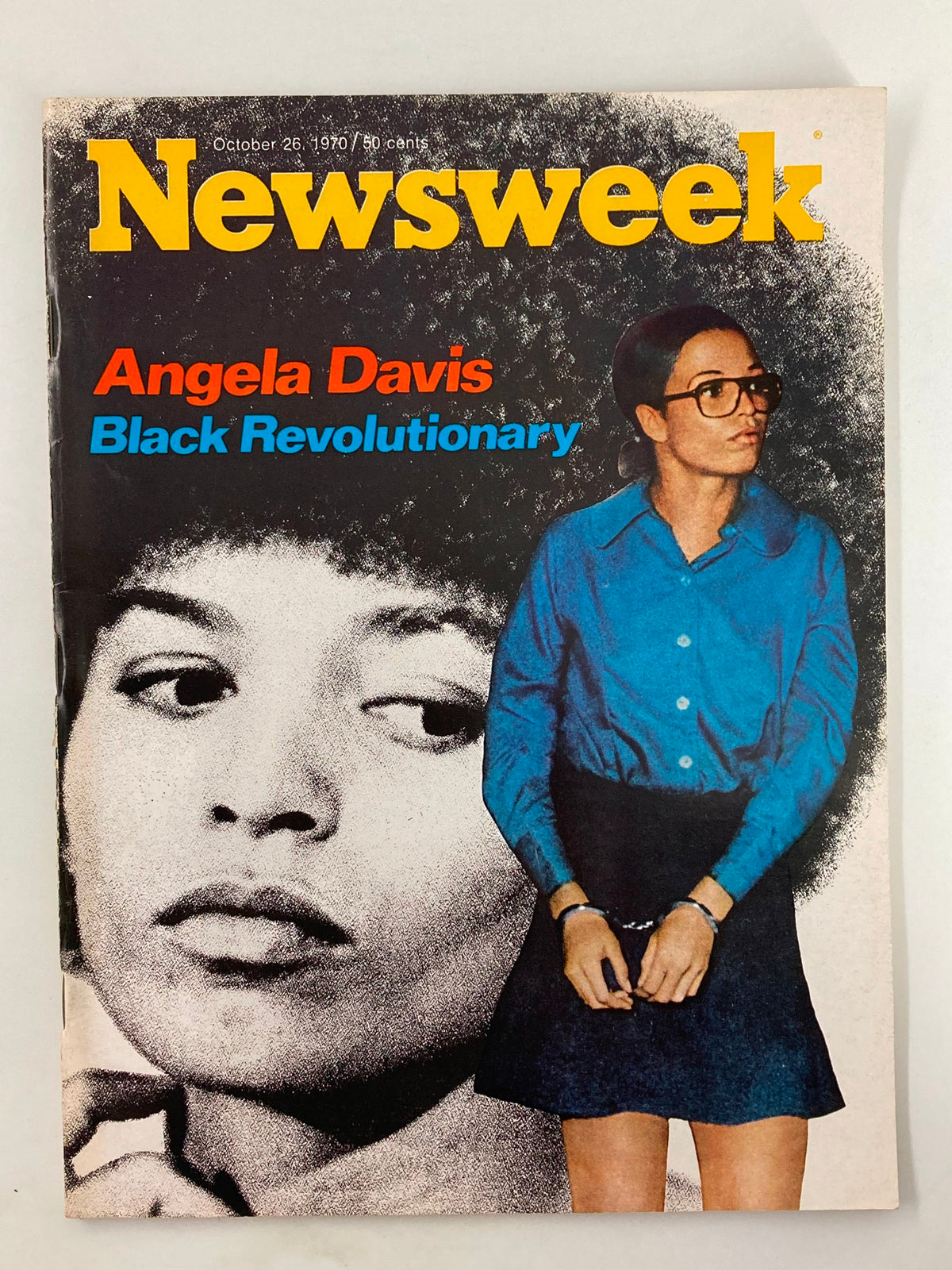

Description
Collector's Note – Why This Issue Matters
The October 26, 1970 issue of Newsweek featuring Angela Davis on the cover arrived at one of the most volatile and consequential moments in the history of American civil rights, radical politics, and the relationship between the state and its most determined dissenters. Just weeks before this issue's cover date, Davis had been placed on the FBI's Ten Most Wanted Fugitives list — only the third woman in the list's history — following her connection to the August 7, 1970 Marin County Courthouse incident in which guns registered in her name were used in an attempted escape that left four people dead, including a judge. Davis had gone underground and was being actively hunted by federal and state law enforcement when this cover appeared on newsstands. The image of her face on a major national newsmagazine cover was itself a statement — a recognition by the mainstream American press that Angela Davis had become one of the most significant and polarizing figures in the country, a flashpoint for every contested question about race, radicalism, Communist politics, and the limits of state power that the late 1960s had generated and left unresolved. For collectors building a serious archive of vintage Newsweek magazines, this cover is among the most historically charged of the entire decade.
Angela Davis in October 1970 was simultaneously a wanted fugitive, a cause célèbre for the international left, a symbol of Black revolutionary resistance, and a former philosophy professor whose intellectual credentials made her impossible to dismiss as a marginal figure. She had been fired from her position at UCLA the previous year following Governor Ronald Reagan's personal intervention to remove her from the faculty after her membership in the Communist Party became public — a firing that itself became a landmark case in the intersection of academic freedom, political persecution, and civil liberties. Her connection to the Soledad Brothers, including George Jackson whose brother Jonathan had used her registered firearms in the Marin County incident, placed her at the center of a network of prison activism and radical politics that the Nixon administration and J. Edgar Hoover's FBI regarded as among the most dangerous forces in America. She would be captured in New York City in October 1970 — just days after this issue's cover date — setting in motion a trial that would become one of the most internationally watched legal proceedings of the decade, ending in her acquittal on all charges in 1972. The Newsweek cover documenting her at the precise moment of her fugitive status and capture is a primary document of that extraordinary sequence of events. Issues from 1970 capture a year of almost unrelenting social and political crisis in America, and this October issue is among the most historically concentrated single covers of that year.
The broader context of October 1970 amplifies this issue's documentary significance considerably. The United States was still absorbing the shockwaves of the May 1970 Kent State shootings, the expansion of the Vietnam War into Cambodia, and the domestic upheaval that those events had catalyzed on college campuses and in urban centers across the country. The Black Panther Party was under sustained FBI pressure through the COINTELPRO program. The women's liberation movement was gathering institutional momentum. And the Nixon administration was pursuing a law-and-order political strategy that cast figures like Davis as existential threats to American stability — a framing that Newsweek's decision to put her face on its cover both reflected and complicated, giving her a platform and a visibility that the administration's rhetoric simultaneously amplified and sought to contain. The magazine's characterization of her as a "Black revolutionary" in its cover framing was itself an editorial choice that positioned this issue at the center of a fierce national debate about the meaning of dissent, the legitimacy of radical politics, and the character of American democracy at a moment when all of those questions felt genuinely unresolved.
About the Publication
Newsweek was founded in 1933 and had established itself by 1970 as one of the two essential American weekly newsmagazines, alongside Time, with a national circulation in the millions and an editorial voice that combined hard news analysis with longer investigative features, political commentary, cultural criticism, and international correspondence. Its coverage of the late 1960s and early 1970s — the civil rights movement, the Vietnam War, the assassinations of Martin Luther King Jr. and Robert Kennedy, the Nixon presidency, and the domestic upheaval of the counterculture — was among the most comprehensive and widely read journalism of that era, and its cover choices during this period were themselves cultural and political acts, reflecting editorial judgments about which figures and events merited the full weight of national attention. By 1970, Newsweek's Washington bureau and its network of national correspondents were operating at full capacity covering what was arguably the most turbulent sustained period in American domestic life since the Civil War, and individual issues from this year are regarded by historians and collectors alike as primary documents of exceptional historical density. The magazine's willingness to place Angela Davis on its cover — a fugitive, a Communist, a Black radical — at the height of the Nixon administration's law-and-order political moment reflects the editorial courage and journalistic independence that made Newsweek's early 1970s archive one of the most significant in American magazine history.
Key Highlights Inside
- Cover feature on Angela Davis at the precise moment of her fugitive status — placed on the FBI's Ten Most Wanted list following the August 1970 Marin County Courthouse incident and actively sought by federal and state law enforcement when this issue appeared on newsstands, making it a real-time document of one of the most dramatic law enforcement pursuits in American political history.
- In-depth coverage of Davis as a central figure in the Black revolutionary movement of the late 1960s and early 1970s — examining her role as a Communist Party member, her UCLA dismissal under Governor Reagan's intervention, her connections to the prison activism network surrounding the Soledad Brothers, and her significance as a symbol of resistance to what her supporters characterized as systematic state repression of Black radical politics.
- Socio-political coverage reflecting the extraordinarily volatile domestic landscape of October 1970 — a moment that encompassed the ongoing Vietnam War, the aftermath of Kent State, sustained FBI pressure on Black radical organizations, and a Nixon administration pursuing a law-and-order political strategy that made figures like Davis central to the national political conversation.
- Vintage advertising and editorial content documenting the commercial and cultural landscape of early 1970s America — a research resource for historians of the period whose value extends well beyond the cover story to encompass the full texture of American life at this particular historical moment.
- Note: Specific interior article titles, additional features, and bylines beyond those referenced on the cover and in the listing description have not been independently confirmed for this issue. The above reflects only what is verifiable from the cover, the named subject, and well-documented public knowledge of the events immediately surrounding this cover date.
Condition & Rarity
Newsweek issues from 1970 are now more than five decades old, printed on the standard wood-pulp coated stock of mid-century weekly newsmagazines — inherently acidic paper that tans, becomes brittle, and deteriorates steadily without archival intervention, regardless of how carefully individual copies have been stored. The survival rate for copies of any specific 1970 issue in genuinely collectible condition is considerably lower than the original print run suggests, and issues tied to high-profile cover subjects — particularly those with the kind of political and cultural significance that the Angela Davis cover commands — are subject to additional attrition from readers who kept them for personal or political reasons and stored them in conditions that prioritized sentiment over preservation. A Good condition grade on a magazine of this age is an honest and appropriate assessment, indicating a copy that retains its completeness and documentary integrity with the minor surface wear — light edge softening, slight tanning of interior pages, small marks consistent with careful storage — that fifty-plus years of existence inevitably produces in a publication of this paper stock and binding type. The absence of a subscriber address label is a meaningful positive attribute, preserving the full visual impact of the Davis cover portrait without the ink stamps and address blocks that mark mailed subscription copies and reduce their display appeal. The protective plastic sleeve represents sound basic conservation practice, limiting further light oxidation and handling wear on a cover image of considerable historical and cultural significance. For collectors evaluating surviving copies of this issue, the legibility and visual integrity of the cover portrait, the tightness of the spine, and the completeness of the interior page block are the primary condition attributes that determine suitability for display and long-term archival preservation.
Looking for More Issues Like This?
The October 26, 1970 Newsweek with Angela Davis on the cover is one of the genuinely essential issues for any serious collector of civil rights era press history, American radical politics, or 1970s newsmagazine archives — it documents a specific, extraordinary moment with a contemporaneous authority and editorial boldness that gives it a significance well beyond its cover date, and label-free copies in Good or better condition are not encountered with any regularity. If this particular issue has already been claimed, the complete vintage Newsweek archive at OriginalMagazines.com is the most reliable resource for continuing the search, with a substantial selection spanning the full breadth of the magazine's coverage of the civil rights movement, the Nixon era, and the turbulent early 1970s that makes it essential reading for collectors of American political history. For those building a broader archive of the period, the full 1970 magazine collection offers a wide range of titles and cover dates from that extraordinary year that together document the depth and intensity of the American crisis that produced the Angela Davis story in the first place.