
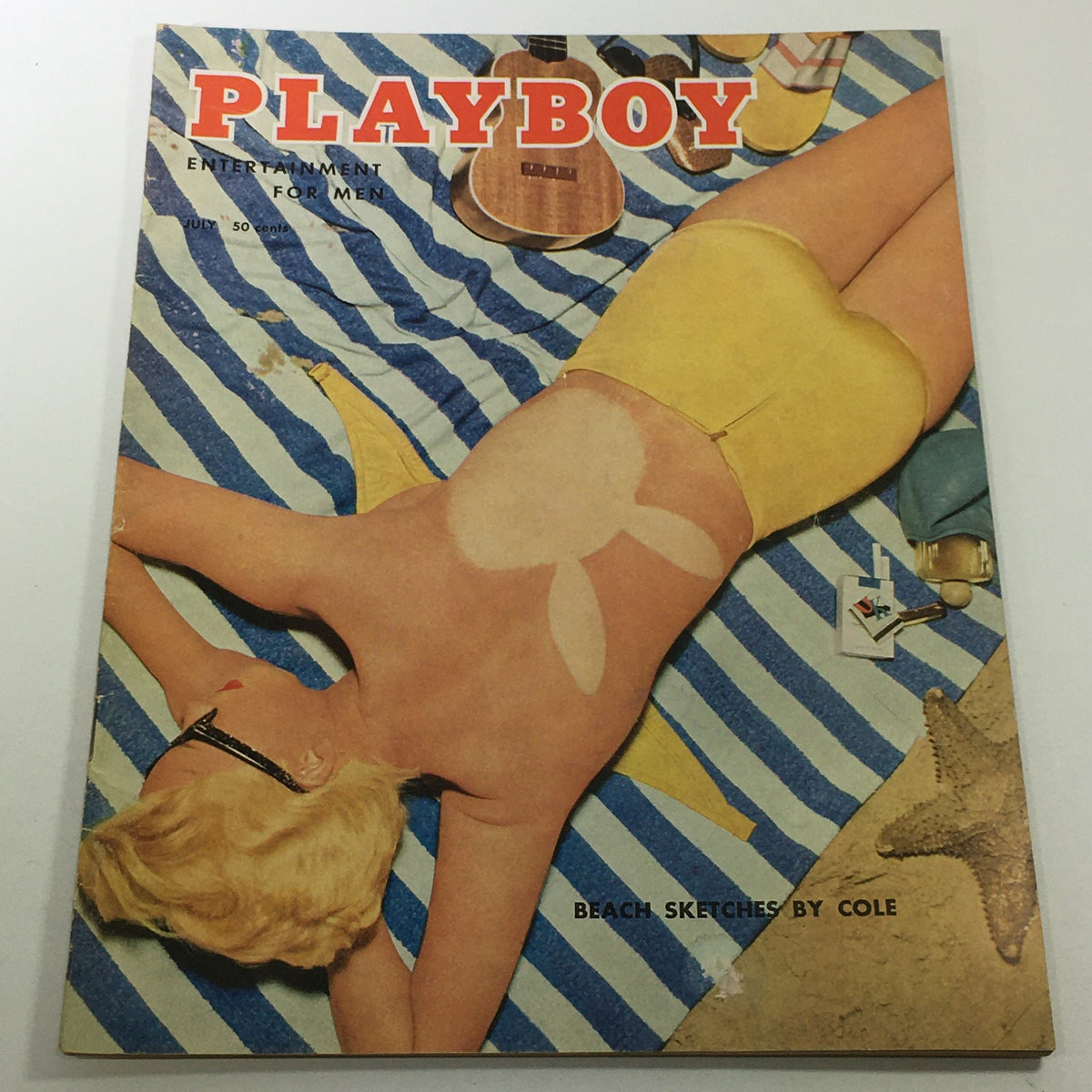

Description
Collector's Note – Why This Issue Matters
The July 1955 issue of Playboy featuring Janet Pilgrim is one of the most historically significant issues in the magazine's early run — and Janet Pilgrim herself is one of the most interesting figures in Playboy's founding mythology. Pilgrim was not a professional model or actress; she was a subscription fulfillment employee at the magazine, working in the offices that processed reader mail and subscriptions. Hugh Hefner's decision to feature her as Playmate of the Month was a deliberate editorial statement about the "girl next door" philosophy that he wanted to establish as central to the magazine's identity — the idea that the Playmate was not a remote, inaccessible professional but an ordinary American woman who happened to work in the next office. The fact that Pilgrim literally worked at Playboy made the concept unusually concrete and generated significant press attention.
Janet Pilgrim appeared in Playboy not once but three times across 1955 and 1956 — a decision that reflected both her popularity with readers and Hefner's continued investment in the "girl next door" concept she embodied. Her July 1955 appearance is the first and most historically resonant of those appearances, and it places this issue firmly within the period when Playboy was actively constructing the editorial identity that would define it for the following decade. The beach sketches by Cole that accompany the issue provide additional visual context — artist Jack Cole was one of the most significant early contributors to Playboy's visual identity, and his work for the magazine in its first years helped establish the aesthetic language of sophisticated, witty illustration that distinguished it from its competitors. For collectors building serious archives of Playboy's early publishing history, a July 1955 issue with both Pilgrim and Cole content is a particularly well-documented and historically layered find.
July 1955 places this issue in Playboy's third year of publication — past the precarious founding period but still very much in the formative phase when the magazine's distinctive editorial voice was being developed issue by issue. The mid-1950s were a moment of genuine cultural tension in America, and Playboy's particular combination of sexual frankness, literary aspiration, and lifestyle philosophy was being actively assembled in response to the conformist pressures of postwar American culture. Issues from this period are not merely early examples of a later-famous publication; they are primary documents of that construction process. Collectors interested in the American magazine landscape of 1955 will find this issue one of the more culturally significant numbers of that year.
About the Publication
Playboy was founded by Hugh Hefner in December 1953 and by July 1955 had survived its precarious launch period and was actively establishing the editorial identity that would make it one of the most influential American magazines of the twentieth century. Its format combined the monthly Playmate feature with fiction, interviews, humor, and lifestyle content that gave it an editorial scope considerably broader than its reputation sometimes suggested. Its early years — particularly 1954 through 1957 — are now studied by cultural historians as the period when the magazine's foundational philosophy was being actively constructed, and issues from this window are collected both as early examples of a major American publication and as primary documents of mid-century American culture and sexuality.
Key Highlights Inside
- Janet Pilgrim as Playmate of the Month — her first appearance in the magazine, notable as a Playboy office employee rather than a professional model, representing the deliberate "girl next door" editorial philosophy Hefner was establishing in the magazine's early years.
- Beach sketches by Jack Cole — one of the most significant early illustrators in Playboy's history, whose visual work helped define the magazine's aesthetic language during its formative period.
- Editorial content from Playboy's third year of publication — fiction, humor, and lifestyle content reflecting the magazine's developing voice and the cultural moment of mid-1950s America.
Note: Specific interior articles and features beyond the Playmate feature and Cole sketches are unconfirmed for this issue. The above reflects what is verifiable from the listing description, the publication's well-documented early history, and Janet Pilgrim's documented role at the magazine.
Condition & Rarity
No specific grade is stated in the listing beyond the representation that the magazine shows wear on edges and binding, with condition visible in the listing photographs. The newsstand designation — no address label — identifies this as a copy that was not mailed to a subscriber with a label affixed, which is the preferred form for display-oriented collectors of early Playboy issues. Edge wear and binding wear are the expected condition signatures for a publication now seventy years old that was produced for immediate consumption rather than archival preservation. A protective plastic sleeve provides appropriate ongoing care. Early Playboy issues from 1955 are among the more actively sought in the magazine's long run, and issues featuring Janet Pilgrim — whose three appearances have been extensively documented in Playboy history — carry additional collector significance beyond the standard early-issue premium.
Looking for More Issues Like This?
Mid-1950s Playboy issues featuring historically significant Playmates and early contributor art are a consistently active category in vintage magazine collecting, and the July 1955 Janet Pilgrim and Jack Cole number is one of the more well-documented entries from that founding period. The full Playboy collection at OriginalMagazines.com is the best place to explore available issues across the magazine's remarkable publishing history. For collectors building a broader archive of mid-1950s American print and popular culture, the complete 1955 magazine archive offers a wide range of titles from a year that sits at a fascinating cultural threshold in postwar America.