

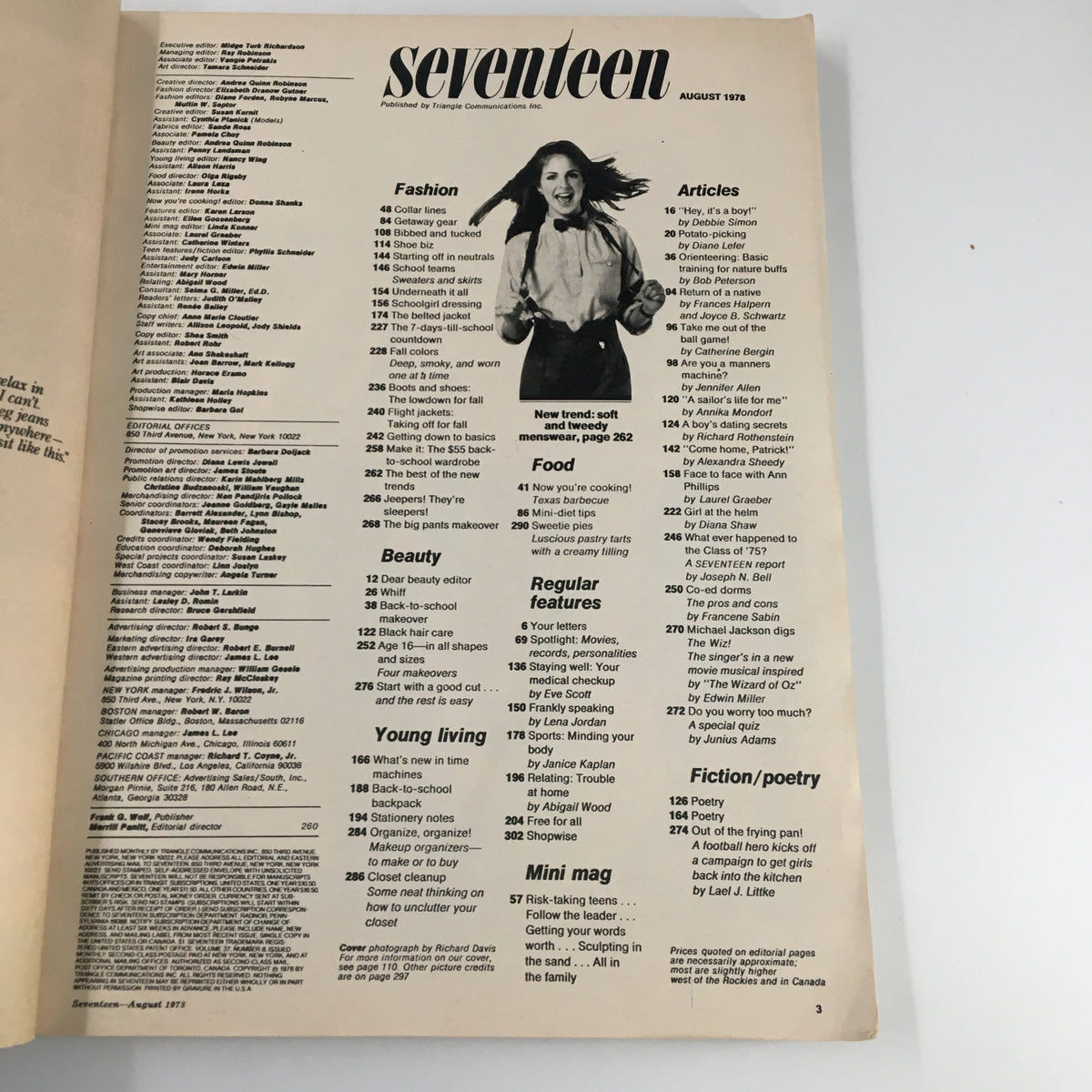


Description
Collector's Note – Why This Issue Matters
The August 1978 issue of Seventeen Magazine, with its feature on co-ed dorms weighing the pros and cons of mixed-gender college living, documents a genuine social debate that was actively reshaping American campus life in the late 1970s. Co-educational dormitories had been introduced at many American universities beginning in the late 1960s and early 1970s, and by 1978 they had moved from controversial experiment to mainstream campus option — but they remained a subject of significant parental anxiety, institutional ambivalence, and genuine discussion among the college-bound teenagers who were Seventeen's core readership. A Seventeen feature presenting both sides of the argument reflects the magazine's characteristic approach to social change: engaged with the real concerns of its readers, careful to acknowledge competing perspectives, and oriented toward helping teenage girls navigate decisions and discussions that their parents' generation had not faced. For collectors building an archive of Seventeen Magazine issues documenting changing American teen and young adult culture, an August 1978 edition engaging co-ed dorm life is a primary document of that navigation at a specific cultural moment.
The August timing is editorially significant. August issues of Seventeen were traditionally among the most college-focused of the year — the back-to-school and college preparation season made late summer the natural moment for content addressing dormitory life, campus fashion, and the transition from high school to higher education. A co-ed dorm feature in August 1978 would have reached exactly the readership for whom the question was most immediately relevant: high school seniors preparing for their first year away from home and grappling with decisions about housing, social dynamics, and the new freedoms of college life. The late 1970s context adds further dimension — the post-feminist second wave had fundamentally altered how young American women understood their options and their rights, and the co-ed dorm debate existed within a broader cultural conversation about gender, independence, and the changing norms of American social life. Publications from 1978 document American youth culture at a specific transitional moment between the upheaval of the early 1970s and the more conservative social mood that would characterize the early 1980s, and this Seventeen issue is a characteristic document of that in-between space.
About the Publication
Seventeen Magazine, founded in 1944, was by August 1978 the dominant American magazine for teenage girls, with a readership in the millions and an editorial identity built around fashion, beauty, relationships, and the specific concerns of female adolescence and young adulthood. Its format combined fashion spreads, beauty advice, fiction, and editorial features with a consistent orientation toward helping its readers navigate the practical and emotional challenges of their age group. By the late 1970s, Seventeen's editorial coverage had expanded to engage more directly with social and cultural questions — including college life, relationships, and the evolving expectations for young American women — reflecting both the influence of the women's movement on its readership and the magazine's awareness that its audience was coming of age in a changed social landscape.
Key Highlights Inside
- "Co-Ed Dorms: Pros and Cons" — a balanced feature addressing mixed-gender dormitory living at a moment when co-ed dorms had moved from controversial novelty to mainstream campus option, targeted at the high school seniors and college-bound readers who comprised Seventeen's core August audience.
- August 1978 back-to-school editorial context — placing this issue within the traditional Seventeen seasonal focus on college preparation and campus life, when the magazine's coverage was most directly oriented toward the transition from high school to higher education.
- Newsstand copy with no label — confirming clean cover presentation without mailing label adhesion or removal marks, the preferred configuration for display collectors of vintage teen magazine issues.
- Note: Specific additional features, fashion spreads, beauty content, and departments beyond what is confirmed in the listing are unverified for this issue. The above reflects what is documented and consistent with Seventeen's well-established editorial format during this period.
Condition & Rarity
Good condition with minor age-consistent wear is an honest and appropriate assessment for a teen magazine now nearly fifty years old. Seventeen issues from the late 1970s were read actively by their target audience and were rarely preserved with collector intent at the time of purchase — surviving copies in displayable condition represent a meaningfully smaller fraction of the original print run than circulation numbers alone would suggest. The absence of a mailing label confirms newsstand origin, which is the preferred configuration for collectors and avoids the label adhesion or removal damage common to subscriber copies of this era. The plastic protective covering indicates deliberate subsequent preservation storage, which is favorable for overall page integrity. For a glossy-stock teen magazine of this vintage, the primary condition factors to assess in any surviving copy are cover surface brightness and color saturation, spine integrity, and the absence of moisture or handling damage to interior pages.
Looking for More Issues Like This?
A label-free August 1978 Seventeen in good condition with substantive social content is a more historically specific find than the format might suggest — late-1970s teen magazine issues that engaged the real cultural debates of their moment hold up as genuine primary sources for researchers of American youth culture and gender history. If this one has already been claimed, the full archive of Seventeen Magazine issues spans the publication's entire run and is worth exploring for other significant issues from the late-1970s period. The broader 1978 magazine collection offers additional context for this specific year in American cultural life across multiple publications.