

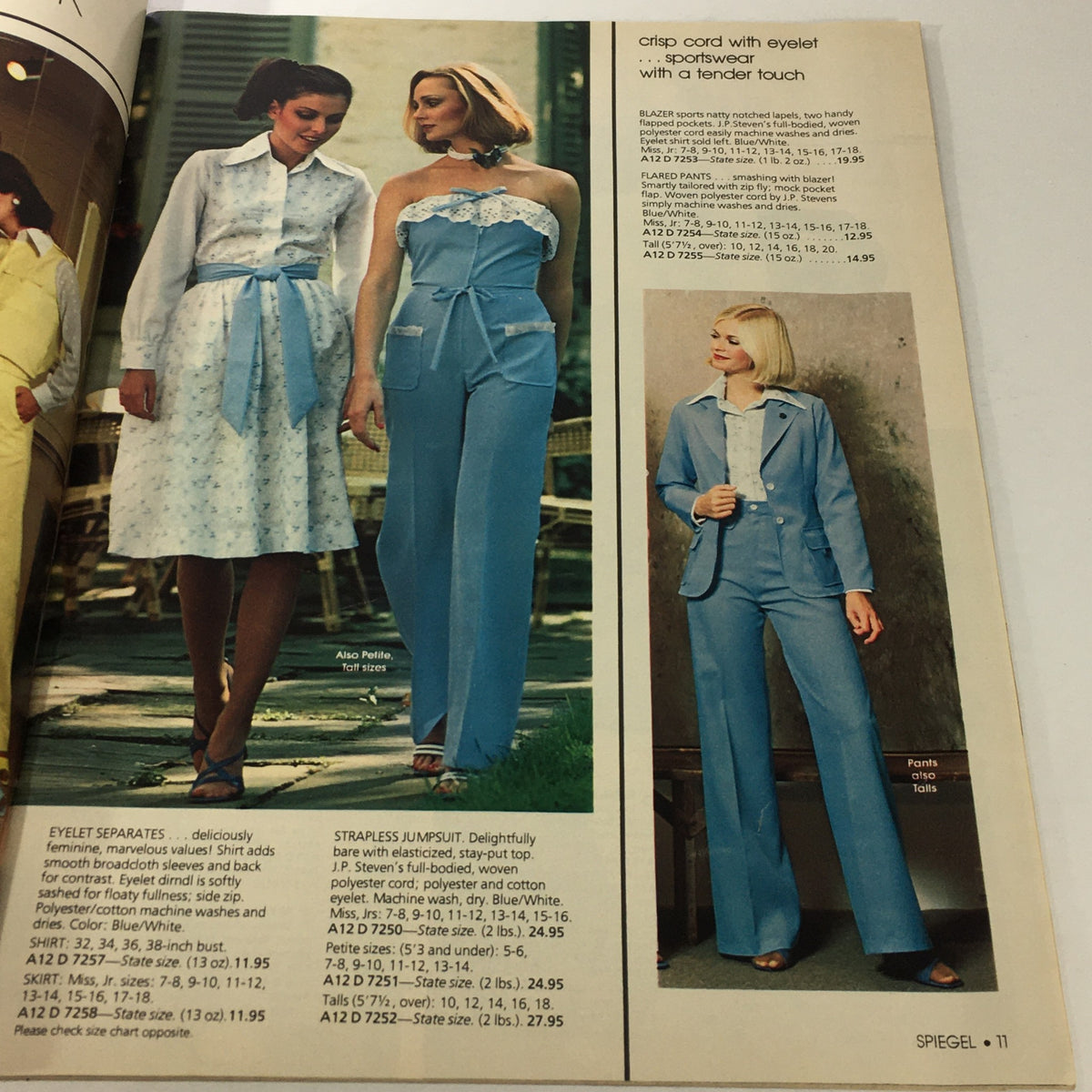


Description
Collector's Note – Why This Issue Matters
This 1978 Spiegel catalog arrived in the middle of one of the most consequential corporate transformations in the company's long history, a turnaround effort that was reaching a critical milestone in this exact year. Henry "Hank" Johnson, a veteran of Montgomery Ward and Avon's mail-order operations, had become Spiegel's CEO in 1976 with the explicit goal of transforming the near-bankrupt company into what he envisioned as "a department store in print," built around upscale, designer fashion and luxury furnishings rather than the budget-oriented merchandise that had previously defined the catalog. As part of that broader streamlining effort, Johnson closed Spiegel's remaining 131 catalog stores in February 1978, the same year this catalog was issued, while overall company employment was being cut roughly in half, from 7,000 employees in 1976 down to 3,500 by 1981. Collectors building an archive of magazines from 1978 will find this catalog a genuinely precise document of Spiegel mid-transformation, captured in the very year the company was actively dismantling its older retail infrastructure in favor of the leaner, catalog-only, fashion-forward identity that would define its next decade.
This catalog's documented scope, spanning clothing, home and decor, and eyewear alongside other general merchandise, reflects a company still in the process of shedding its earlier identity as a broad-based mail-order generalist in favor of the more curated, fashion-focused positioning Johnson was actively building. The most visible markers of that eventual repositioning, including designer-labeled merchandise like the Gloria Vanderbilt product line, would not actually arrive until 1980, meaning this 1978 catalog captures the company genuinely mid-transition: no longer the budget-oriented generalist it had been through the early 1970s, but not yet the fully realized upscale fashion catalog it would become within just a few more years. For collectors researching the broader history of 1978 magazines and catalogs, this item offers a precise snapshot of a major American retailer's identity in active flux, caught between two distinct commercial eras.
The broader business context surrounding this catalog underscores just how high the stakes were for Johnson's turnaround effort at this specific moment. Spiegel had faced mounting pressure throughout the mid-1970s from rising interest rates that made its traditional installment-credit business more expensive to operate, compounded by intensifying competition from rapidly expanding discount chains like Kmart. The eventual payoff for this turnaround strategy would prove substantial: catalog sales in general boomed during the early 1980s, with Spiegel's own sales growing 25 to 30 percent a year, and the company's strategies were being closely studied by larger competitors even though Spiegel still ranked only fourth in catalog sales behind Sears, J.C. Penney, and Montgomery Ward. This 1978 catalog therefore documents the company roughly midway through the difficult, unglamorous restructuring work that would ultimately make that later success possible.
About the Publication
Spiegel traced its origins to 1865, when German immigrant Joseph Spiegel opened a small home furnishings shop in Chicago, eventually evolving into one of the major American mail-order catalog retailers of the twentieth century alongside competitors like Sears and Montgomery Ward. The company had been purchased by Beneficial Finance Company in 1965 after a century of operation as a family business, becoming a wholly owned subsidiary, and faced FTC scrutiny over credit disclosure and debt collection practices throughout the early 1970s before Beneficial brought in new leadership in 1976 to address the company's mounting financial and competitive pressures. By 1978, Spiegel was actively executing a deliberate strategic transformation, closing physical retail locations and streamlining operations as a precursor to the fully redesigned, fashion-forward catalog identity it would complete by the early 1980s. The company's catalog format combined seasonal clothing, home goods, and accessory offerings, reflecting the broad general-merchandise scope that defined major mail-order catalogers of this era even as Spiegel specifically worked to narrow and elevate that scope going forward.
Key Highlights Inside
- A 1978 general merchandise lineup spanning clothing, home and decor, and eyewear, representative of Spiegel's catalog scope during this specific transitional year in the company's history.
- Merchandising produced during the same year Spiegel closed its remaining 131 catalog stores nationwide, a documented February 1978 event that marked a major step in the company's broader shift toward a streamlined, catalog-only retail model.
- Catalog content reflecting a company actively mid-transformation: no longer operating under its older budget-generalist identity, but not yet featuring the designer-labeled merchandise lines that would arrive starting in 1980 under CEO Hank Johnson's "fine department store in print" repositioning.
- A documented snapshot of Spiegel roughly two years into a CEO-led turnaround effort that would, within the following several years, transform the company into one of the catalog industry's fastest-growing and most closely watched retailers.
- Note: Specific page-by-page product listings and pricing beyond the documented general merchandise categories have not been independently confirmed for this particular catalog. The highlights above reflect verified information about Spiegel's corporate history and catalog format during this specific transitional year.
Condition & Rarity
Surviving copies of late-1970s Spiegel catalogs are evaluated using criteria suited to their format as substantial, frequently consulted mail-order reference volumes rather than typical magazines, with completeness of pages, cover condition, and overall binding integrity standing as the primary factors collectors weigh. This catalog is described as being in good condition with an address label present on the front, indicating original distribution directly to a specific household by mail, along with minor wear on the edges and the possibility of rips or marks typical for a catalog of this age and original functional purpose. Because catalogs of this kind were used actively for ordering throughout a full shopping season rather than preserved as collectibles from the outset, surviving copies in good condition reflect a reasonable level of care relative to the substantial majority that were heavily marked, damaged through repeated handling, or discarded once a new seasonal edition arrived.
A protective plastic covering, as included with this catalog, provides an effective ongoing barrier against further handling wear and environmental exposure, helping preserve a catalog already noted to be in good condition. Spiegel catalogs from this specific transitional period in the company's history draw particular interest from collectors of retail and business history, given the catalog's documented connection to one of the more closely studied corporate turnaround stories in American mail-order retailing. Collectors evaluating any surviving copy of this catalog should prioritize completeness of pages and the legibility of its featured merchandise categories, given the catalog's value as a primary-source record of Spiegel's identity at this specific, well-documented inflection point in its corporate history.
Looking for More Issues Like This?
Vintage Spiegel catalogs from the late 1970s, particularly editions documenting the company's pivotal mid-transformation years under CEO Hank Johnson's turnaround strategy, are a genuinely interesting category for collectors of mail-order retail history and American business history alike. Since this particular catalog does not have a dedicated Spiegel collection link available, the broader 1978 magazine archive at OriginalMagazines.com is the best starting point for collectors looking to explore other publications from that specific year in American retail and popular culture. It offers a practical way to continue building a collection centered on a pivotal decade in the evolution of American catalog retailing.