


Description
Collector's Note – Why This Issue Matters
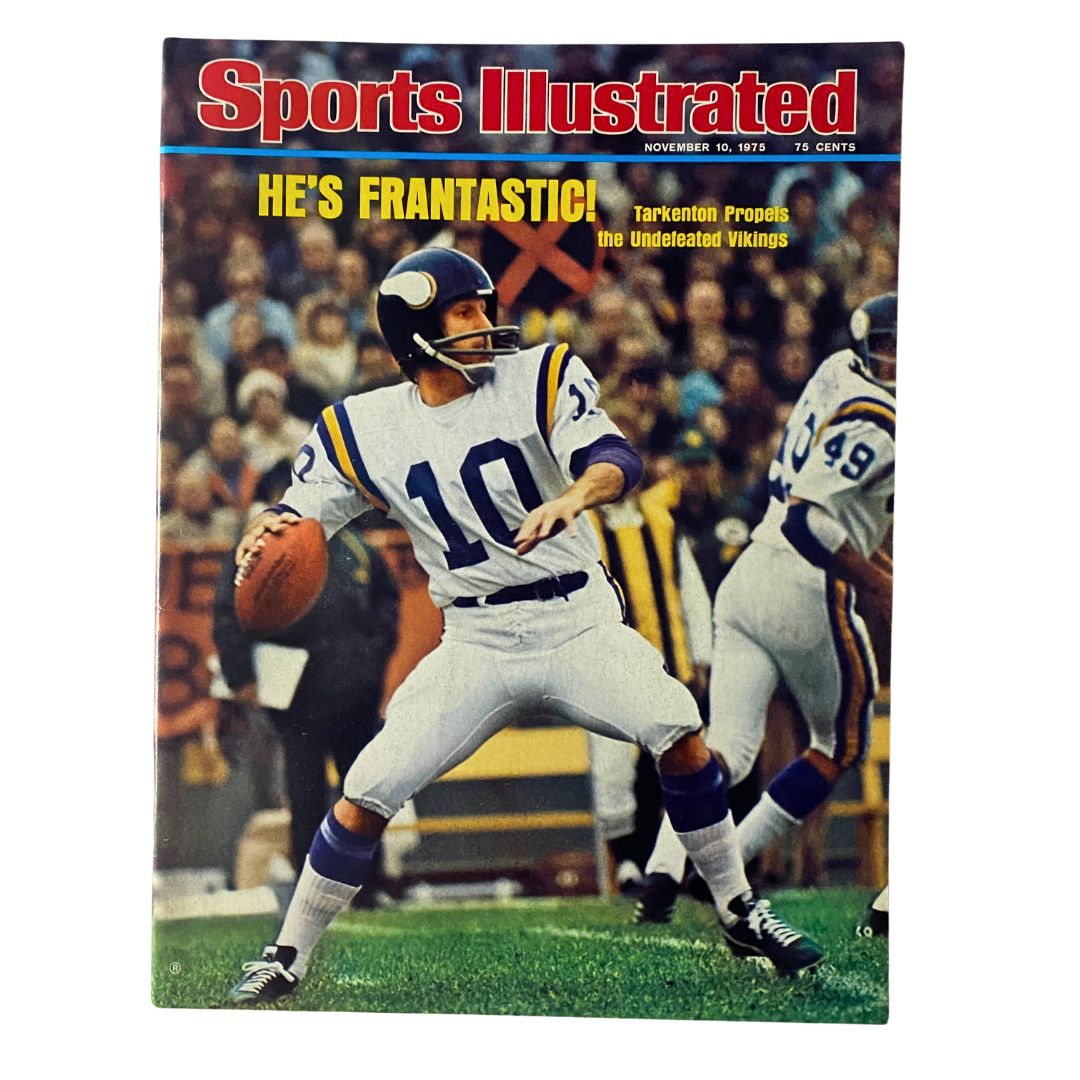
November 10, 1975 places this Sports Illustrated cover at a specific and consequential moment in Fran Tarkenton's career and in the broader history of the NFL. The Minnesota Vikings were in the middle of what would prove to be one of their strongest regular seasons of the decade, and Tarkenton — at thirty-five years old — was playing the most statistically productive football of his life. He had already led the Vikings to two Super Bowl appearances earlier in the seventies, losses that had complicated his legacy in the eyes of critics who questioned whether his unconventional scrambling style could win the biggest game, and the 1975 season represented another opportunity to answer those questions definitively. By November, the Vikings were legitimate NFC title contenders, and Tarkenton's ability to extend plays, improvise under pressure, and distribute the ball across the full range of his receiving options was generating the kind of weekly national attention that a Sports Illustrated cover reflected and amplified simultaneously. For collectors building a documented archive of Fran Tarkenton magazine covers and features, this November 1975 Sports Illustrated represents him at his peak individual performance — a Hall of Fame quarterback in the middle of the season that would eventually see him named the NFL's Most Valuable Player for the year.
The NFL in November 1975 was itself in one of its most commercially and competitively dynamic periods. The merger with the AFL five years earlier had produced a league of genuine competitive balance, the Dallas Cowboys and the Pittsburgh Steelers were at the height of their respective dynasties, and the concept of the professional football player as national celebrity had fully arrived — driven in large part by the television contracts that were transforming the NFL's commercial footprint and by the Monday Night Football phenomenon that had made the sport a mainstream entertainment institution rather than merely a sports preference. Tarkenton occupied a specific and interesting position within that landscape: he was one of the most recognizable and discussed quarterbacks in the country, a figure who had generated controversy throughout his career for playing the position in a way that challenged the orthodox conventions of the drop-back passer, and who had parlayed his visibility into a broader media presence that included television appearances and business interests. A Sports Illustrated cover in November 1975 was a statement about where Tarkenton stood in the national conversation about the game's best players at its most commercially intense moment. Collectors researching Sports Illustrated issues from the mid-seventies NFL era will find this cover a precisely situated document of the quarterback, his team, and the sport at a specific competitive and cultural peak.
The broader context of the 1975 NFL season deepens this issue's documentary value for serious football historians and collectors. The season was ultimately won by the Pittsburgh Steelers, who defeated the Dallas Cowboys in Super Bowl X in January 1976 — one of the most celebrated championship games of the decade. The Vikings, despite Tarkenton's exceptional individual season, fell short in the playoffs once again, adding another chapter to a complicated legacy that would not be fully resolved until his Hall of Fame induction in 1986. A November 1975 Sports Illustrated with Tarkenton on the cover is therefore a document published in the middle of a season whose outcome, still unknown at the time of publication, would contribute significantly to how his career was evaluated and remembered. That uncertainty — the season still in progress, the playoffs still ahead, the ultimate verdict still unwritten — is part of what makes a mid-season cover from this year a more historically textured document than a retrospective feature would be. Collectors researching sports and cultural magazines from 1975 will find this issue a primary source record of a genuinely consequential NFL season at its most actively contested moment.
About the Publication
Sports Illustrated was founded by Henry Luce and Time Inc. in 1954 and by the mid-1970s had established itself as the dominant sports journalism publication in the United States, combining sophisticated long-form writing with high-quality photography to create a weekly magazine that was taken seriously by both the sporting public and the broader journalism community. Its coverage of professional football in the 1970s was particularly authoritative — the NFL's rise to commercial dominance during this decade coincided with Sports Illustrated's editorial peak, and the magazine's writers, photographers, and editors brought a level of craft and ambition to football coverage that no competitor matched. Its cover was among the most recognized and coveted placements in American sports journalism, and a Sports Illustrated cover in the mid-seventies carried a cultural weight that extended well beyond the sports press into mainstream American conversation about athletes, competition, and celebrity. The magazine's readership was broad — both passionate sports fans and general readers with a more casual interest in the national sports conversation — and its editorial ambition consistently exceeded what a purely commercial sports publication would have attempted.
Key Highlights Inside
- Fran Tarkenton cover feature from November 10, 1975 — a primary document of the Minnesota Vikings quarterback during his MVP season, published mid-year while the outcome of one of his most personally significant campaigns was still undecided, and representing Sports Illustrated's formal acknowledgment of Tarkenton's standing as one of the NFL's premier performers at a moment of genuine competitive uncertainty.
- NFL regular season coverage consistent with Sports Illustrated's November 1975 editorial scope — the mid-point of the NFL season was one of the magazine's most content-rich periods, with divisional races, emerging storylines, and weekly game coverage all demanding editorial attention, and the surrounding football content in this issue would have provided the full competitive context for the Tarkenton cover feature.
- Sports journalism content spanning multiple sports consistent with Sports Illustrated's established weekly format — the magazine's coverage extended well beyond football to basketball, hockey, college sports, and the broader American sports landscape of November 1975, providing the cross-sport context that made individual issues from this period rich primary sources for researchers studying the full breadth of mid-seventies American athletic culture.
- Period advertising representing the sports and general consumer culture of Sports Illustrated's mid-seventies readership — the advertising environment of a November 1975 Sports Illustrated captures the brands and products most actively associated with American sports culture and its audience at a specific moment in the NFL's commercial expansion, providing documentary material for researchers studying the intersection of sports, advertising, and consumer culture in this period.
- Note: Specific article titles, confirmed secondary sports coverage, and detailed interior content beyond the documented cover feature have not been individually verified for this issue. The highlights above reflect Sports Illustrated's well-established editorial format, the verified cover subject, and the well-documented NFL and sports landscape of November 10, 1975.
Condition & Rarity
Sports Illustrated issues from November 1975 present a condition profile shaped by the publication's specific format and the fifty-plus years that have elapsed since publication. Printed as a weekly on paper stock that balanced photographic reproduction quality with cost efficiency, and consumed by an active sports readership that read their magazines thoroughly rather than archiving them, surviving copies in Very Good condition represent a meaningful subset of the original print run that has been cared for more deliberately than the majority of its contemporaries. Very Good condition with minor edge wear is an honest and accurate grade for a fifty-year-old weekly sports magazine — it indicates a copy that retains full structural integrity, displays cleanly, and shows no significant cover damage or interior page loss beyond the light handling evidence of its age. The absence of a mailing label is a meaningful condition attribute for Sports Illustrated specifically, where the subscription base was enormous and label-free newsstand copies represent a minority of surviving examples; the Tarkenton cover image in its uninterrupted form, without adhesive damage or removal marks, is both visually and documentarily preferable for collectors focused on the cover as a primary artifact. The plastic protective sleeve provides ongoing archival protection. Collectors evaluating surviving examples of this issue should prioritize cover legibility and the integrity of the Tarkenton image, spine condition, and the completeness of the interior NFL coverage as the primary condition criteria most relevant to this issue's collector value.
Looking for More Issues Like This?
A Very Good newsstand copy of Sports Illustrated from November 10, 1975 with the Fran Tarkenton cover is a specific enough mid-seventies NFL find that it surfaces infrequently among collectors focused on either Tarkenton's career documentation or the broader Sports Illustrated archive from the decade's most commercially dynamic period for professional football. If this issue is no longer available, the Fran Tarkenton magazine collection at OriginalMagazines.com is the most focused resource for other cover appearances and features from his career. The full Sports Illustrated collection offers surviving issues across the publication's history for collectors building a broader archive of the magazine's NFL and multi-sport coverage, and the 1975 magazine collection brings together issues from across that year's major sports and cultural publications for collectors documenting one of the most consequential seasons in the history of professional football.