






Description
Collector's Note – Why This Issue Matters
The Saturday Evening Post's July 23, 1938 issue features "More Will Live," an article by Arthur Train, Jr. covering the medical research collaboration between aviator Charles A. Lindbergh and French surgeon Alexis Carrel, published at the peak of public fascination with their work. Lindbergh had begun studying organ perfusion with the Nobel Prize-winning Carrel starting in 1931, developing a glass perfusion pump known as the "Model T" that is credited with helping make future heart surgeries and organ transplantation possible. Between 1935 and 1938 the two men used their pulsatile pump to keep a heart beating for several days, maintain peristalsis in a Fallopian tube, and keep a pancreas secreting insulin, successfully perfusing organs including the ovary, kidney, and spleen, with dozens of the pumps eventually built and distributed to laboratories around the world for thousands of subsequent experiments. This Post article arrived at almost exactly the same moment Lindbergh and Carrel published "The Culture of Organs," the book in which they summarized their research and described a theoretical artificial heart, decades before one would actually be built. Collectors building an archive of magazines from 1938 will find this issue a genuinely significant document of a moment when two of the era's most famous men were being celebrated for groundbreaking medical research, captured in print just weeks after their joint appearance on the cover of Time magazine that same June.
The Lindbergh-Carrel partnership represented an unusual convergence of fame and expertise that captivated American readers throughout the mid-1930s. Carrel was already one of the most famous figures in medicine, a Nobel Prize-winning surgeon-scientist renowned for pioneering work suturing small blood vessels and transplanting organs, while Lindbergh brought his own global celebrity as the aviator who had made the first solo transatlantic flight in 1927. Lindbergh's personal motivation for the research was deeply human: his wife's sister had suffered a heart attack that permanently damaged her heart valves, and Lindbergh, drawing on his mechanical aptitude, devised the basic concept for a heart pump that he brought to Carrel, who was sufficiently impressed to begin a formal research partnership. The two men continued their collaborative work on the perfusion pump intermittently into the early 1940s, despite the disruptions of the gathering world war, making this 1938 Post article a snapshot of their partnership roughly midway through its full active span. For collectors researching the history of The Saturday Evening Post and its science journalism, this issue captures mainstream American press coverage of genuine, historically significant medical research at the precise moment it was unfolding, well before later events would substantially complicate both men's public reputations.
It is worth noting for collectors and researchers that both men's historical legacies became considerably more complicated in the years immediately following this article's publication. Lindbergh made several visits to Nazi Germany between 1936 and 1938 to evaluate its military aviation capability, and in October 1938, just months after this Post issue appeared, he accepted the Service Cross of the German Eagle from Hermann Göring, an act that drew significant criticism in the American press and contributed to his later isolationist activism with the America First Committee. Carrel, for his part, held documented eugenicist views regarding human heredity and what he considered racial superiority, perspectives that Lindbergh's own background made him receptive to, and these shared views would later tarnish both men's legacies alongside their wartime political associations. This July 1938 issue predates the most consequential of these developments and reflects an earlier moment when both men's public reputations rested almost entirely on their celebrated achievements in aviation and medicine respectively, a useful reminder that historical figures' reputations and the public record surrounding them can shift dramatically within a remarkably short span of time.
About the Publication
The Saturday Evening Post traced its origins to the early nineteenth century and had, by 1938, established itself as one of the most widely circulated general-interest magazines in the United States, combining serialized fiction, short stories, and substantive feature journalism within a dependable weekly format. Its science and medical coverage during this period regularly profiled prominent researchers and their work for a broad national readership, translating complex scientific developments into accessible narrative journalism without sacrificing factual substance. The magazine's willingness to devote feature space to genuinely technical medical research, as exemplified by its coverage of the Lindbergh-Carrel perfusion work, reflects the Post's broader ambition to serve as a serious chronicle of contemporary scientific and cultural developments alongside its more purely entertainment-oriented fiction and serials. By the late 1930s, the Post remained a dominant institution in American print journalism, reaching readers across the country with a weekly mix that balanced popular fiction from leading authors with substantive nonfiction on science, politics, and society.
Key Highlights Inside
- The feature article "More Will Live" by Arthur Train, Jr., covering the organ perfusion research collaboration between Charles A. Lindbergh and Nobel laureate Alexis Carrel, published the same year their joint research summary, "The Culture of Organs," appeared in book form.
- The second installment of an eight-part serialization of P.G. Wodehouse's "The Code of the Woosters," documenting this issue's place within a longer-running fiction series from one of the era's most popular comic novelists.
- The fourth installment of a seven-part J.P. Marquand serial, "Mr. Moto Is So Sorry," reflecting the Post's standard practice of running multiple ongoing serialized works alongside standalone short stories in a single issue.
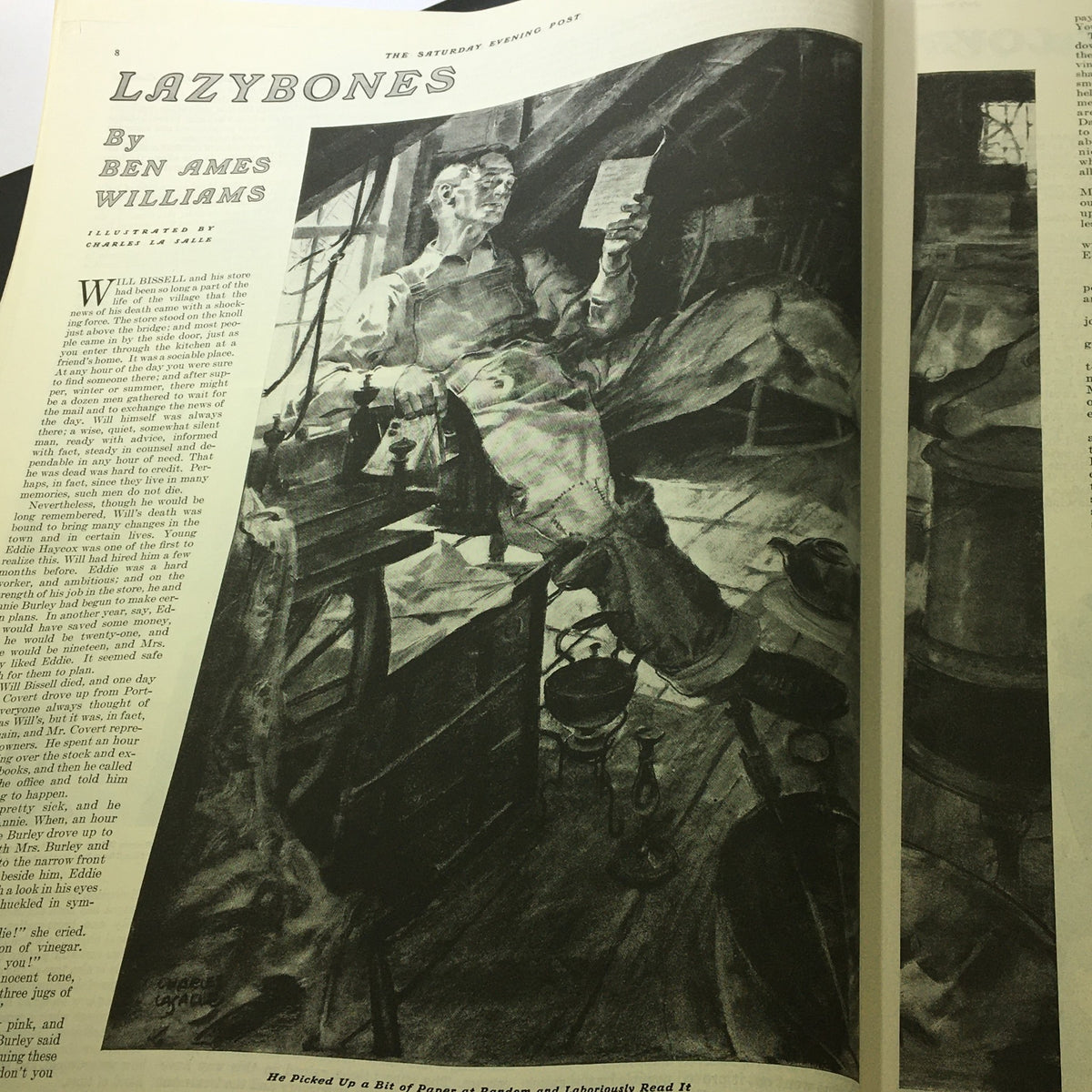
- Five short stories from contributors including Ben Ames Williams, Booth Tarkington, and Margaret Weymouth Jackson, representing the kind of accessible popular fiction that filled out the Post's fiction lineup during this period.
- Additional feature articles spanning wildlife conservation, aviation, and contemporary social commentary, including "Don't Feed the Bears" by Victor H. Cahalane and "Voters, We Love You All!" credited to an anonymous congressman's wife, illustrating the breadth of subject matter the Post covered within a single 1938 issue.
Condition & Rarity
Surviving copies of late-1930s Saturday Evening Post issues are evaluated using standard periodical grading criteria: the condition of the cover, the completeness of interior pages, and the soundness of the original binding, all factors that face significant pressure after nearly ninety years of potential handling and storage. This issue is described as good and used condition, with an address label present on the front indicating original subscription delivery, along with minor edge wear, possible marks or rips, and holes noted on the front cover. Given this issue's documented connection to a genuinely significant moment in the history of medical research, collectors evaluating any surviving copy should prioritize whether the cover remains identifiable and whether the full Lindbergh-Carrel feature article is intact, since this content carries particular historical and research value extending beyond the issue's general collectible appeal.
A plastic protective covering, as included with this issue, provides an effective ongoing barrier against further deterioration from handling and environmental exposure, though it cannot reverse wear accumulated since the magazine's original 1938 printing. Issues documenting the Lindbergh-Carrel perfusion pump research draw sustained interest from collectors specializing in the history of medicine and cardiovascular surgery specifically, in addition to general vintage periodical collectors and those interested in Lindbergh memorabilia. Collectors and researchers evaluating this issue should recognize its value as a primary-source historical document of pre-cardiopulmonary-bypass medical research, a field this collaboration helped advance even though the specific pump technology described would itself fall out of favor by the early 1940s. A good-condition copy with the feature article fully intact represents a meaningful piece of medical and aviation history.
Looking for More Issues Like This?
Saturday Evening Post issues documenting major mid-century scientific and medical research, particularly features involving figures as historically significant as Lindbergh and Carrel, are of consistent interest to collectors and researchers spanning medical history, aviation history, and general vintage periodical collecting. If this particular issue is currently unavailable, the Saturday Evening Post collection at OriginalMagazines.com is the most direct resource for collectors tracing the publication's journalism and feature reporting across its long run. The broader 1938 magazine archive is equally worth browsing for anyone building a multi-publication record of that specific year in American journalism and culture.