
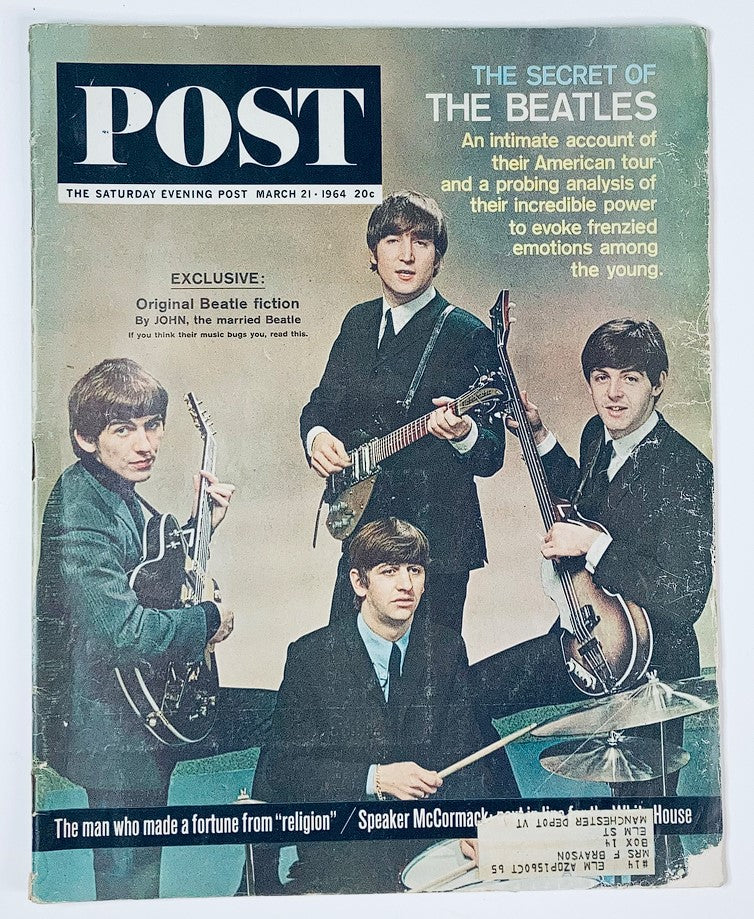


Description
Collector's Note – Why This Issue Matters
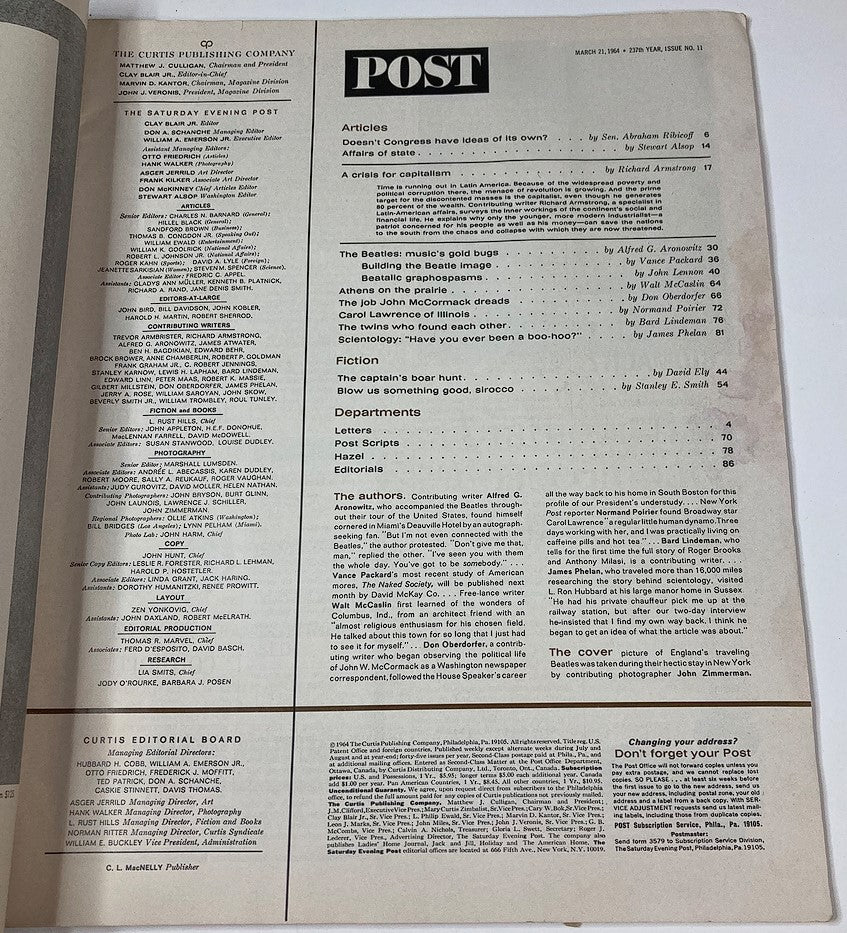
The March 21, 1964 issue of The Saturday Evening Post — No. 11 — is one of the most historically significant Beatles-related magazine features published by a mainstream American publication, and its timing is precise to the point of being extraordinary. The Beatles had performed on The Ed Sullivan Show on February 9, 1964 — just six weeks before this issue's publication date — to an audience estimated at 73 million viewers, the largest in American television history to that point. Beatlemania had arrived in the United States in a single weekend, and the American press was still scrambling to explain, categorize, and contextualize what had just happened to its readership. The Post's response was not a single piece but a multi-article package: Alfred G. Aronowitz on the music's commercial dimensions, Vance Packard on the deliberate construction of the Beatles' image, and John Loomis's photographic essay on Beatlemania itself. That Vance Packard — the author of The Hidden Persuaders (1957), the era's most influential analysis of advertising and mass manipulation — was assigned to write about how the Beatles' image was built is itself a historically significant editorial choice, reflecting the mainstream press's ambivalence about whether Beatlemania was a genuine cultural phenomenon or a manufactured one. Collectors building a comprehensive record of the Beatles' early American press coverage will find the Beatles magazine archive at OriginalMagazines.com an essential resource.
The depth and seriousness of this issue's Beatles coverage — three separate pieces, by named journalists with established reputations — reflects the Post's recognition that what had happened in February 1964 required genuine analytical engagement rather than dismissive cultural commentary. Aronowitz had been covering the intersection of music and culture for years and had a genuine relationship with the Beatles and their orbit; his framing of them as "music's gold bugs" engages with the commercial phenomenon while taking the music seriously. Packard's image-building piece asks the harder question that serious observers were raising: to what degree was the Beatles' phenomenon a product of deliberate marketing rather than organic cultural response? That question, asked in March 1964 by one of America's foremost analysts of commercial persuasion, carries a historical resonance that reads differently now that the answer — that both were true simultaneously — has been established by decades of scholarship. The Saturday Evening Post archive at OriginalMagazines.com provides essential context for collectors tracing the magazine's coverage of American cultural moments across its long publishing history, and the 1964 magazines collection offers surrounding material from the full sweep of this pivotal year.
The rest of this issue's table of contents places the Beatles coverage within the full editorial context of the Post in early 1964 — and that context is itself historically rich. Senator Abraham Ribicoff on congressional independence, Stewart Alsop on the aftermath of hatred, a detailed analysis of Latin American political instability and American policy options, and a piece on Scientology by James Phelan — who was one of the first mainstream journalists to investigate the organization critically — all appear in the same issue as the Beatles package. This is the Post at its broadest editorial reach: a general-interest weekly confident that its readers could move from a congressional critique to Beatlemania photospasms to a Latin American geopolitical analysis within a single reading session.
About the Publication
The Saturday Evening Post traces its publishing history to 1821 and reached the height of its influence under editor George Horace Lorimer, who built it into the most widely circulated magazine in the United States. By 1964 it remained one of the dominant general-interest weeklies in American publishing, though it was beginning to face the competitive pressures from television and specialized publications that would eventually lead to its suspension in 1969. Its editorial model combined long-form journalism, fiction, editorial commentary, and illustration for a broad, educated, middle-class readership that expected serious engagement with the events of the day alongside quality entertainment. The March 1964 Beatles package is representative of the Post at its most ambitious: deploying its full editorial resources to explain a phenomenon that had just reshaped American popular culture in a matter of weeks.
Key Highlights Inside
- "The Beatles' music's gold bugs" by Alfred G. Aronowitz — coverage by a journalist with documented access to the Beatles' circle, published six weeks after the Ed Sullivan appearance, engaging seriously with both the commercial and musical dimensions of the phenomenon.
- "Building the Beatle image" by Vance Packard — analysis of the Beatles' image construction by the author of The Hidden Persuaders, one of the era's most influential critics of commercial manipulation, asking the defining question of whether Beatlemania was manufactured or organic.
- "Beatlemania photospasms" by John Loomis — a confirmed photographic feature documenting the visual spectacle of American Beatlemania at its first explosive moment, published while that moment was still at maximum intensity.
- "Scientology: 'Have you ever been a boo-hoo?'" by James Phelan — one of the earliest critical mainstream press examinations of Scientology, appearing in a general-interest weekly at a moment when the organization was still largely unknown to most American readers.
- Latin American political instability analysis by Richard Armstrong — a substantial geopolitical feature examining Cold War dynamics in South America, reflecting the Post's consistent engagement with international affairs alongside its domestic and cultural coverage.
- Senator Abraham Ribicoff on congressional independence and Stewart Alsop on the aftermath of hatred — political journalism from two of the era's most respected voices, confirming the issue's full editorial breadth beyond its Beatles package.
Condition & Rarity
The listing does not specify detailed condition attributes beyond confirming the issue comes with a plastic protective sleeve and directing buyers to the listing photographs for condition assessment. Prospective collectors should examine those photographs carefully for the standard condition variables relevant to a Saturday Evening Post issue of this vintage: cover integrity, presence or absence of a subscription label, spine condition, and any page tanning or structural wear. For a weekly general-interest magazine now more than sixty years old, a complete copy with its pages intact and cover undamaged represents survivorship above the average for publications that were read as current periodicals rather than preserved as collectibles. The plastic sleeve confirms deliberate protective storage. The Beatles content specifically — three pieces by named journalists at the exact moment of maximum Beatlemania — gives this issue a sustained collector demand across both Beatles memorabilia and vintage magazine categories that makes condition assessment particularly important for informed evaluation.
Looking for More Issues Like This?
Early-1964 Beatles press coverage in mainstream American publications is among the most actively sought material in the entire vintage magazine collecting market, and a Saturday Evening Post issue with three separate Beatles features from six weeks after the Ed Sullivan appearance occupies a genuinely specific and irreplaceable position in that documentary record. If this March 1964 issue has already been claimed, the Beatles magazine collection at OriginalMagazines.com is the best starting point for other issues documenting their American arrival and subsequent career across publications. The full Saturday Evening Post archive is worth exploring for other significant issues from the magazine's final decade of continuous publication, and collectors building a picture of 1964's extraordinary cultural landscape will find the 1964 magazines collection rich with period material.