

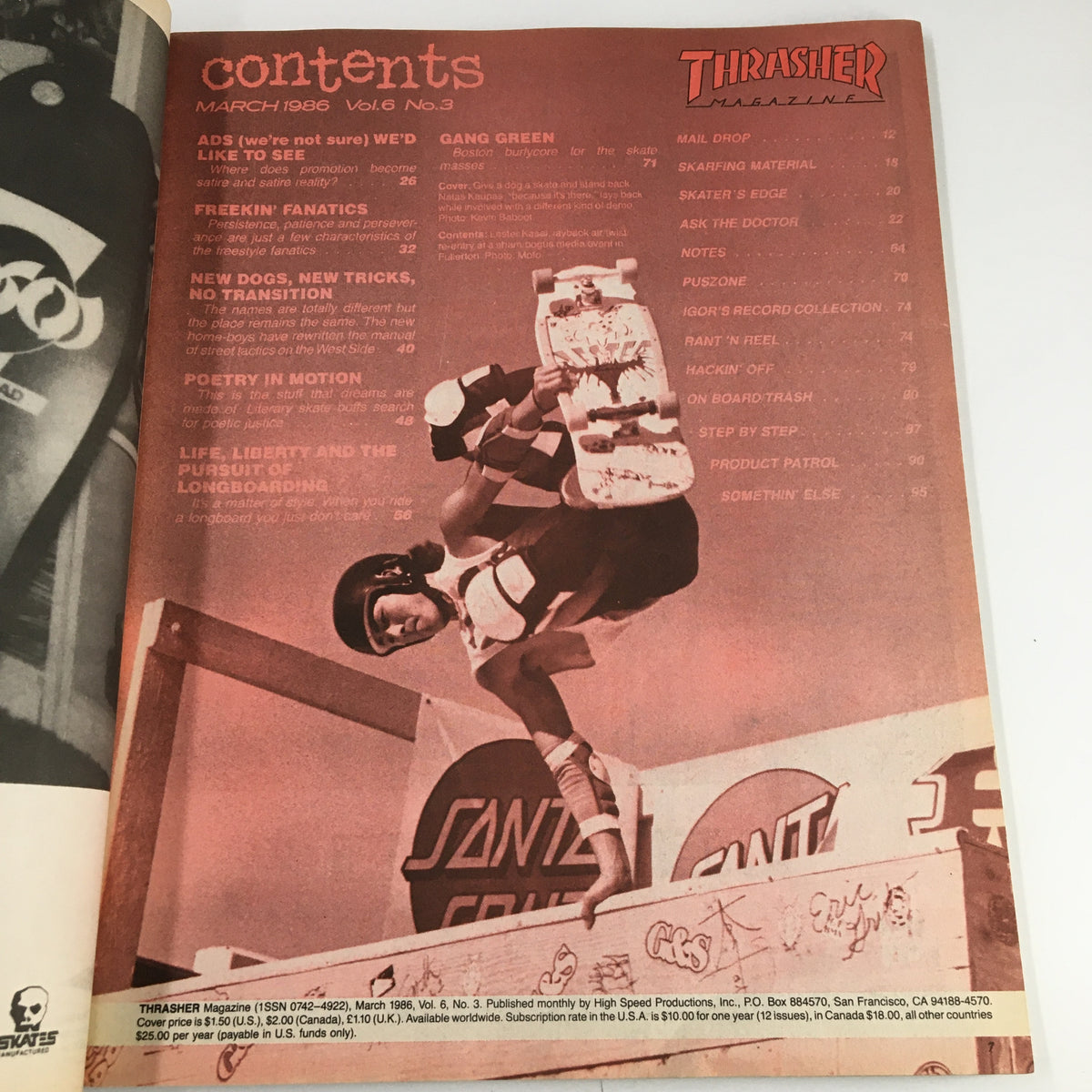


Description
Collector's Note – Why This Issue Matters
The March 1986 issue of Thrasher documents a moment that serious students of skateboarding history treat with particular reverence. Natas Kaupas was, at this point, still an emerging figure — not yet the fully canonized icon he would become by the late 1980s — and coverage of him in early 1986 captures something genuinely rare: a skater in the process of developing a vocabulary that the sport had never seen before. Where the dominant contest culture of the era was built around vertical skating and halfpipe performance, Kaupas was among the handful of riders who were quietly, methodically expanding what street skating could mean. His approach to urban obstacles — treating curbs, walls, fire hydrants, and car hoods as legitimate skating terrain — would become foundational to how the sport evolved through the late 1980s and into the 1990s. A Thrasher feature framed around a demo appearance, described here as a "different kind" of demonstration, suggests the magazine recognized early that what Kaupas was doing required a different kind of attention. Collectors building a serious archive of Thrasher's coverage of street skating's formative years consistently identify early Kaupas appearances as among the most historically significant editorial moments the publication produced.
March 1986 is also a meaningful date in the broader context of what Thrasher was doing editorially at the time. The magazine was in the middle of a period when it was actively documenting a sport in genuine transition — vert skating still commanded the competitive mainstream, but the creative energy was beginning to shift, and Thrasher's willingness to give serious coverage to skaters like Kaupas was part of how that shift got legitimized and amplified in print. This issue sits at that inflection point. For collectors tracking skateboarding and youth culture publishing across 1986, it represents one of the more consequential editorial decisions the magazine made that year — covering a skater whose influence would ultimately reshape the sport more profoundly than most of the contest champions being celebrated at the same moment.
Natas Kaupas would go on to appear on the cover of Thrasher and become one of the most influential figures in the history of street skating, with a signature style that inspired generations of skaters who came after him. Early documentation of his skating — particularly from 1986, before that reputation was fully established — carries a historical weight that later coverage simply cannot replicate. This issue is a primary document of that early chapter.
About the Publication
Thrasher magazine launched in San Francisco in January 1981, founded by Fausto Vitello and Eric Swenson through the Independent Truck Company. From its earliest issues it positioned itself as the authentic, unvarnished voice of skateboarding — skeptical of mainstream crossover, committed to the skaters and scenes that the sport's commercial apparatus tended to overlook. By 1986 it had become the definitive record of where skateboarding stood and where it was heading, read seriously by riders, photographers, and anyone with a genuine stake in the culture. Its editorial format combined action photography, long-form features, contest coverage, and product content in a way that felt genuinely organic to the community it served rather than imposed from outside. That credibility is precisely why its early coverage of figures like Kaupas carries the documentary weight it does.
Key Highlights Inside
- A feature on Natas Kaupas centered on a demo described as a "different kind" of demonstration — framing that strongly implies the coverage was engaging directly with how Kaupas's approach to skating departed from the contest-vert mainstream of the era.
- Early print documentation of Kaupas at a formative stage of his career, predating the wider recognition he would receive as street skating moved to the center of the sport's culture in the late 1980s.
- Photography and editorial content consistent with Thrasher's mid-1980s style — direct, energetic, and attentive to the specific physical and environmental contexts in which skating was happening.
- Note: Specific additional article titles, interviews, and secondary features beyond the confirmed Kaupas coverage have not been independently verified for this issue. The above reflects what is documentable from the cover subject, publication, and date.
Condition & Rarity
Mid-1980s issues of Thrasher are among the more actively pursued targets in the vintage skate magazine market, and the survival rate for copies in genuinely good condition is lower than the magazine's print run might suggest. Thrasher was a newsstand publication read by teenagers who were, by definition, not thinking about archival preservation — issues were shared, stored in garages, and discarded at rates that have made clean survivors meaningful finds. The absence of a mailing label on the cover is an important positive attribute in collector grading: it confirms newsstand or shop origin rather than subscription delivery, and leaves the full cover art undisturbed. Minor wear across a magazine now approaching four decades old is expected and does not diminish research or display value provided the cover remains structurally intact and the interior pages are complete. Plastic protective covering present on a surviving copy is a reliable indicator that a previous owner treated the issue as a collectible rather than a disposable read — generally a good sign for spine integrity and page condition throughout.
Looking for More Issues Like This?
Early Natas Kaupas coverage in Thrasher is exactly the kind of material that serious collectors of skate history pursue persistently, and issues from 1986 with confirmed feature content are not easy to replace once they're gone. The broader Thrasher magazine archive is the best starting point for exploring what other issues from this era are currently available. For collectors working through the full landscape of skate publishing from this specific year, the 1986 magazines collection offers a wider view of what the newsstand looked like across multiple titles during this pivotal period.