




Description
Collector's Note – Why This Issue Matters
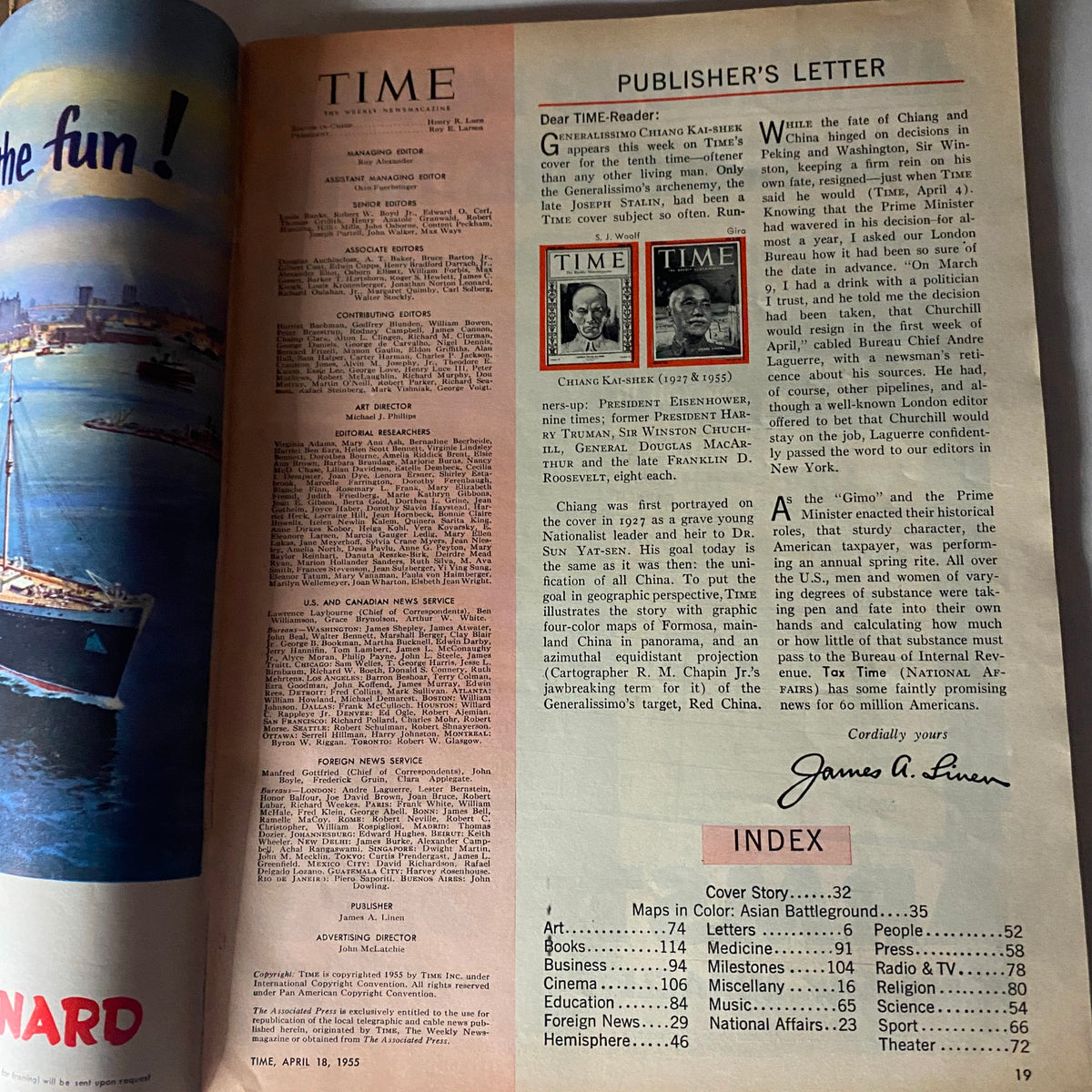
This April 18, 1955 issue of Time Magazine marks a genuinely remarkable publishing milestone: it was Generalissimo Chiang Kai-shek's tenth appearance on the magazine's cover, more than any other living person had achieved at that point in Time's history. Only the recently deceased Joseph Stalin had appeared on Time's cover more often, while runners-up among the living included President Eisenhower with nine cover appearances, and Harry Truman, Winston Churchill, and General Douglas MacArthur each with eight. That statistic, explicitly noted in the magazine's own Publisher's Letter for this issue, reflects just how central a figure Chiang had remained to American understanding of East Asian geopolitics across nearly three decades, from his first Time cover appearance in 1927 as a young Nationalist leader and heir to Sun Yat-sen, through the Chinese Civil War, and into his exiled leadership of the Republic of China on Taiwan. This issue's cover arrives at a genuinely consequential moment in that long arc, capturing Chiang during the tense final weeks of the First Taiwan Strait Crisis, one of the most significant early Cold War confrontations in East Asia and a moment when American military involvement, potentially including consideration of nuclear weapons, remained a genuine possibility under discussion within the Eisenhower administration.
The crisis that forms this issue's backdrop had begun in September 1954, when the People's Liberation Army initiated heavy artillery bombardment of the Nationalist-held island of Kinmen, also known as Quemoy, located just a few miles off the Chinese mainland, with shelling subsequently extending to the Matsu and Tachen Islands as well. That escalation prompted the United States and the Republic of China to sign the Sino-American Mutual Defense Treaty in December 1954, followed by the U.S. Congress passing the Formosa Resolution in January 1955, granting President Eisenhower broad authority to defend Taiwan and its surrounding islands against further communist attack. By the time this issue reached newsstands in mid-April 1955, the crisis had reached its critical turning point: Chinese Premier Zhou Enlai had just announced, at the Bandung Conference held that same month, the People's Republic of China's willingness to negotiate directly with the United States, a diplomatic overture that would lead to the crisis's de-escalation the following month and eventually to ambassadorial-level talks between the two nations beginning in Geneva that August. This issue therefore captures Chiang at the precise moment when the immediate military crisis surrounding his government's offshore island holdings was beginning to ease, even as the fundamental unresolved tensions between Taiwan and mainland China remained firmly in place, tensions that would erupt again in a second Taiwan Strait crisis just three years later.
Time's editorial approach to this milestone tenth cover reflected the magazine's characteristic use of sophisticated visual cartography to convey complex geopolitical stakes to its American readership, illustrating the accompanying story with detailed four-color maps of Formosa, a panoramic view of the Chinese mainland, and a specialized azimuthal equidistant projection centered on mainland China, credited to Time cartographer R. M. Chapin Jr. That visual approach reflected the magazine's effort to help American readers understand the specific geographic stakes of a conflict playing out across a series of small, strategically significant islands most Americans would have had little prior familiarity with. Chiang's stated goal, as this issue's own framing noted, remained unchanged from his first Time cover appearance nearly three decades earlier: the eventual unification of all China under Nationalist rule, a goal that by 1955 had become increasingly distant given the Communist government's firm control over the mainland and the Cold War stalemate that had settled over the Taiwan Strait. This issue captures that persistent, unresolved ambition at a moment when it was being tested by genuine military confrontation, offering readers a documented snapshot of Chiang's continued centrality to American Cold War strategy in East Asia even as his ultimate goal grew less realistic with each passing year.
For collectors of Cold War history specifically, this issue offers a documented artifact from one of the era's most consequential and least remembered early confrontations, arriving at the exact narrative turning point when diplomatic de-escalation began to replace the threat of direct military conflict between the United States and the People's Republic of China. For collectors of Chiang Kai-shek material or Time Magazine's cover history specifically, this issue's status as his record-setting tenth cover appearance gives it genuine bibliographic and historical significance beyond the immediate crisis it documents. This issue stands as a substantive primary source connecting one of the 20th century's most enduring political figures to one of the Cold War's most tense and consequential early flashpoints.
About the Publication
Time Magazine was founded in 1923 by Henry Luce and Briton Hadden and grew into one of the most influential news and current affairs publications in American history, known for its weekly coverage of politics, business, culture, and international affairs. The magazine's cover feature became one of its most recognizable editorial conventions, and by 1955 Time had begun explicitly tracking and noting cover-appearance milestones for its most frequently featured subjects, as this issue's own Publisher's Letter demonstrates in detailing Chiang Kai-shek's record as the most-featured living cover subject in the magazine's history at that time. Time's international reporting during this period relied heavily on sophisticated cartography and visual aids to help its American readership understand complex geopolitical situations, particularly those involving unfamiliar geography, a practice this issue's detailed maps of Formosa and mainland China exemplify directly. The magazine's audience was broad and national, reaching a readership across the country interested in comprehensive, digestible coverage of current events and emerging international developments during the anxious early years of the Cold War. Advertising within the magazine during this period reflected products aimed at a broad, educated, and professionally engaged national readership. Time's willingness to devote such sustained cover attention to a single foreign leader across nearly three decades reflected the magazine's broad editorial ambition to track significant international figures and developments as they unfolded across extended historical arcs, not merely as isolated news events. This issue exemplifies that longitudinal editorial approach clearly, situating a single cover feature within a documented, decades-spanning pattern of coverage.
Key Highlights Inside
- A cover feature marking Chiang Kai-shek's tenth appearance on Time's cover, a record among living people at the time. Only the recently deceased Joseph Stalin had appeared on the cover more often. This milestone was explicitly noted in the issue's own Publisher's Letter.
- Coverage of the First Taiwan Strait Crisis, arriving at its critical diplomatic turning point. Premier Zhou Enlai had just announced China's willingness to negotiate with the United States at the Bandung Conference that same month. This issue captures the crisis at the exact moment its military tensions began to ease.
- Detailed four-color cartography illustrating the story, including maps of Formosa, a panorama of mainland China, and an azimuthal equidistant projection credited to cartographer R. M. Chapin Jr. This visual approach reflects Time's characteristic use of sophisticated maps to convey complex geopolitical stakes. It helped American readers understand the specific geography of the offshore island conflict.
- Context connecting this crisis to the broader Cold War containment policy, including the December 1954 Sino-American Mutual Defense Treaty and the January 1955 Formosa Resolution. These developments granted President Eisenhower broad authority to defend Taiwan against communist attack. This issue arrives as that authority was being actively tested by the unfolding crisis.
- Additional national affairs and international reporting likely present, consistent with Time's standard weekly issue structure. Issues typically combined multiple substantial features per edition. Specific additional article titles for this issue beyond those noted here are not detailed in available records.
- Advertising content reflecting Time's broad, educated national readership during the mid-1950s. These pages offer useful secondary context for researchers studying period consumer culture. Specific advertisers appearing in this issue are not detailed in available records.
Condition & Rarity
This issue is described as being in excellent condition for its age, a grade reflecting a periodical that has held up well given over seven decades since its original publication. At this grade, collectors can generally expect strong cover integrity, minimal handling marks, and good overall structural preservation, an outcome that is notably less common among widely circulated 1950s newsweeklies than among more specialized or limited-run publications. Time Magazine issues from this period were produced in large volumes and read broadly across the country, meaning surviving copies in genuinely excellent condition represent a smaller proportion of original print runs than the sheer circulation numbers might suggest. Cover feature issues connected to a documented publishing milestone, such as this one's record-setting tenth Chiang Kai-shek cover, often draw additional collector interest beyond the magazine's general publishing history, since such issues carry significance both for their immediate news content and for their specific place within Time's own cover-history record. A plastic protective covering, when present, functions as a stabilizing measure intended to preserve a copy's current condition rather than a factor that changes its underlying grade. Collectors evaluating any surviving copy of this issue should examine the spine and cover gloss closely, since these are the attributes most likely to distinguish a genuinely excellent-grade copy from one merely described as such. Given the combination of this issue's substantive Cold War subject matter and its documented status as a genuine cover-history milestone, an excellent-grade surviving copy represents a particularly desirable find for collectors of Cold War history and vintage news journalism alike.
Looking for More Issues Like This?
Well-preserved issues of Time Magazine documenting significant Cold War flashpoints, particularly one marking a genuine publishing milestone like Chiang Kai-shek's record-setting tenth cover appearance, are a genuinely appealing category for collectors spanning both magazine history and 20th-century East Asian political history. For those drawn to this particular issue, our Time Magazine collection is an excellent place to continue browsing, since it gathers other surviving issues from across the publication's long history of political and international cover journalism. That collection offers a broader look at how Time's cover choices documented the shifting concerns of the Cold War across different years and developments. Collectors with a specific interest in Chiang Kai-shek's decades-long career, the Taiwan Strait crises, or mid-century Time cover cartography may find related material of interest scattered throughout that same collection. Beyond the publication itself, our 1955 magazines collection offers useful context for the broader publishing landscape of the same year, spanning titles well outside news journalism. Browsing by year can be especially valuable for researchers interested in a specific historical moment rather than a single magazine title. Given how appealing genuine publishing-milestone issues like this one tend to be to collectors once discovered, we'd encourage anyone interested in this period to browse both collections at their own pace. There is always more of this history available than a single issue can represent on its own. We hope these collections help round out whatever corner of Cold War and mid-century news journalism history you're most drawn to.