

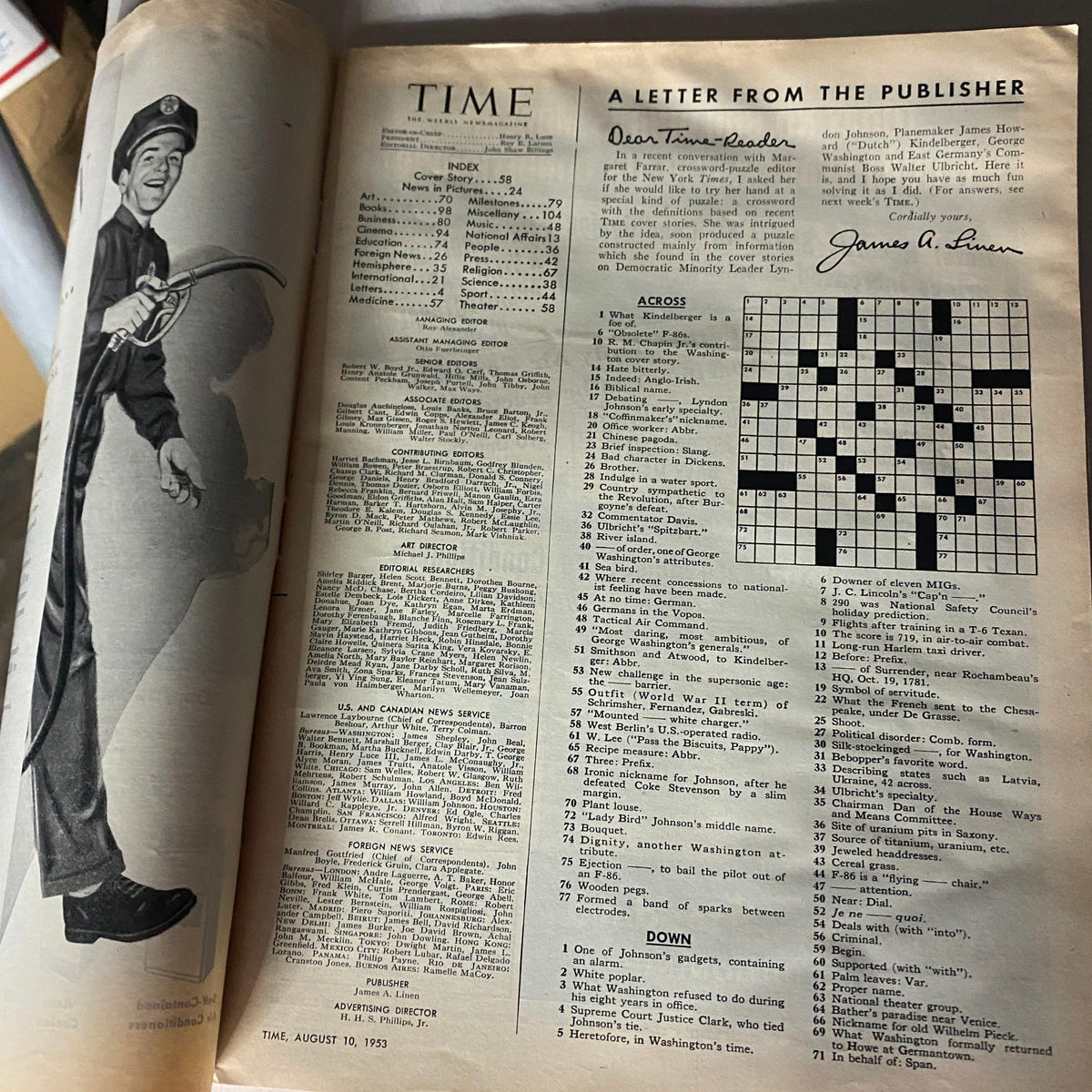


Description
Collector's Note – Why This Issue Matters
The August 10, 1953 issue of Time Magazine, identified as Volume 62, Number 6, features actress Shirley Booth on a painted cover by Boris Chaliapin. The principal profile is titled “The Trouper,” emphasizing Booth’s endurance and professional discipline after more than twenty-five years in American theater. The article appeared only months after she received the Academy Award for Best Actress for her performance as Lola Delaney in the film adaptation of Come Back, Little Sheba. She had originated the same role on Broadway and received the 1950 Tony Award for Best Actress in a Play. In 1953, she received another Tony Award for her starring performance as Leona Samish in Arthur Laurents’s The Time of the Cuckoo. Time therefore presented her during an unusually concentrated period of recognition across stage and screen. The cover records the moment when a respected character actress became one of the most celebrated performers in American entertainment.
Booth’s achievement was particularly notable because Come Back, Little Sheba marked her first motion-picture performance. Rather than being introduced as a conventional Hollywood glamour figure, she became known to film audiences through a psychologically demanding portrayal of disappointment, loneliness, marriage, and regret. Time’s article argues that her apparent naturalness was the result of extensive experience in stock companies, Broadway productions, comedy, drama, and radio. It also considers why widespread stardom arrived relatively late despite the admiration she had long received from fellow performers and theater critics. At the time of publication, Booth was appearing in a summer production of The Time of the Cuckoo at the Central City Opera House in Colorado. The profile also looked ahead to further film and stage projects, showing that her Oscar victory was not being treated as the conclusion of her career. The resulting article is both a celebrity profile and a period assessment of acting craft, theatrical persistence, and unconventional stardom.
The magazine appeared shortly after the Korean Armistice Agreement of July 27, 1953, which suspended major fighting without producing a final peace treaty. Its national and international departments examine the consequences of the truce, American defense planning, European alliances, French Indochina, Iran, Israel, Italy, Germany, Pakistan, and other Cold War concerns. Domestic coverage considers Congress, military affairs, political organization, agriculture, fashion, and the Eisenhower administration. Separate departments address science, medicine, religion, education, business, sports, books, cinema, music, theater, and art. This breadth places Booth’s rise within the wider political and cultural atmosphere of the summer of 1953. The issue demonstrates how Time could use one performer’s portrait as the visual entrance to a much broader weekly survey of world events. Related entertainment and historical coverage can be examined through the collection of vintage Time Magazines and through other magazines published in 1953.
About the Publication
Time Magazine was founded by Henry R. Luce and Briton Hadden, with its first issue published in March 1923. The weekly publication was designed to organize major national and international developments into a compact and recognizable news format. Its departments covered government, diplomacy, armed conflict, economics, labor, science, medicine, religion, education, sports, books, theater, cinema, music, radio, and visual art. Articles were generally concise and arranged so that readers could move through a broad account of the week’s events. Time became especially associated with cover portraits of political leaders, military commanders, scientists, executives, writers, performers, clergy, and athletes. During the middle decades of the twentieth century, many of these covers were commissioned paintings rather than ordinary news photographs. Artists such as Boris Chaliapin combined recognizable likenesses with symbolic details and carefully controlled color. The magazine’s red border developed into one of the most familiar visual devices in American periodical publishing. Its writing frequently blended reporting with interpretation, compressed character descriptions, and a distinctive editorial voice. Entertainment profiles treated theater and film as significant parts of public life rather than as subjects entirely separate from politics or business. Surviving issues now document both the people and events reported and the editorial framework through which contemporary readers encountered them.
Key Highlights Inside
- “The Trouper” is the verified principal profile associated with Shirley Booth’s cover appearance. It examines her development from stock-company and supporting-stage work to major recognition in Come Back, Little Sheba and The Time of the Cuckoo. The complete article should be consulted before attributing individual quotations, personal opinions, or private biographical details to Booth.
- The issue reports on the political and military aftermath of the Korean armistice. Articles titled “Tug of War,” “Wary Peace,” and “The Economy: After the Truce” reflect uncertainty about whether the agreement would produce stability. These reports preserve commentary written while the consequences of the cease-fire were still unfolding.
- International coverage includes “Street Without Joy,” concerning the conflict in French Indochina, and “Chaos in the Sun,” concerning Iran. Additional reports address European defense, Britain, Italy, Germany, Israel, Pakistan, Hong Kong, Burma, Japan, Cuba, and Costa Rica. The range illustrates how Cold War strategy, decolonization, political instability, and trade were treated as interconnected developments.
- Domestic departments include “The Record of the 83rd,” “Rude Awakening,” “Citizens for Eisenhower,” and “Hiking the Hemline.” These features address Congress, the armed forces, political organization, and women’s fashion within the same national-affairs section. Their placement demonstrates the expansive definition of current affairs used by a weekly general newsmagazine.
- Science and medicine features include “Bountiful Algae,” “Atomic Patent,” “Malignant Tumors,” and “Sigmund’s Jewel.” The arts section contains Booth’s theater profile alongside coverage of music, contemporary exhibitions, cinema, and newly published books. Sports, education, religion, business, press criticism, people, letters, and milestones further extend the issue beyond its cover subject.
Condition & Rarity
The supplied listing states that the pictured magazine is the exact issue represented by the description. No formal collector grade is provided, so the physical condition should be assessed from the accompanying photographs rather than from an assumed category such as good or very good. The written description acknowledges that the magazine shows age-related condition but does not identify particular tears, stains, creases, marks, or binding defects. The presence or absence of a mailing label is not specified. That detail should therefore be established from the cover photograph rather than inferred from another surviving example of the same issue. A plastic protective covering accompanies the magazine and may reduce further exposure to dust, fingerprints, and surface abrasion. The sleeve does not verify page completeness, staple security, cover attachment, or the condition of pages hidden inside. Inspection should focus on Booth’s painted portrait, the red border, the Time nameplate, and the printed date because damage in these areas directly affects the cover presentation. The spine, corners, and outer edges should be checked for rubbing, splitting, bending, and stress caused by repeated reading or storage. Interior examination should look for clipping, handwriting, missing pages, stains, moisture exposure, brittleness, fading, tape, and previous repairs. Historical interest in Booth’s awards and career does not independently establish rarity, which should be assessed through the condition and documented availability of surviving examples.
Looking for More Issues Like This?
Exact Time issues can require patience to identify when research is centered on a particular performer, cover artist, volume number, and stage of a career. The August 10, 1953 edition is especially relevant to readers studying Shirley Booth, American theater, Come Back, Little Sheba, and the relationship between Broadway and Hollywood. Related actor profiles and cultural reporting can be explored through the broader collection of vintage Time Magazines. Other issues document playwrights, directors, stage performers, film actors, musicians, television personalities, and changing forms of popular entertainment. Comparing neighboring editions also reveals how arts coverage was positioned beside war, diplomacy, politics, science, medicine, business, and fashion. The collection of original magazines from 1953 provides a wider view of the year in which Booth appeared on the cover. Publications from that year preserve the Korean armistice, the Eisenhower administration, Cold War tensions, cinema, theater, television, advertising, sports, and consumer culture. Examining several titles together helps distinguish Time’s interpretive newsmagazine style from the photographic, literary, and entertainment-centered approaches used by other periodicals. Closely dated issues remain historically useful even when this precise August edition is not represented because they establish the surrounding political and cultural chronology. Together, the Time and 1953 collections provide a useful foundation for continued research into Shirley Booth and American magazine culture during the early 1950s.