


Description
Collector's Note – Why This Issue Matters
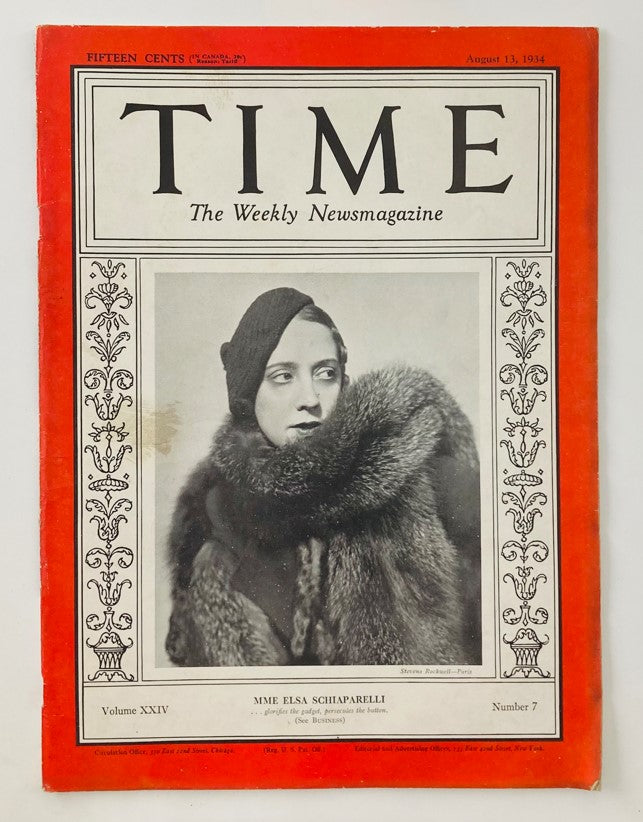
August 1934 found Elsa Schiaparelli at the precise moment of her greatest creative ascent. She had opened her Paris couture house in 1927 and by the early 1930s had established herself as the most intellectually provocative designer in fashion — the figure most seriously engaged with the Surrealist movement that was reshaping European art, and the most direct rival to Coco Chanel for dominance of the Paris couture world. Her 1934 collections were generating intense international attention, and a Time cover was a signal that her influence had crossed from the specialized world of fashion into the broader cultural consciousness that the magazine's readership represented. To appear on the cover of Time in 1934 was to be recognized as a figure of consequence well beyond one's own field.
The historical context of August 1934 adds layers that serious collectors will appreciate. Europe was darkening rapidly — Hitler had consolidated power in Germany following Hindenburg's death just days before this issue's publication date, declaring himself Führer on August 2, 1934. Schiaparelli, operating from Paris at the center of European creative life, was producing work of exuberant imagination at a moment when the continent was moving toward catastrophe. Her designs of this period — bold, witty, deeply engaged with the artistic avant-garde — were in some sense a counterstatement to the political climate surrounding them, and a Time cover documenting her influence at this specific moment carries that historical weight. For collectors of Time magazine issues that intersect fashion, art, and history, this is a genuinely charged document.
Schiaparelli's legacy has only grown since her death in 1973. The revival of her house in 2012 and the ongoing critical reassessment of her work as a foundational influence on contemporary fashion — from Alexander McQueen to John Galliano — has renewed collector and scholarly interest in primary documents of her career. A 1934 Time cover from the height of her original influence belongs in any serious collection of fashion history ephemera, and for collectors assembling an archive of magazines from 1934 that document European cultural life in the interwar period, it is an essential piece.
About the Publication
Time magazine, founded in 1923 by Henry Luce and Briton Hadden, had by 1934 established itself as the preeminent weekly news magazine in the United States and a publication with genuine international reach and influence. Volume 24, Number 7 places this issue in the magazine's second decade, during a period of steady editorial maturation and expanding circulation. Time's cover subject selection in the 1930s was a reliable indicator of who the American press considered most consequential across politics, business, science, and culture, and a fashion designer receiving that recognition in 1934 — when the magazine's covers were overwhelmingly dominated by political figures — speaks to the genuine magnitude of Schiaparelli's cultural standing at the time. The magazine's format combined concise departmental news summaries with longer feature coverage, surrounded by advertising that itself constitutes a significant historical record of 1930s American commercial culture.
Key Highlights Inside
- A cover feature on Elsa Schiaparelli documenting her standing as the most internationally prominent and critically discussed fashion designer of the early 1930s, at the height of her engagement with Surrealism and her rivalry with Chanel for dominance of the Paris couture world.
- News department coverage consistent with Time's format for August 1934 — a historically significant week that included Adolf Hitler's assumption of the title of Führer following President Hindenburg's death, placing this issue in the context of one of the most consequential moments in twentieth-century European history.
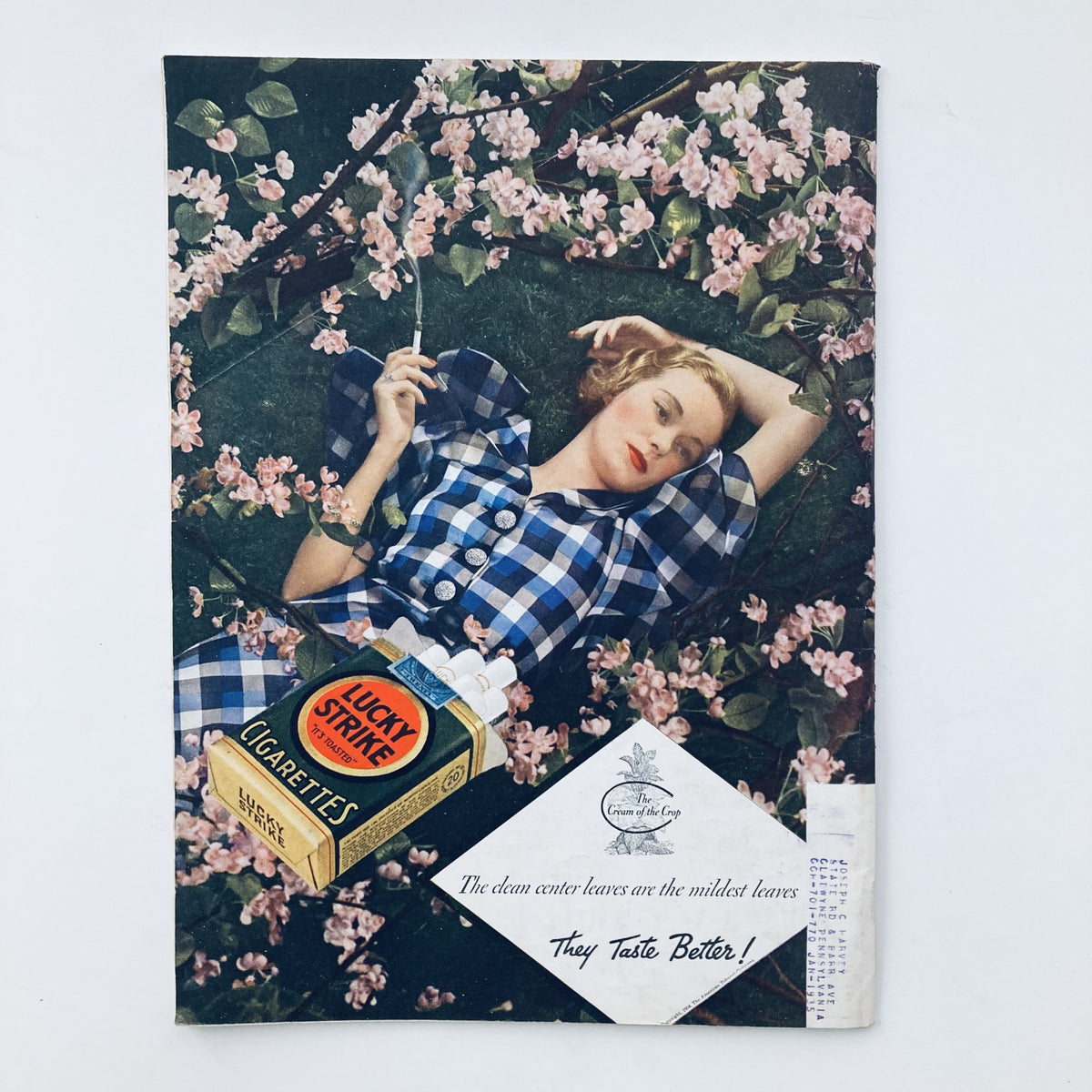
- Period advertising and photography reflecting the commercial and visual culture of 1930s America, which for collectors of interwar ephemera constitutes a significant secondary layer of historical documentation beyond the editorial content.
- Specific interior article titles and features beyond the cover story are unconfirmed from the listing; content described above reflects what is verifiable from the cover subject, volume and issue number, and publication date.
Condition & Rarity
A surviving copy of Time from August 1934 is now more than 90 years old, and condition assessment must account honestly for that age. The listing does not specify a formal condition grade beyond referencing the photographs for assessment, which means prospective collectors should treat the cover images as the primary condition reference. For a weekly newsmagazine of this vintage, the most consequential condition factors are cover integrity — color retention, absence of significant tears or creasing across the Schiaparelli portrait — and interior page stability, including brittleness, browning, and the presence of any moisture damage or foxing. The protective plastic sleeve provides ongoing stabilization. No label is not noted as a confirmed attribute for this issue; the presence or absence of a subscriber label on the cover should be verified from the photographs, as label status is a meaningful consideration for a cover of this visual and historical significance.
Looking for More Issues Like This?
Time covers featuring fashion designers are genuinely uncommon across the magazine's century-long run, and the August 1934 Schiaparelli issue — arriving at such a charged historical moment — is among the most contextually significant of that rare category. If this issue has already been claimed, the Time magazine collection at OriginalMagazines.com is the best place to explore other available issues spanning the magazine's history. The 1934 magazine collection is also worth browsing for collectors building a broader archive of interwar cultural and political history.