

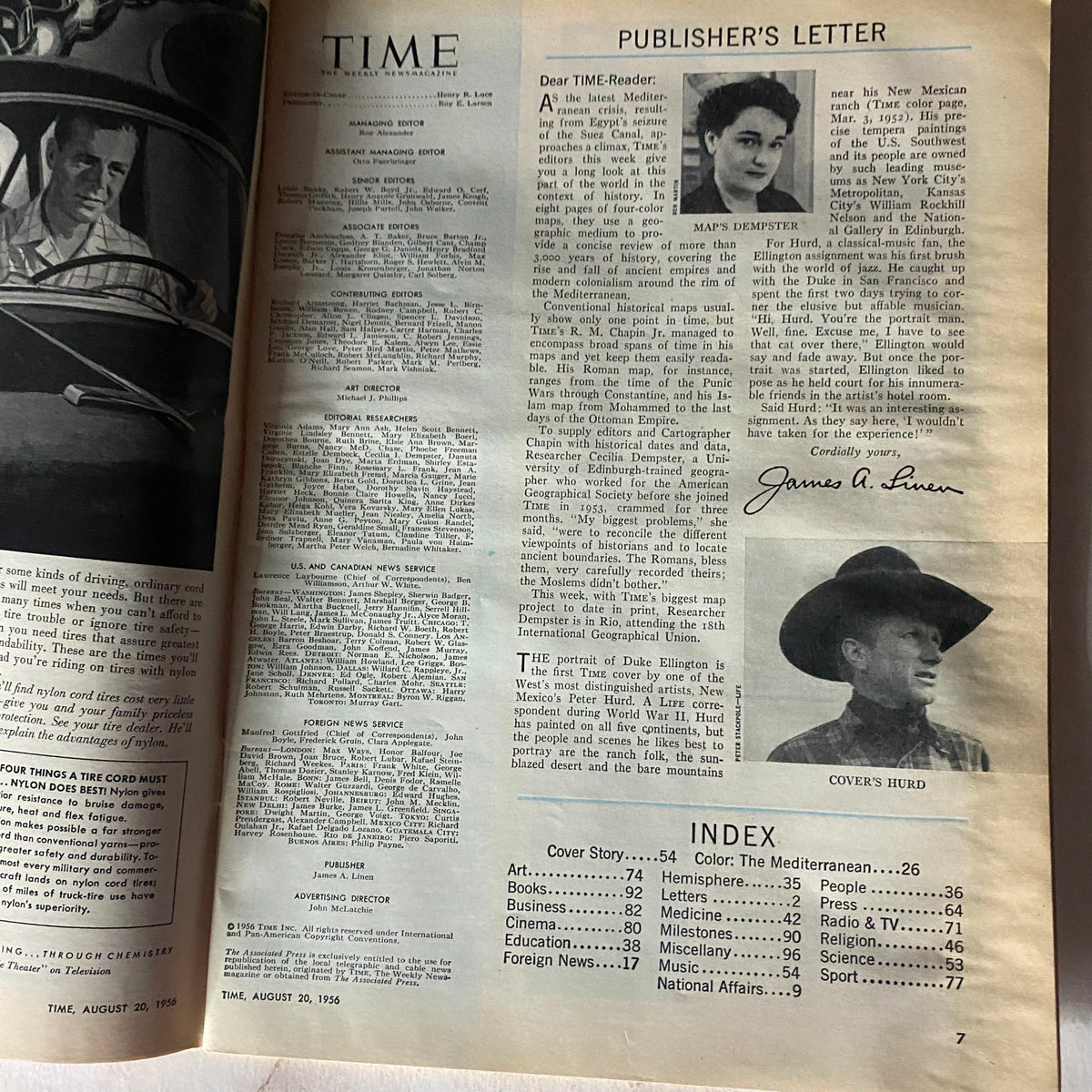


Description
Collector's Note – Why This Issue Matters
The August 20, 1956 issue of Time magazine featuring Duke Ellington on its cover is one of the most historically significant jazz-related magazine covers of the entire twentieth century, and its timing is historically precise in a way that rewards close attention. The cover date falls just weeks after one of the most celebrated moments in Ellington's career: his performance at the Newport Jazz Festival on July 7, 1956, which is now recognized as one of the most important live events in jazz history. Ellington had been considered a figure of the jazz establishment by the mid-1950s — respected, revered, but perhaps past his commercial peak. The Newport performance, and in particular tenor saxophonist Paul Gonsalves's extraordinary 27-chorus improvisation on "Diminuendo and Crescendo in Blue" that sent the festival crowd into near-riot, electrified the jazz world and the mainstream press simultaneously. The performance was widely credited with revitalizing Ellington's career and public profile at a stroke. The Time cover that followed in August 1956 was a direct response to that Newport moment — the mainstream media's acknowledgment that Ellington had reasserted himself as the dominant figure in American jazz with one of the most dramatic live performances the music had ever produced. Collectors who pursue vintage Time magazine issues documenting American music history will find that the August 1956 Ellington cover is one of a handful of issues in the publication's run where the cover story and the historical event it documents are so precisely aligned as to be inseparable.
The cultural significance of an Ellington Time cover in August 1956 extends well beyond the Newport concert itself. By the mid-1950s, jazz was engaged in one of the most consequential debates in its history: the tension between the jazz establishment represented by swing-era figures like Ellington and the new languages of bebop, cool jazz, and hard bop that had emerged since the mid-1940s. Ellington had consistently transcended those generational and stylistic divisions — his orchestra had absorbed and transformed musical influences throughout its history — but the Newport performance demonstrated that he could still command the kind of visceral, physically overwhelming audience response that the popular press understood as the measure of musical greatness. A Time cover in 1956 was also a statement about racial representation in mainstream American media, and Ellington's appearance on the cover — as a Black American artist being celebrated on his own musical terms rather than in a sports or political context — carries weight that extends beyond the music journalism of the moment. The broader context of American culture in this pivotal year of the civil rights era is documented across the 1956 magazine archive, which places this issue within one of the most consequential years of the postwar decade.
Ellington's biography up to August 1956 gives the cover additional historical depth. He had led his orchestra continuously since the 1920s, had composed some of the most ambitious extended works in jazz history — Black, Brown and Beige, the Far East Suite, his sacred concerts — and had maintained a creative output across three decades that no other figure in jazz had approached. The Newport concert did not create Ellington's greatness; it reminded a generation that had perhaps taken that greatness for granted. The Time cover of August 20, 1956, arriving in the immediate wake of Newport, is a primary document of that reminder — the mainstream media's formal acknowledgment that Duke Ellington remained, at fifty-seven years old, the most significant figure in American jazz.
About the Publication
Time magazine, founded in 1923 by Henry Luce and Briton Hadden, was by 1956 the dominant American newsweekly, with a circulation of several million and a cover selection process that functioned as one of the most reliable indicators in American journalism of which figures and events the mainstream media establishment considered worthy of national attention. Its music and arts coverage in the 1950s was substantial and serious, reflecting Luce's consistent editorial interest in American cultural achievement alongside political and international news. A Time cover appearance for a jazz musician in 1956 carried institutional weight that no other print platform could match, and the decision to feature Ellington in the immediate aftermath of Newport reflected an editorial judgment about the cultural significance of both the man and the moment.
Key Highlights Inside
- Duke Ellington cover feature in the aftermath of Newport 1956 — Published weeks after Ellington's legendary July 7, 1956 Newport Jazz Festival performance — widely credited with revitalizing his career and producing one of the most celebrated moments in jazz history — this cover documents the mainstream media's recognition of that event's significance in real time.
- Paul Gonsalves and the Newport performance context — The 27-chorus improvisation on "Diminuendo and Crescendo in Blue" that electrified the Newport audience and generated the press attention that led directly to this cover is the historical event this issue documents, making it a primary source for the history of the Newport Jazz Festival and of Ellington's career arc.
- Mid-1950s jazz culture at a pivotal moment — August 1956 represents a specific inflection point in jazz history, when the generational and stylistic tensions of the postwar decade were being actively negotiated and Ellington's Newport performance had reasserted the continuing vitality of the swing-era orchestral tradition against the newer languages of bebop and cool jazz.
- Racial representation in mainstream American media — The Ellington cover in August 1956 — one year after the Montgomery Bus Boycott began — carries significance as a document of Black American achievement being recognized and celebrated on its own cultural terms in the nation's dominant newsweekly at a specific moment in the civil rights era.
Condition & Rarity
Surviving copies of this issue with a protective sleeve represent the appropriate collector storage baseline for a nearly seventy-year-old coated and newsprint stock newsweekly. Time issues from 1956 will typically show some degree of edge toning, light cover surface aging, and minor page browning at the margins — these are inherent characteristics of the paper chemistry at this age rather than indicators of poor storage. The listing does not specify a formal condition grade beyond the general collectible description, and the accompanying photographs are the most reliable reference for the specific condition of any surviving copy of this issue. For this particular cover, the condition of the Ellington portrait image — its color fidelity, surface clarity, and freedom from moisture damage or significant abrasion — is the primary collector evaluation variable. The magazine's historical significance means that copies across a wide condition range retain research and reference value, with display-grade copies naturally commanding more attention from collectors focused on presentation.
Looking for More Issues Like This?
The August 1956 Ellington cover is one of the most historically grounded jazz-related Time covers in the magazine's entire run, and copies in solid displayable condition are pursued by jazz historians, Ellington specialists, and mid-century American culture collectors alike. The full Time magazine archive at OriginalMagazines.com is the most comprehensive place to browse what's currently available across the publication's history, including other significant music and arts covers from the 1950s. For collectors working the broader cultural landscape of this pivotal postwar year, the 1956 magazine archive brings together issues from multiple titles that together document one of the most consequential years in American music, politics, and social history.