




Description
Collector's Note – Why This Issue Matters
The August 26, 1957 issue of Time magazine — Volume 70, Number 9 — arrived on newsstands at one of the most electrifying moments in the history of American sports and civil rights simultaneously. Althea Gibson had just won Wimbledon in July 1957, becoming the first Black athlete, male or female, to win a Grand Slam tennis title. The achievement was seismic. Tennis in the mid-fifties was not merely a sport — it was a carefully maintained social institution, one of the last major athletic arenas in America to integrate, and its most prestigious venues were steeped in the genteel racial exclusivity that characterized elite white American social life. Gibson's path to Wimbledon had required years of fighting simply for the right to compete on the same courts as white players, a battle she had waged with the support of figures including Alice Marble, the former world number one who had written a landmark open letter demanding Gibson's inclusion in USLTA events in 1950. By the time Time put her on its cover in August 1957, Gibson had not merely won a tennis tournament — she had broken open one of the last formally segregated major sports institutions in the Western world. For collectors assembling a serious archive of Time magazine covers from the civil rights era, this issue is an essential primary document of a moment of genuine historical consequence.
The cultural weight of a Time cover in 1957 cannot be overstated, and Gibson's appearance on it requires that context to be fully understood. Time's cover was not simply a magazine feature — it was a weekly declaration by the editors of the most influential newsmagazine in America about who mattered most in the national conversation at that precise moment. In August 1957, with the Civil Rights Movement building toward the confrontation at Little Rock Central High School that would occur just weeks after this issue's publication, a Black woman's face on the cover of Time carried a symbolic charge that went far beyond sports coverage. Gibson was simultaneously a tennis champion, a pioneering figure in the desegregation of American athletics, and a living rebuttal to the racial hierarchies that American society was being forced to confront at every level. The magazine's decision to feature her in the immediate aftermath of her Wimbledon victory placed that victory in its correct cultural frame — not as an isolated sporting achievement but as an event of national significance. That framing is precisely what makes this issue valuable not just to sports collectors but to anyone seriously engaged with the documentary history of mid-century American civil rights and social change.
Althea Gibson's 1957 achievements did not end at Wimbledon. She went on to win the U.S. National Championships at Forest Hills that same summer — completing a remarkable Grand Slam double in a single season — and she successfully defended both titles in 1958, making her the dominant player in women's tennis for a sustained period at the exact moment the sport was being forced to reckon with its own exclusionary history. Her career trajectory after tennis, which included a professional golf career that made her the first Black woman to compete on the LPGA Tour, only deepened the historical significance of this cover as a document of a figure whose impact extended across multiple domains of American sporting and social life. The Time cover from this specific week captures Gibson at the absolute peak of her athletic career, freshly triumphant from Wimbledon and weeks away from her Forest Hills victory, in a year that would come to define her legacy entirely. Those building a comprehensive archive of 1957 magazines as documents of one of the most consequential years in American civil rights history will find this issue indispensable — a year that also saw the passage of the Civil Rights Act of 1957 and the Little Rock crisis, and that produced a remarkable concentration of historically significant magazine covers across multiple publications.
About the Publication
Time magazine, co-founded by Henry Luce and Briton Hadden in 1923, established itself over the following three decades as the definitive American weekly newsmagazine and one of the most influential periodicals in the world. Its editorial format combined concise, opinionated reporting on the week's major news events with longer analytical features, cultural criticism, and regular coverage of science, medicine, business, and the arts — a breadth of coverage that made it genuinely useful to the educated, engaged American reader who wanted a single authoritative weekly source for the full landscape of current events. The magazine's cover, chosen each week by editors who treated the selection as the single most important editorial decision of the publishing cycle, became over time one of the most recognizable and culturally powerful images in American journalism — to appear on the cover of Time was to be declared, by the most widely read newsmagazine in the country, the person or subject that mattered most to the nation that week. By 1957 Time was publishing at the height of its influence, reaching millions of subscribers at a moment when weekly newsmagazines were the primary analytical filter through which educated Americans processed the accelerating events of the postwar world. Volume 70, Number 9 falls within a particularly significant period of the magazine's publishing history, when its covers were documenting the civil rights transformations that were reshaping American society in ways that would only become fully visible in the decade that followed.
Key Highlights Inside
- The cover features Althea Gibson in the immediate aftermath of her 1957 Wimbledon victory — the first Grand Slam title ever won by a Black athlete in the history of tennis — placing this issue at the intersection of sports history, civil rights history, and the history of American magazine journalism at one of the most significant single moments any of those three narratives produced in the mid-twentieth century.
- The issue is precisely identified as Volume 70, Number 9, published August 26, 1957 — a date that falls between Gibson's Wimbledon victory in July and her U.S. National Championships victory at Forest Hills in September, capturing her at the peak of a season that would make her the dominant figure in world women's tennis and the most decorated American tennis player of her era.
- The Time cover story on Gibson appeared just weeks before the Little Rock Central High School desegregation crisis of September 1957 — one of the defining confrontations of the Civil Rights Movement — placing this issue within a compressed period of American civil rights history that was moving with extraordinary speed and intensity, and lending Gibson's cover appearance a broader symbolic weight that Time's editors were certainly conscious of in selecting it.
- Gibson's appearance on a Time cover in 1957 marked one of the relatively rare instances in the magazine's mid-century history when a Black American was featured as the cover subject in a context of celebration and achievement rather than crisis or controversy — a distinction that collectors and historians focused on the representation of Black Americans in mainstream media regard as a significant editorial data point.
- As a late-August 1957 issue, this edition would have carried Time's coverage of the full range of domestic and international events of that consequential week — including developments in the Cold War, the early stages of the space race, and the ongoing legislative maneuvering around what would become the Civil Rights Act of 1957 — making it a rich documentary cross-section of a year of extraordinary historical density.
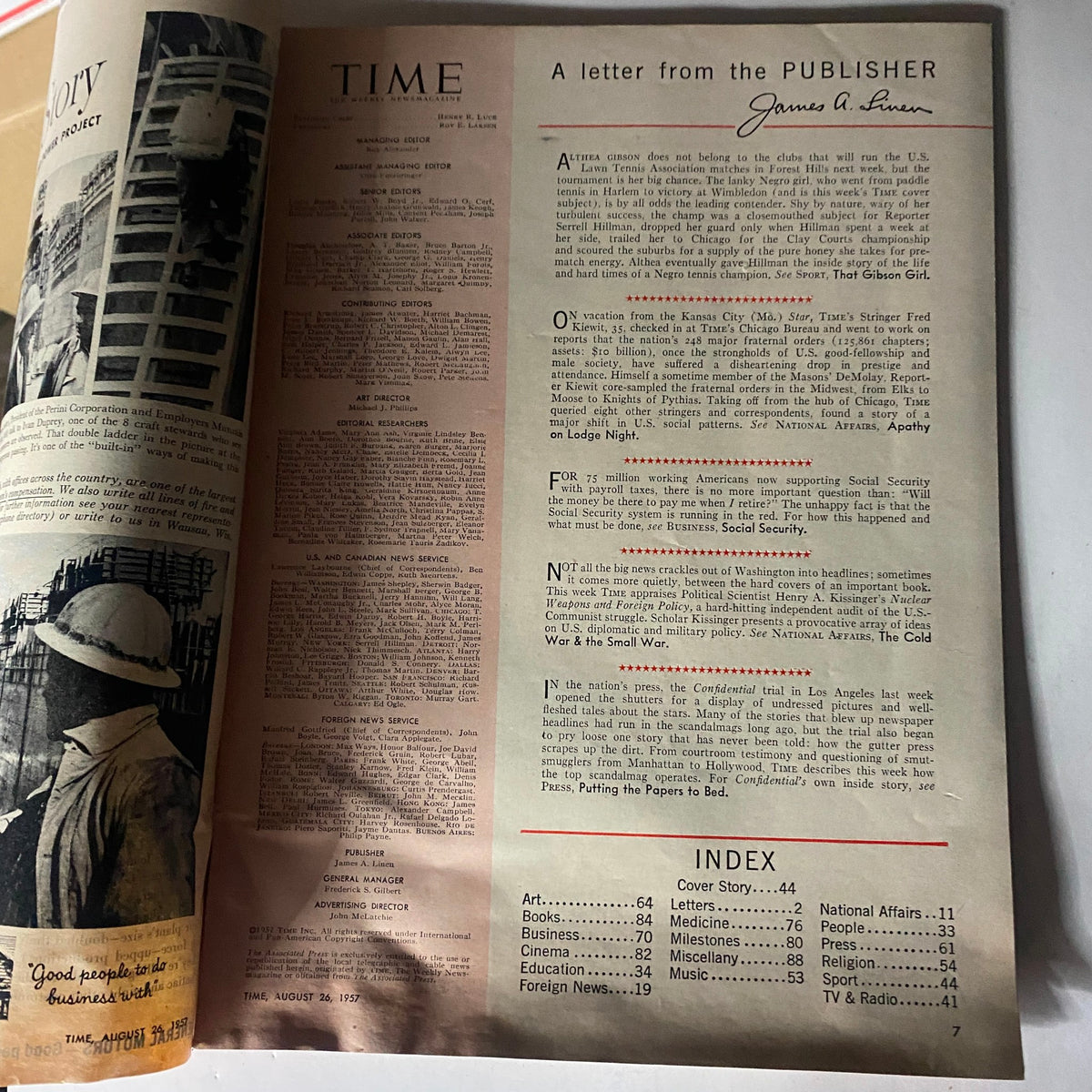
- Note: Specific article titles, page numbers, and secondary editorial content beyond the confirmed cover subject have not been independently verified for this issue. The above reflects what is documented from the cover, volume and issue identification, and the well-established historical record surrounding Althea Gibson's 1957 tennis season and its broader civil rights significance.
Condition & Rarity
Surviving copies of the August 26, 1957 Time in genuinely collectible condition represent a meaningful minority of the original print run, and nearly seven decades of attrition have created a real gap between the millions of copies originally distributed and the number that have survived in states worth describing to a serious collector. Time of this era was printed on a combination of coated stock for photographic pages and lighter text-weight paper for its news sections — more durable than pure newsprint but not engineered for long-term archival preservation, and susceptible to the tanning, brittleness, and surface oxidation that accumulate in paper-based periodicals over decades of storage in variable conditions. The listing describes this issue as being in excellent condition for its age — a characterization that, applied honestly to a nearly seventy-year-old weekly newsmagazine, implies minimal tanning, intact structural integrity throughout, a well-preserved spine with no significant cracking or separation, and cover stock that retains its original color and legibility without major surface damage. The listing does not specify the presence or absence of an address label, which is a relevant condition detail for display-focused collectors: label-free covers preserve the full visual impact of the Gibson portrait — one of the more historically significant cover images in Time's mid-century publishing history — without the interruption or residue that subscriber labels routinely left on the coated cover stock of this era. Protective plastic sleeve storage, applied at whatever point in the copy's history, is the correct archival approach for glossy-stock newsmagazines of this period and significantly reduces the risk of further light-driven and humidity-driven deterioration that would otherwise continue to affect unprotected examples.
Looking for More Issues Like This?
The August 26, 1957 Althea Gibson Time cover is one of the most historically significant sports and civil rights magazine covers of the entire mid-twentieth century, and copies in excellent condition are genuinely difficult to locate given both the age of the issue and the sustained demand from collectors working across multiple collecting categories simultaneously. The Time magazine collection at OriginalMagazines.com spans a wide and carefully assembled range of issues from across the publication's long and distinguished run, and is the essential starting point for anyone building a serious archive of mid-century American newsmagazine history or the civil rights era as documented through mainstream press coverage. For collectors drawn to the full historical landscape of the year this cover appeared — a year that produced the Civil Rights Act of 1957, the Little Rock crisis, the launch of Sputnik, and Althea Gibson's unprecedented double Grand Slam triumph — the 1957 magazine collection offers a rich and varied cross-section of that extraordinary year across multiple titles and editorial perspectives, making it an invaluable companion resource for anyone who understands the depth and density of what that single year produced.