




Description
Collector's Note – Why This Issue Matters
This August 3, 1953 issue of Time Magazine features Allen Welsh Dulles on its cover, arriving roughly six months into his tenure as Director of Central Intelligence, a position President Eisenhower had appointed him to that February. This cover captures Dulles at the very outset of what would become the longest tenure of any CIA director in the agency's history, a role he would hold until 1961 and during which he would help shape the fundamental structure and operating culture of American intelligence for decades to come. Notably, this issue arrived just weeks before one of the defining covert operations of Dulles's early tenure, the August 1953 CIA-backed coup that removed Iranian Prime Minister Mohammad Mossadegh from power, an operation that remained entirely secret to the public at the time and would not be officially acknowledged by the American government for decades afterward. That timing means this cover feature captures Dulles purely on the basis of his public role and reputation as the new head of a still-young intelligence agency, published just before one of his most consequential and controversial covert actions unfolded, an operation contemporary readers of this issue would have had no knowledge of whatsoever. This issue therefore offers a genuinely valuable snapshot of how Dulles and the CIA were being publicly presented and understood at this early, formative moment, entirely uncolored by the historical judgments that would later attach to his tenure.
Dulles himself brought a substantial and well-established background in intelligence and diplomacy to his CIA directorship, having served as a chairman of a committee surveying the U.S. intelligence system in 1948 before becoming deputy director of the CIA in 1951 under General Walter Bedell Smith. His elder brother, John Foster Dulles, simultaneously served as Eisenhower's Secretary of State, giving the Dulles brothers a genuinely unusual and significant joint influence over American foreign policy and national security affairs throughout the Eisenhower administration. Time's own later retrospective on Dulles described a marked contrast in temperament between the two brothers, characterizing John Foster as a stiff, ideologically driven intellectual who viewed communism as a morally repugnant philosophy, while portraying Allen as a more practical, charming extrovert who approached the Soviet Union primarily as a formidable political and military adversary to be countered through craft rather than pure ideology. That dynamic between the brothers, one shaping public diplomatic policy and the other directing covert intelligence operations, gives this issue's cover feature added significance as a document of a genuinely unique moment in American foreign policy history, when two siblings held simultaneous command over the nation's overt and covert approaches to the Cold War.
The broader context of Dulles's early CIA tenure, as captured by this issue, situates it within the agency's genuinely formative period, when the CIA itself was still a relatively young institution, having been established only in 1947 and reorganized as an independent civilian intelligence agency in the years immediately preceding this issue's publication. Dulles would go on to oversee the CIA's involvement in numerous consequential and often controversial operations throughout the remainder of the decade and into the early 1960s, including the 1954 Guatemalan coup, the development of the U-2 spy plane program, and ultimately the failed 1961 Bay of Pigs invasion that would lead to his resignation. This issue, arriving so early in that broader arc, captures Dulles before any of those later, more historically consequential episodes had occurred, offering readers today a genuinely useful benchmark for understanding how the American press initially introduced and characterized the man who would go on to become one of the most influential and controversial figures in the history of American intelligence.
For collectors of Cold War history specifically, this issue offers a documented artifact from a genuinely formative moment in the CIA's institutional history, capturing Dulles at the very beginning of a tenure that would prove enormously consequential for American foreign policy over the following eight years. Its timing, arriving just weeks before the still-secret Iranian coup, gives it a particular historical resonance for researchers studying how public perception of American intelligence institutions has evolved as covert operations from this era have gradually come to light in the decades since. This issue stands as a significant primary source for anyone researching the early institutional history of the CIA and the specific public reputation Allen Dulles carried at the genuine outset of his consequential directorship.
About the Publication
Time Magazine was founded in 1923 by Henry Luce and Briton Hadden and grew into one of the most influential news and current affairs publications in American history, known for its weekly coverage of politics, business, culture, and international affairs. The magazine's cover feature became one of its most recognizable editorial conventions, regularly spotlighting major American and international figures, often accompanied by substantial reported features examining the subject's significance within unfolding current events. Time's coverage of intelligence and national security figures during the early Cold War period reflected the magazine's broader ambition to document the individuals shaping American foreign policy, even when, as in Dulles's case, much of that individual's actual work remained necessarily secret from public view. The magazine's audience was broad and national, reaching a readership across the country interested in comprehensive, digestible coverage of current events and the officials responsible for shaping American policy during the anxious early years of the Cold War. Advertising within the magazine during this period reflected products aimed at a broad, educated, and professionally engaged national readership. Time's willingness to feature a relatively new and still-developing agency head on its cover, so early in his tenure, reflected the magazine's broad editorial ambition to introduce readers to significant emerging figures in American government before their ultimate historical significance had become fully apparent. This issue exemplifies that editorial approach clearly, capturing Dulles at the genuine outset of a consequential and controversial career.
Key Highlights Inside
- A cover feature on Allen Dulles, arriving roughly six months into his tenure as Director of Central Intelligence. Dulles had been appointed by President Eisenhower in February 1953. This issue captures him early in what would become the longest tenure of any CIA director in the agency's history.
- Context on Dulles's relationship with his brother, Secretary of State John Foster Dulles, and their joint influence over American foreign policy during the Eisenhower administration. The brothers represented contrasting approaches to Cold War strategy, one diplomatic and ideological, the other covert and pragmatic. This dynamic reflects a genuinely unique moment in American foreign policy history.
- Coverage of the CIA's institutional development during its formative early years as a civilian intelligence agency. The agency had been established in 1947 and was still relatively young at the time of this issue's publication. This context situates Dulles's directorship within the CIA's broader early institutional history.
- Additional national affairs and international reporting likely present, consistent with Time's standard weekly issue structure. Issues typically combined multiple substantial features per edition. Specific additional article titles for this issue beyond the featured Dulles coverage are not detailed in available records.
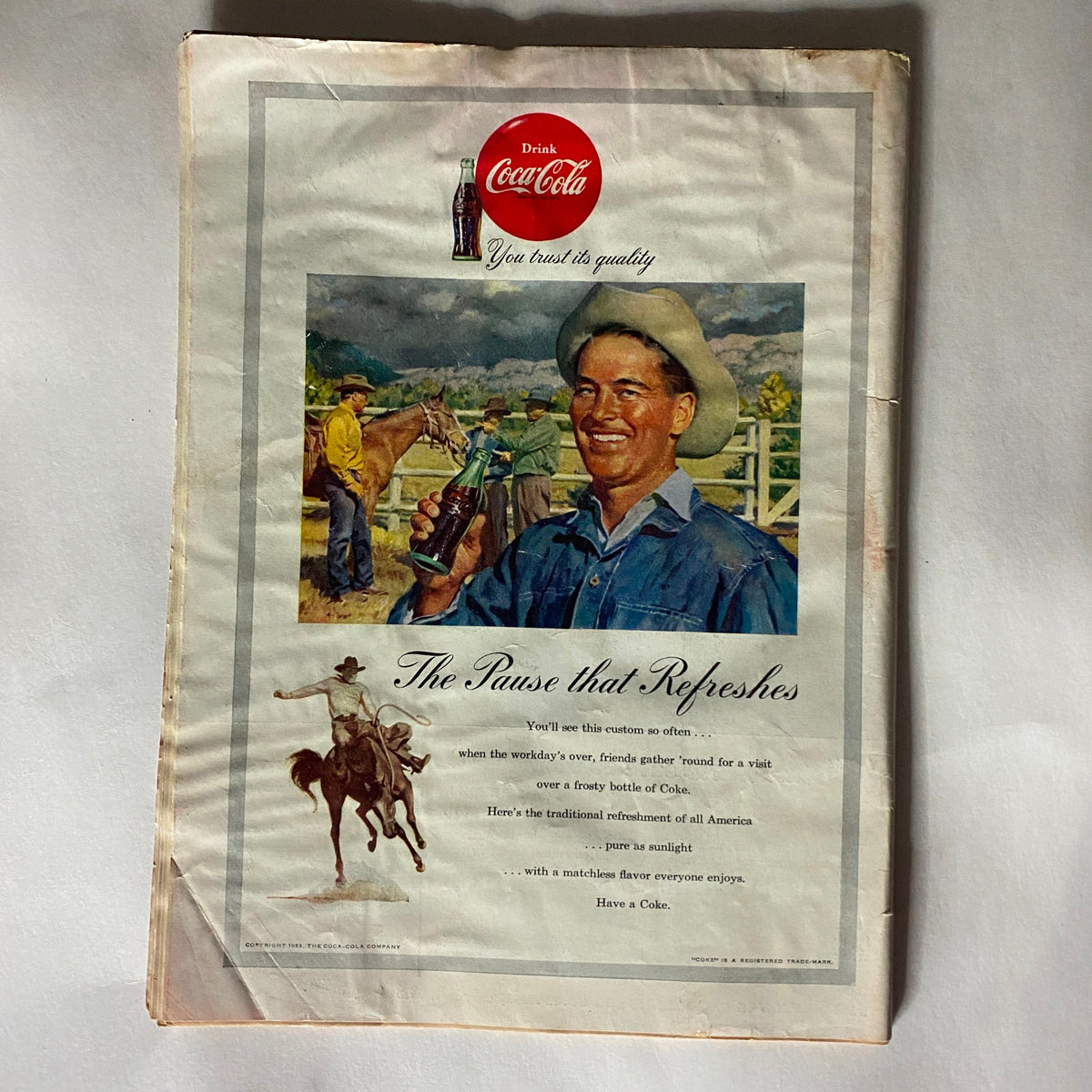
- Advertising content reflecting Time's broad, educated national readership during the early 1950s. These pages offer useful secondary context for researchers studying period consumer culture. Specific advertisers appearing in this issue are not detailed in available records.
Condition & Rarity
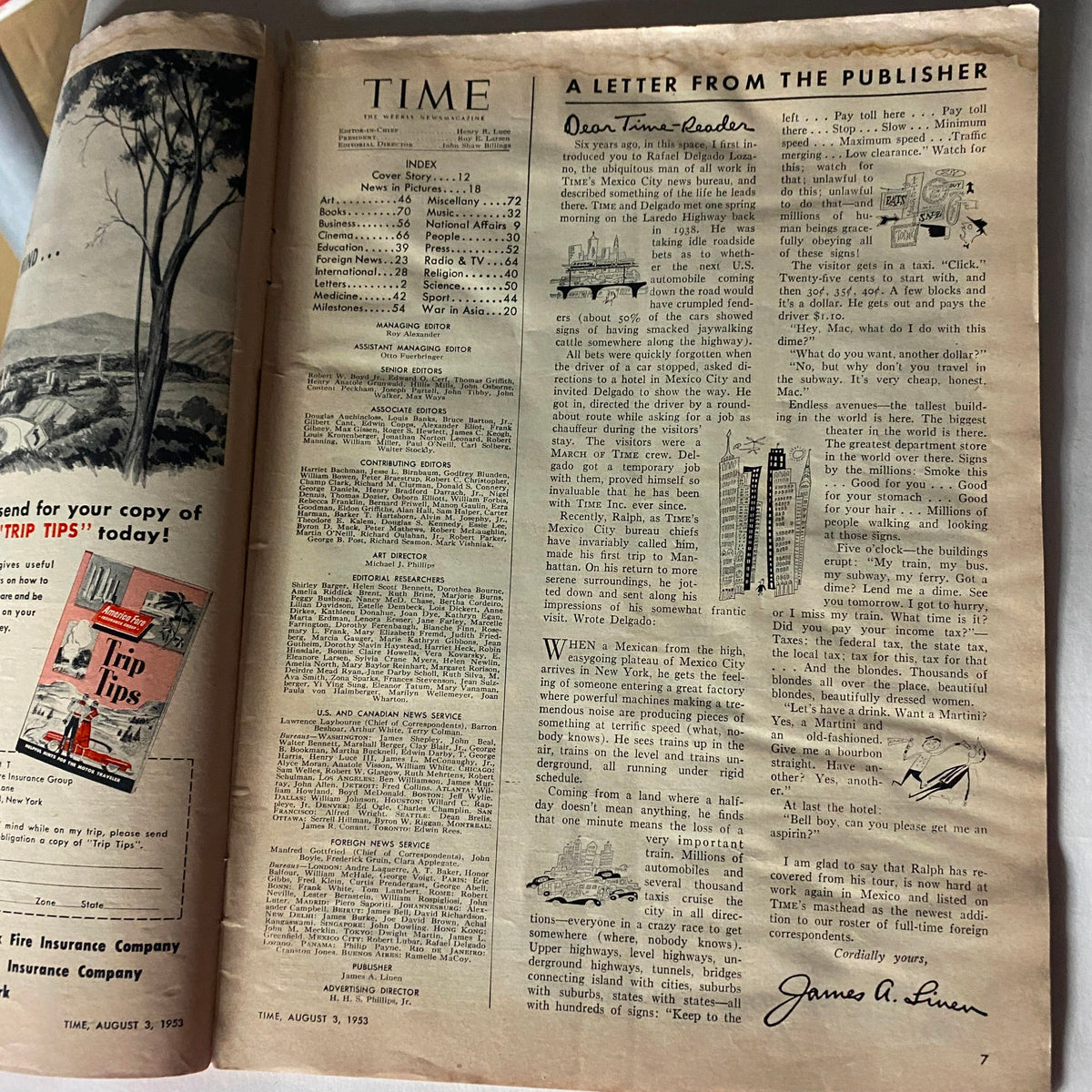
This issue shows creases on the front cover, various marks throughout, minor rips, and some water damage, characteristics collectors should generally expect from a periodical that has survived over seven decades since its original publication. Water exposure is one of the more significant condition factors collectors evaluate for vintage periodicals, since it can affect page integrity and staining more substantially than ordinary handling wear. Time Magazine issues from this period were produced in large volumes and read broadly across the country, meaning surviving copies in pristine condition represent a smaller proportion of original print runs than the sheer circulation numbers might suggest. Cover feature issues connected to significant early Cold War figures, particularly one capturing a major intelligence official as early in his tenure as this issue's Dulles feature, often draw additional collector interest beyond the magazine's general publishing history. A plastic protective covering, when present, functions as a stabilizing measure intended to prevent further deterioration rather than a factor that changes the underlying grade already present. Collectors evaluating any surviving copy of this issue should weigh the noted water damage and wear against the issue's genuine historical significance, since both factors affect overall desirability. Given this issue's connection to a genuinely foundational moment in CIA history, a surviving copy showing this level of wear still represents a meaningful find for collectors of Cold War history and vintage news journalism.
Looking for More Issues Like This?
Issues of Time Magazine capturing major Cold War intelligence and foreign policy figures at early or formative points in their careers, particularly one as historically significant as this early Allen Dulles cover feature, are genuinely valuable finds for collectors of CIA and Cold War history specifically. For those drawn to this particular issue, our Time Magazine collection is an excellent place to continue browsing, since it gathers other surviving issues from across the publication's long history of political and international cover journalism. That collection offers a broader look at how Time's cover choices documented the shifting concerns and key figures of the Cold War across different years and developments. Collectors interested in the wider context of 1953, a genuinely pivotal year in Cold War and CIA history, may also want to explore our 1953 magazines collection, which spans titles well beyond news journalism alone. Browsing across both collections can be especially valuable for collectors interested in Cold War intelligence history or the broader publishing landscape of this specific year. Given how significant early institutional-history issues like this one tend to be among collectors once discovered, we'd encourage anyone interested in this period to browse these collections at their own pace. There is always more of this history available than a single issue can represent on its own. We hope these collections help round out whatever corner of Cold War and mid-century news journalism history you're most drawn to.