
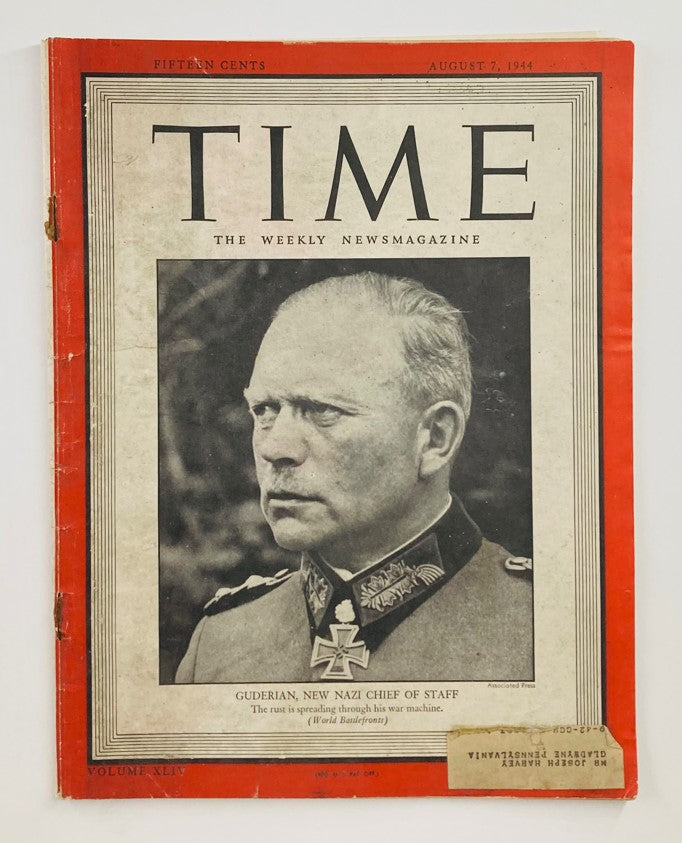


Description
Collector's Note – Why This Issue Matters
August 7, 1944 is one of the most historically specific and consequential publication dates in Time Magazine's wartime archive, and the Heinz Guderian cover story is a primary document of the Nazi military leadership at its most critically exposed moment. Guderian had been appointed Chief of the German General Staff on July 21, 1944 — just seventeen days before this issue's publication — in direct response to the July 20 assassination attempt on Hitler by Colonel Claus von Stauffenberg and the conspirators of Operation Valkyrie. The failed bomb plot had shattered Hitler's trust in the traditional German officer corps, and Guderian's appointment as Chief of Staff was part of the immediate Nazi response to the conspiracy — a reorganization of military command intended to ensure ideological loyalty alongside professional competence. A Time cover story on Guderian published on August 7, 1944 is therefore a primary document of the Nazi military command structure at the precise moment of its most dramatic post-Stauffenberg reorganization, produced by American journalism engaging the most significant internal crisis of the Hitler regime in the context of the broader Allied military campaigns that were simultaneously reshaping the war's outcome. The Normandy breakout was under way — Operation Cobra had launched on July 25, just days before this issue went to press — and the Eastern Front was experiencing the catastrophic German collapse of Operation Bagration that had been devastating German forces since June 23. For collectors building an archive of Time Magazine covers from the Second World War, this August 7, 1944 edition is one of the most historically precisely dated and most multiply significant covers in the publication's entire wartime run.
Heinz Guderian himself was one of the most significant military figures of the Second World War, and his specific position in August 1944 rewards careful attention. He had been the architect of the Blitzkrieg panzer tactics that had produced Germany's stunning early-war victories in Poland, France, and the Soviet Union, had been relieved of command after the failure before Moscow in December 1941, and had spent two and a half years in semi-retirement before his July 21 appointment as Chief of the General Staff. His return to the highest position in the German military command was therefore simultaneously a recognition of his professional competence, a product of the post-July 20 crisis, and a demonstration of Hitler's specific tactical needs in the summer of 1944 when the military situation was deteriorating on all fronts simultaneously. Time's cover portrait of Guderian in August 1944 engaged all of these dimensions for an American readership that was actively following the Allied military campaigns and had a strong interest in understanding the military leadership of the enemy they were fighting. The broader context of the August 7, 1944 issue — Normandy, the Eastern Front's collapse, the Italian campaign, the Pacific war — would have provided the full strategic landscape within which the Guderian appointment and the German military crisis had their complete meaning. Collectors researching American wartime magazines from 1944 will find this Time issue a primary document of one of the most historically significant single weeks of the entire war.
The physical condition notes documented in the listing — cover creases, marks throughout, possible small rips — are honest and expected characteristics of a wartime newsmagazine now approaching its eighty-second year of existence. Issues from August 1944 were produced under wartime paper rationing constraints, printed on paper stock of reduced quality relative to prewar standards, and have had more than eight decades to accumulate the physical evidence of their age and original use. A copy that circulated in August 1944 — that was read by someone following the war news in the week of Guderian's appointment, the Normandy breakout, and the Eastern Front's unraveling — carries an authentic physical history that connects it to the historical moment it documents in ways that perfectly preserved unread examples cannot claim. The address label absence is not noted in the listing, and the plastic protective sleeve provides ongoing archival protection for a publication of this age and historical significance.
About the Publication
Time Magazine was founded in 1923 by Henry Luce and Briton Hadden as the first weekly news magazine in the United States, and by August 1944 had sustained twenty-one years as one of the most widely read and institutionally authoritative publications in American journalism. Its wartime editorial approach — committing the full resources of its reporting and its cover portrait tradition to documenting the global conflict with weekly urgency and analytical depth — had made it the primary framework through which millions of Americans understood the war's progress and its military and political dimensions. The August 7, 1944 Guderian cover is one of the more analytically sophisticated enemy-leadership cover treatments in Time's wartime archive, engaging not merely a specific military commander but the specific internal crisis and command reorganization that his appointment represented in the context of the July 20 assassination attempt.
Key Highlights Inside
- Heinz Guderian cover story — a primary document of Time's engagement with the Nazi Chief of Staff's appointment on July 21, 1944, published seventeen days after his elevation in direct response to the failed July 20 assassination attempt on Hitler, constituting one of the most historically precisely dated and contextually rich enemy-leadership cover stories in the publication's entire wartime archive.
- July 20 assassination attempt aftermath context — coverage produced in the specific atmosphere of the Nazi regime's most significant internal crisis, when the Stauffenberg bomb plot had shattered Hitler's trust in the officer corps and the subsequent military reorganization was reshaping the German command structure at the precise moment when Allied forces were breaking out in Normandy and the Eastern Front was experiencing catastrophic German collapse.
- Normandy campaign coverage — Operation Cobra had launched on July 25, 1944, just days before this issue went to press, and the Allied breakout from the Normandy beachhead was under way in the specific week of August 7, giving the Guderian cover story its full strategic context within the simultaneous Allied military campaigns on multiple fronts.
- Eastern Front documentation — Operation Bagration's devastating destruction of German Army Group Centre had been under way since June 23, 1944, and the catastrophic German military losses in the East were the specific backdrop against which Guderian's appointment as Chief of Staff had its full strategic meaning for American readers following the war.
- Note: Specific secondary article titles, confirmed departmental content details, and individual bylines beyond the cover story framing have not been individually verified for this issue. The highlights above reflect Time's well-documented wartime editorial format, the verified cover subject and volume/issue number, and the thoroughly documented historical context of August 7, 1944.
Condition & Rarity
Time Magazine issues from August 1944 are approaching their eighty-second year of existence, and the condition landscape for surviving copies of this specific issue reflects both the general attrition of that age and the specific historical collecting significance of a cover story that engages the Nazi military command at its most historically precise post-July 20 reorganization moment. Creases on the front cover, marks throughout, and possible small rips are honest and appropriate condition notes for an eighty-one-year-old wartime newsmagazine produced under wartime paper rationing — they describe a copy that has survived more than eight decades while retaining readable content and structural integrity, carrying the authentic physical evidence of its age and original use. Wartime paper quality reflects the materials constraints of 1944 production standards, and surviving copies with complete editorial content that remain structurally sound represent meaningful survivals against the odds of time and paper chemistry. The plastic protective sleeve provides ongoing archival protection. Collectors evaluating surviving examples should prioritize the Guderian cover portrait legibility, the completeness of all interior pages, and overall structural soundness as primary condition criteria for one of the most historically significant covers in Time's wartime archive.
Looking for More Issues Like This?
A surviving copy of the August 7, 1944 Time Magazine with the Heinz Guderian cover — published seventeen days after the July 20 assassination attempt and in the week of the Normandy breakout — is among the most historically concentrated single-week primary source documents in Time's entire wartime archive, and issues from this specific summer 1944 period of maximum simultaneous crisis on multiple fronts surface infrequently in any readable condition. If this issue is no longer available, the full Time Magazine collection at OriginalMagazines.com is the most comprehensive place to browse surviving issues from across the publication's wartime archive and locate other Nazi leadership covers, D-Day and Normandy campaign documentation, or significant issues from Time's most historically engaged wartime year. The 1944 magazine collection brings together surviving issues from across that year's major publications for collectors working to document the full breadth of American print journalism during the most decisive year of the Second World War.