




Description
Collector's Note – Why This Issue Matters
The December 15, 1952 issue of Time Magazine features General Sir Gerald Templer on a painted cover by Boris Chaliapin. The official archive identifies the publication as Volume 60, Number 23, correcting the Number 24 designation appearing in the supplied listing. Its principal article is titled “Battle of Malaya: Smiling Tiger.” Templer was then serving as both British High Commissioner and Director of Operations in the Federation of Malaya. Combining these civil and military responsibilities gave him unusual authority over the colonial government’s response to the Communist-led insurgency known as the Malayan Emergency. The cover presents him as a stern administrator whose reputation depended upon both military force and political control. It records one of the most frequently discussed counterinsurgency campaigns of the early Cold War.
Templer arrived in Malaya in early 1952 after the previous High Commissioner, Sir Henry Gurney, had been killed in an insurgent ambush. The conflict involved the British colonial government and Commonwealth forces fighting guerrillas of the Malayan National Liberation Army, which was associated with the Malayan Communist Party. Templer sought closer coordination among the military, police, intelligence services, civil administration, and local communities. His program included increased security activity, strengthened local forces, administrative reform, citizenship measures, rural development, and greater attention to public support. It also relied upon coercive practices that included population resettlement, food controls, curfews, surveillance, detention, and collective punishment. Those measures make the campaign historically more complicated than later summaries presenting it only as a successful effort to win popular loyalty. The magazine should therefore be read as contemporary Cold War journalism rather than as the final judgment on Templer’s conduct or legacy.
The article appeared near the end of Templer’s first year in Malaya and reported that guerrilla activity had declined while government control had strengthened. Time’s “Smiling Tiger” description combined his controlled public manner with a reputation for impatience, discipline, and forceful command. The profile also examined his earlier military service, including assignments during both world wars and his work in occupied Germany. Its account reflects the magazine’s strong anti-Communist editorial position and its interest in leaders presented as capable of containing insurgency. The wider issue places Malaya beside the Korean War, French Indochina, Western European defense, the incoming Eisenhower administration, labor leadership, aviation, science, and the arts. This breadth makes the edition useful for studying how American readers were encouraged to connect colonial conflict with a worldwide Cold War struggle. Related political and international coverage can be explored through the collection of vintage Time Magazines and through other magazines published in 1952.
About the Publication
Time Magazine was founded by Henry R. Luce and Briton Hadden, with its first issue published in March 1923. The weekly publication was designed to organize major national and international developments into a compact and recognizable news format. Its departments covered politics, diplomacy, armed conflict, business, labor, science, medicine, religion, education, sports, books, theater, cinema, music, radio, and visual art. Articles were generally concise and arranged so that readers could move through a broad survey of the week’s events. Time became especially associated with cover portraits of political leaders, military commanders, scientists, executives, writers, performers, clergy members, and athletes. During the middle decades of the twentieth century, many of those covers were commissioned paintings rather than ordinary news photographs. Artists such as Boris Chaliapin combined recognizable likenesses with uniforms, maps, machinery, landscapes, and symbolic background details. The magazine’s red border became one of the most familiar design elements in American periodical publishing. Its writing frequently blended factual reporting with interpretation, compressed character descriptions, and a distinctive editorial voice. During the Cold War, its international reporting generally reflected an anti-Communist and strongly American-centered understanding of global events. Surviving issues now document both the events being reported and the assumptions through which contemporary readers were encouraged to interpret them.
Key Highlights Inside
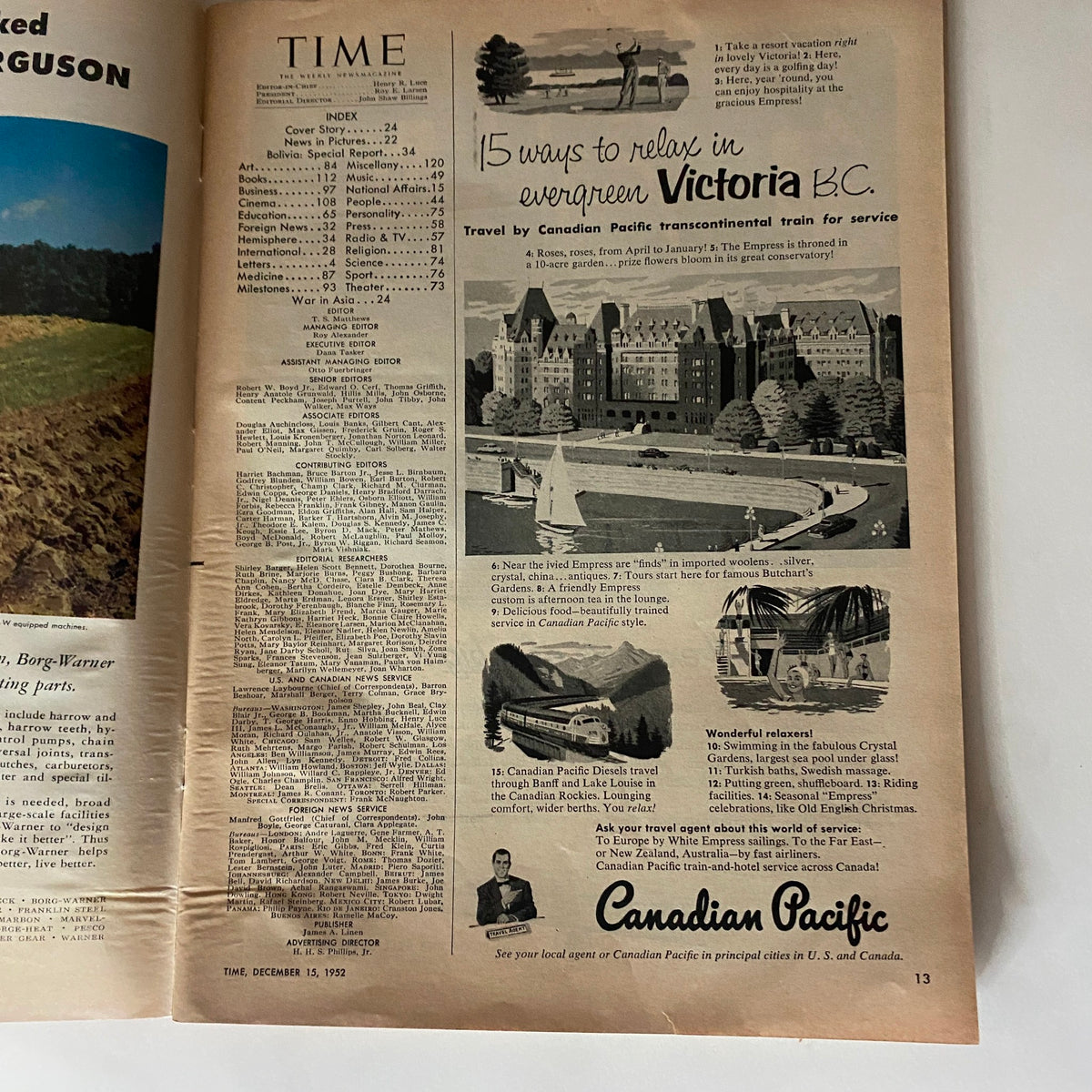
- “Battle of Malaya: Smiling Tiger” is the verified principal feature associated with Gerald Templer’s cover appearance. It examines his military background, appointment to Malaya, administrative style, and campaign against Communist guerrillas. The article should be studied alongside Malayan perspectives and later scholarship because Time’s account reflects British and American Cold War assumptions.
- “The Korean Trip” follows President-elect Dwight D. Eisenhower’s visit to Korea after his campaign promise to examine the conflict personally. The report appeared while fighting continued and before the July 1953 armistice suspended major hostilities. Its analysis preserves the military and political questions awaiting the incoming administration.
- “New Boss of the C.I.O.” concerns the leadership transition within the Congress of Industrial Organizations following the death of Philip Murray. The subject reflects organized labor’s continuing economic and political importance in postwar America. It also anticipates the later merger of the CIO with the American Federation of Labor in 1955.
- “Siege of Nasan” reports on fighting in French Indochina. The battle formed part of France’s war against the Viet Minh before the later defeat at Dien Bien Phu and the 1954 Geneva settlement. The article provides contemporary reporting from a conflict whose consequences for Vietnam, France, and the United States were still developing.
- Business and cultural departments include “Through the Sonic Barrier,” “Connie v. Comet,” and an extensive review titled “The Year in Books.” Science, medicine, religion, education, cinema, radio, theater, music, and visual art receive additional coverage. These departments establish the edition as a complete weekly news survey rather than a publication concerned only with Templer or Malaya.
Condition & Rarity
The December 15, 1952 issue is described as being in good overall condition with signs of age, handling, and storage. The listing states that the photographed magazine is the exact physical example represented. Its accompanying images should therefore be used when evaluating visible creases, marks, edge wear, and cover presentation. A taped binding is specifically reported and represents an important condition consideration. The tape may have been applied to reinforce a weakened spine, reattach the cover, or prevent further separation. Its material, age, placement, discoloration, and effect on the underlying paper should be examined carefully. Binding tape is a repair characteristic and should not automatically be described as an original or archival preservation method. The presence or absence of a mailing label is not confirmed in the supplied description. A plastic protective covering accompanies the magazine and may reduce additional exposure to dust, fingerprints, and surface abrasion. The sleeve does not verify page completeness or rule out clipping, loose leaves, staining, moisture exposure, brittleness, fading, or earlier repairs. Historical importance and a prominent military cover do not independently establish rarity, which should be assessed through documented availability and the physical condition of the individual issue.
Looking for More Issues Like This?
Exact Time issues can require patience to identify when research is centered on a particular military administrator, colonial conflict, cover artist, and publication week. The December 15, 1952 edition is especially relevant to readers studying Gerald Templer, the Malayan Emergency, British colonial policy, and Cold War counterinsurgency. Related political and military reporting can be explored through the broader collection of vintage Time Magazines. Other editions document Korea, French Indochina, Communist movements, decolonization, British imperial policy, and American strategic thinking. Comparing consecutive issues can reveal how events in Malaya were connected editorially with conflicts elsewhere in Asia. The collection of original magazines from 1952 provides a wider view of the historical year represented by this edition. Publications from that year preserve presidential politics, war, diplomacy, labor, aviation, science, cinema, advertising, and postwar consumer culture. Examining several titles together helps distinguish Time’s interpretive newsmagazine style from the photographic, literary, and specialized formats used by competing publications. Closely dated magazines remain useful even when this precise Volume 60, Number 23 issue is not represented because they establish its surrounding political chronology. Together, the Time and 1952 collections provide a valuable foundation for continued research into Gerald Templer and the international history of the early Cold War.