


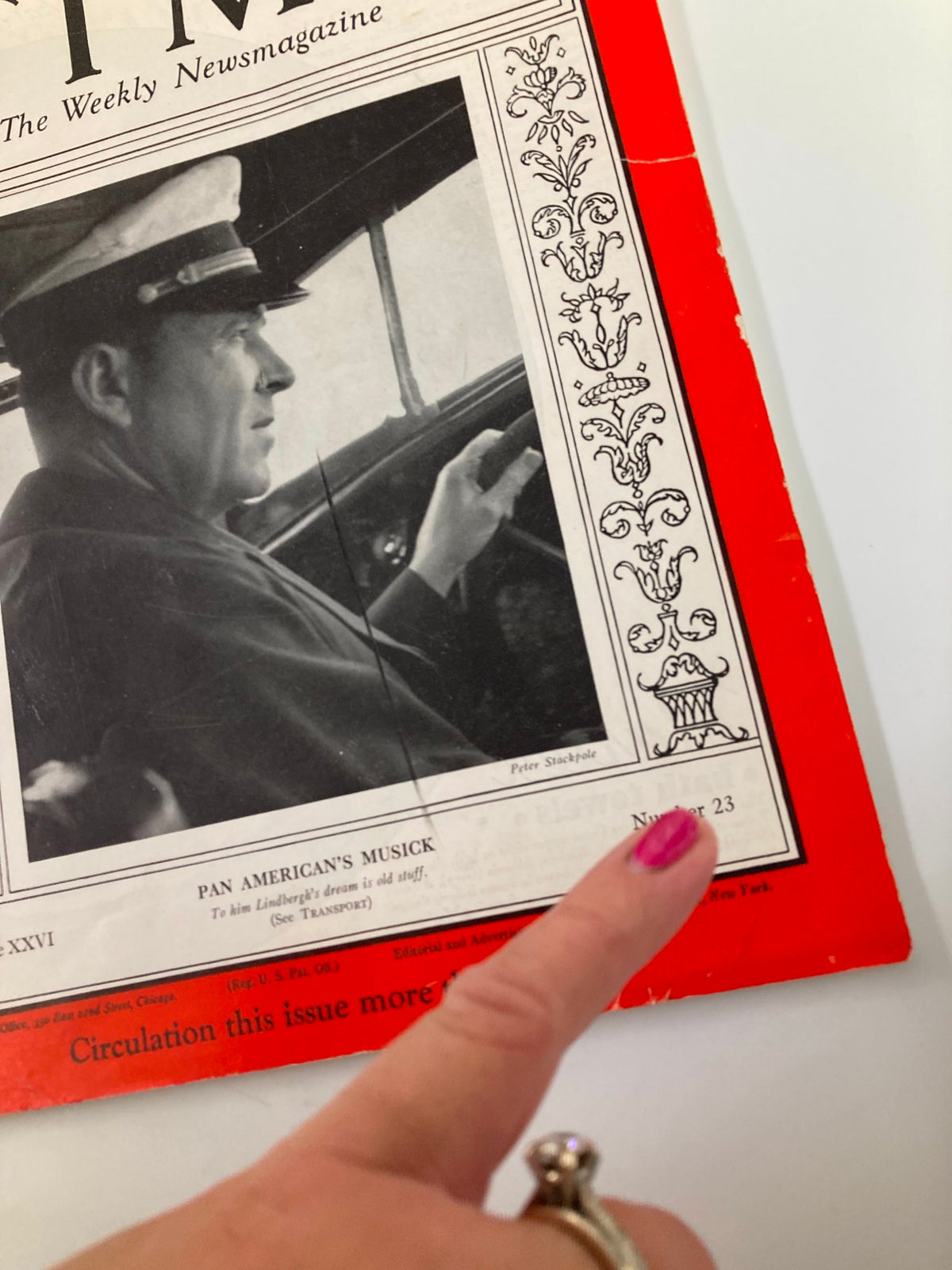


Description
Collector's Note – Why This Issue Matters
The December 2, 1935 issue of Time magazine — Volume 26, Number 23 — arrives at one of the most electrifying moments in the history of commercial aviation. The man on the cover, Edwin Charles Musick, was the foremost long-distance flying boat pilot of his era, a quiet and methodical figure who nonetheless represented something enormous: the imminent conquest of the Pacific Ocean by scheduled passenger air service. Pan American Airways, under the visionary leadership of Juan Trippe, had spent years engineering a transoceanic route across the vast Pacific, and Musick was the man trusted to fly it. His appearance on the cover of Time was not incidental — it came just weeks before he piloted the China Clipper on its inaugural airmail run from San Francisco to Manila in November 1935, a crossing that stunned the world and redrew the map of what commercial flight could achieve. For collectors tracing the golden age of aviation in print, this issue is a primary document of that pivotal month. Broader issues from this extraordinary publication year can be explored through original magazines from 1935, a year dense with political upheaval, cultural transformation, and technological firsts.
Musick himself remains a revered and somewhat melancholy figure in aviation history. He went on to set multiple transoceanic records flying Pan American's Clipper ships, only to be killed in January 1938 when his S-42 flying boat exploded near Pago Pago during a survey flight for a proposed Samoa route. He was posthumously awarded the Harmon Trophy. His Time cover appearance in late 1935 captures him at the absolute apex of his public recognition — the living embodiment of American technological ambition reaching across the Pacific. For researchers, historians, and collectors drawn to this subject, the full archive of Time magazine's original print issues represents one of the most complete running records of twentieth-century public life in existence.
About the Publication
Time, founded in 1923 by Henry Luce and Briton Hadden, was the first weekly news magazine in the United States and rapidly became the country's most influential journalistic arbiter of who and what mattered. By 1935 it was well into its authoritative stride, with its signature format of departmentalized news coverage, opinionated prose style, and the iconic weekly cover portrait driving both its editorial identity and its cultural weight. The cover subject was always a deliberate statement — a declaration that this person, this week, represented something the editors believed the country needed to understand. Its readership in the mid-1930s was educated, upper-middle-class, and politically engaged, and the magazine served as a shared frame of reference for American professional life in a decade of extraordinary instability and change.
Key Highlights Inside
- Cover portrait of Edwin Charles Musick, Pan American Airways' chief transoceanic pilot, featured at the height of his fame following the inaugural China Clipper Pacific airmail service in November 1935.
- Coverage almost certainly contextualizes Pan American's transpacific ambitions and the broader race among nations to establish long-distance commercial air routes during the mid-1930s.
- As a late-1935 issue, this number would have engaged with the ongoing international tensions of the era — the Italian invasion of Ethiopia, the early consolidation of Nazi power in Germany, and the New Deal's evolving domestic landscape.
- Interior details beyond the cover subject are unconfirmed for this specific issue; the above reflects what is historically documented about Time's editorial focus during this period.
Condition & Rarity
Surviving copies of Time from 1935 in any presentable condition are genuinely uncommon. Newsstand copies of this era were printed on acidic wood-pulp paper not designed for long-term preservation, and nearly nine decades of storage take a predictable toll. A copy described as Good — showing minor overall wear and some marks, but intact enough to be stored in a plastic protective covering — represents a solid survival for a magazine of this age. The presence of a label on the back cover is a common feature of newsstand and subscription copies of the period and does not diminish the issue's documentary or display value for most collectors; it is simply an honest attribute of a copy that was read and circulated in its own time. Page integrity is the primary concern with issues of this vintage, and a copy that has been kept under plastic covering suggests thoughtful handling at some point in its history. For display or research purposes, condition at this level is entirely workable.
Looking for More Issues Like This?
A Time cover featuring Edwin Musick is a rare find, and copies from this particular issue don't surface often. If this one has already found a home, the full run of original Time magazine issues is well worth browsing — decades of cover subjects and historical moments in their original print form. For collectors specifically drawn to the mid-Depression era, the 1935 magazine collection spans publications across every subject and genre from that remarkable year.