



Description
Collector's Note – Why This Issue Matters
December 7, 1942 is one of the most symbolically resonant publication dates in American magazine history. Exactly one year to the day after the Japanese attack on Pearl Harbor, Time Magazine chose to mark the anniversary with Admiral Ernest J. King on the cover — the Commander in Chief of the United States Fleet and Chief of Naval Operations, the man most directly responsible for rebuilding and directing American naval power in the year since the attack that had devastated it. The editorial decision was deliberate and precise: not a retrospective on Pearl Harbor itself, not a commemoration of the dead, but a forward-looking portrait of the naval commander overseeing America's response. King was one of the most consequential and least publicly known senior military figures of the Second World War — irascible, relentlessly demanding, and strategically brilliant, he had been appointed to his dual command role in the days immediately following Pearl Harbor and had spent the following year reorganizing, re-equipping, and redeploying the United States Navy on a global scale while simultaneously fighting the Battle of the Atlantic and projecting power into the Pacific. A Time cover on December 7, 1942 was an editorial statement of historical weight: this is what we have built in the year since the disaster. For collectors building an archive of Time Magazine covers from the Second World War period, this December 7, 1942 edition is among the most historically charged single issues in the magazine's entire wartime run — a publication whose date alone makes it an artifact of the first order.
Ernest King himself was a figure of extraordinary historical significance whose public profile was deliberately limited by the demands of military security and his own preference for operational reality over publicity. He was known within the military establishment as the most difficult flag officer in the American service — demanding, intolerant of incompetence, and willing to relieve commanders who failed to meet his standards regardless of seniority or political connection — and his strategic judgment on the allocation of naval resources between the Atlantic and Pacific theaters was one of the most consequential decision-making inputs of the entire war. The simultaneous title of Commander in Chief of the United States Fleet and Chief of Naval Operations, which he held from March 1942, gave him an unprecedented concentration of naval authority that reflected both the emergency that had created it and the specific confidence that President Roosevelt and the Joint Chiefs placed in his ability to exercise it. A Time cover profile published on the one-year anniversary of Pearl Harbor was an editorial judgment that King — not an admiral engaged in a specific battle, not a carrier commander or a submarine ace, but the strategic administrator who was directing the entire naval war — was the figure whose work most merited documentation at this specific historical moment. Collectors researching American magazines from 1942 will find this issue a primary document of American naval leadership at the most critical phase of the war's first full year.
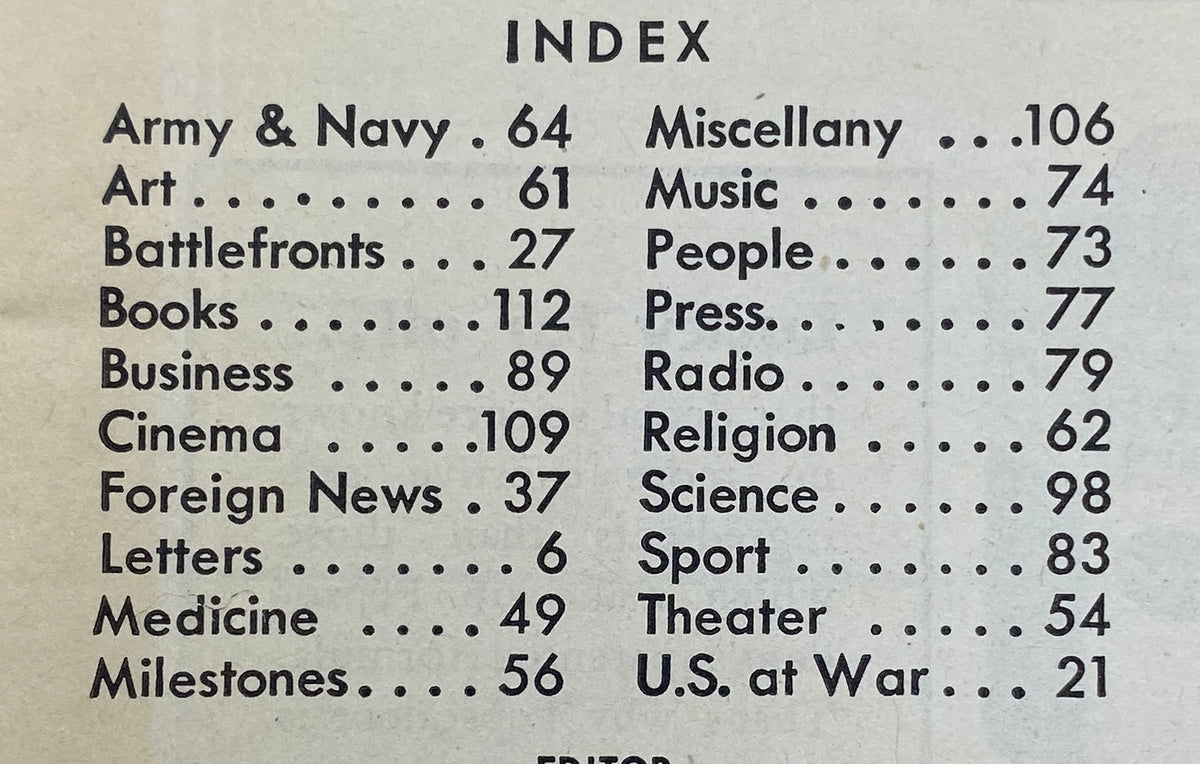
The complete departmental index preserved in the listing gives this issue a bibliographic completeness that rewards careful examination. The December 7, 1942 issue's "Battlefronts" section on page 27 would have engaged the active military situation across multiple theaters on the war's one-year anniversary — the fighting on Guadalcanal was at its most intense, the Allied landings in North Africa had occurred just weeks earlier in November 1942, and the Soviet counteroffensive at Stalingrad was underway. The "U.S. at War" section on page 21, the "Army & Navy" section on page 64, and the "Foreign News" section on page 37 collectively document the full global military and strategic context within which King's naval command had its operational meaning. The cultural departments — Cinema on page 109, Music on page 74, Theater on page 54, Books on page 112, Sport on page 83, and Religion on page 62 — complete the full portrait of American life at the one-year mark of a war that had reorganized every dimension of national existence. The Medicine section on page 49 and the Science section on page 98 document the wartime mobilization of American technical and medical resources that was itself one of the more remarkable stories of the period. Taken together, the complete departmental index makes this December 7 anniversary issue a comprehensive primary source document of the United States at war, one year in.
About the Publication
Time Magazine was founded in 1923 by Henry Luce and Briton Hadden as the first weekly news magazine in the United States, and by December 7, 1942 had sustained nearly two decades as one of the most widely read and institutionally authoritative publications in American journalism. Its wartime editorial approach represented some of the most ambitious journalism in the magazine's history — the full resources of its editorial apparatus were committed to covering the global conflict across military, industrial, political, and cultural dimensions simultaneously, and its cover system, which designated a single figure or development as the week's most historically significant, carried particular editorial weight during the war years when that judgment had genuine strategic and moral implications. The choice of Admiral King for the December 7, 1942 cover — on the first anniversary of the attack that had redefined American military and national life — represents Time's editorial intelligence at its most historically self-aware, using the anniversary date and its chosen cover subject to make a composite statement about American military response that no straightforward retrospective could have achieved with the same economy and force.
Key Highlights Inside
- Admiral Ernest J. King cover story published on the first anniversary of Pearl Harbor — a primary document of Time's editorial engagement with the Commander in Chief of the United States Fleet and Chief of Naval Operations at the one-year mark of American involvement in the war, representing one of the most historically deliberate cover placements in the magazine's wartime run and a primary source document of American naval leadership at its most consequential moment.
- "U.S. at War" section on page 21 and "Battlefronts" on page 27 — wartime military coverage from the December 7, 1942 issue, one year to the day after Pearl Harbor, engaging the active military situation across Guadalcanal, the recently launched North African campaign, and the Stalingrad counteroffensive simultaneously, all within the context of the naval command whose architect was simultaneously on the cover.
- "Army & Navy" section on page 64 and "Foreign News" on page 37 — institutional military and international coverage providing the full strategic and diplomatic context within which Admiral King's naval war was being conducted, documenting the global dimensions of a conflict that was reaching its first major turning points at the moment this issue was published.
- Business on page 89, Science on page 98, Medicine on page 49, and Press on page 77 — documentation of American institutional life at the one-year mark of wartime mobilization, collectively constituting a primary source record of how American commerce, technology, medicine, and media were being reorganized around the demands of global war in December 1942.
- Cinema on page 109, Music on page 74, Theater on page 54, Books on page 112, Religion on page 62, and Sport on page 83 — the complete cultural and human documentation of a Time issue produced on the first anniversary of Pearl Harbor, providing the full texture of American life at a moment of national mobilization and giving the military cover story its human and cultural context.
- People on page 73, Milestones on page 56, Radio on page 79, and Miscellany on page 106 — the complete departmental architecture of a wartime Time issue covering the full breadth of American institutional and personal life at a specific and historically resonant moment, collectively constituting a comprehensive weekly primary source record of the United States exactly one year into its involvement in the Second World War.
Condition & Rarity
Time Magazine issues from December 1942 are approaching their eighty-fourth year of existence, and the condition landscape for surviving copies from this period reflects the combined challenges of that age and the specific paper quality limitations of wartime American production. The Second World War's materials restrictions reduced paper quality across American publishing in ways that accelerated the natural aging of periodicals from this era — Time issues from 1942 were produced on paper already of lower quality than prewar editions, which means that surviving copies show tanning, brittleness, and edge deterioration at rates higher than equivalent prewar issues of the same age. Beyond these general considerations, the December 7 anniversary date gives this issue a specific collector significance that has generated sustained demand across multiple decades, meaning that surviving copies have circulated more actively in the secondary market than many comparably dated wartime Time issues. The listing directs collectors to the photographs for condition assessment — the appropriate practice for a publication approaching its ninth decade — and the plastic protective sleeve provides ongoing archival protection. Collectors evaluating surviving examples should prioritize cover legibility — the King portrait and the December 7 date are the primary visual and historical documents — alongside spine integrity, the completeness of the full departmental content, and the overall structural soundness of the binding as primary condition criteria.
Looking for More Issues Like This?
A surviving copy of the December 7, 1942 Time Magazine with the Admiral Ernest J. King cover and the complete departmental index preserved is among the most historically specific and symbolically charged entries in the magazine's entire wartime archive — the Pearl Harbor anniversary date, the naval command cover subject, and the full documentation of American life one year into the war collectively give this issue a historical weight that no other single wartime Time issue can quite replicate. If this issue is no longer available, the full Time Magazine collection at OriginalMagazines.com is the most comprehensive place to browse surviving issues from across the publication's history and locate other wartime covers, significant military profiles, or specific anniversary issues from Time's Second World War run. The 1942 magazine collection brings together surviving issues from across that year's major publications for collectors working to document the full breadth of American print journalism during the most consequential year of the United States' involvement in the war.